Check patentability & draft patents in minutes with Patsnap Eureka AI!

Human body behavior recognition method based on multi-stream three-dimensional adaptive graph convolution

An adaptive and human body technology, applied in the field of image pattern recognition and deep neural network, can solve the problems of not making full use of skeleton joint information, not making full use of frame information before and after joints, etc., to achieve real-time performance and improve recognition accuracy and improve performance Effect

Active Publication Date: 2021-11-19
SOUTH CHINA UNIV OF TECH +1
View PDF7 Cites 0 Cited by
  • Summary
  • Abstract
  • Description
  • Claims
  • Application Information

AI Technical Summary

Problems solved by technology

The skeleton connection input by the existing skeleton-based behavior recognition algorithm is defined according to the natural connection of the human body, which does not make full use of the information between the skeleton joints, and does not make full use of the front and rear frame information of the joints. The utilization is relatively independent, and the spatiotemporal information between the joints is not fully effectively combined. Therefore, it is urgent to propose an adaptive graph convolution recognition method that adaptively adjusts the skeleton connection and fully integrates the spatial and temporal information.

Method used

the structure of the environmentally friendly knitted fabric provided by the present invention; figure 2 Flow chart of the yarn wrapping machine for environmentally friendly knitted fabrics and storage devices; image 3 Is the parameter map of the yarn covering machine
View more

Image

Smart Image Click on the blue labels to locate them in the text.
Viewing Examples
Smart Image
  • Human body behavior recognition method based on multi-stream three-dimensional adaptive graph convolution
  • Human body behavior recognition method based on multi-stream three-dimensional adaptive graph convolution
  • Human body behavior recognition method based on multi-stream three-dimensional adaptive graph convolution

Examples

Experimental program
Comparison scheme
Effect test

Embodiment Construction

[0054] The present invention will be further described in detail below in conjunction with the embodiments and the accompanying drawings, but the embodiments of the present invention are not limited thereto.

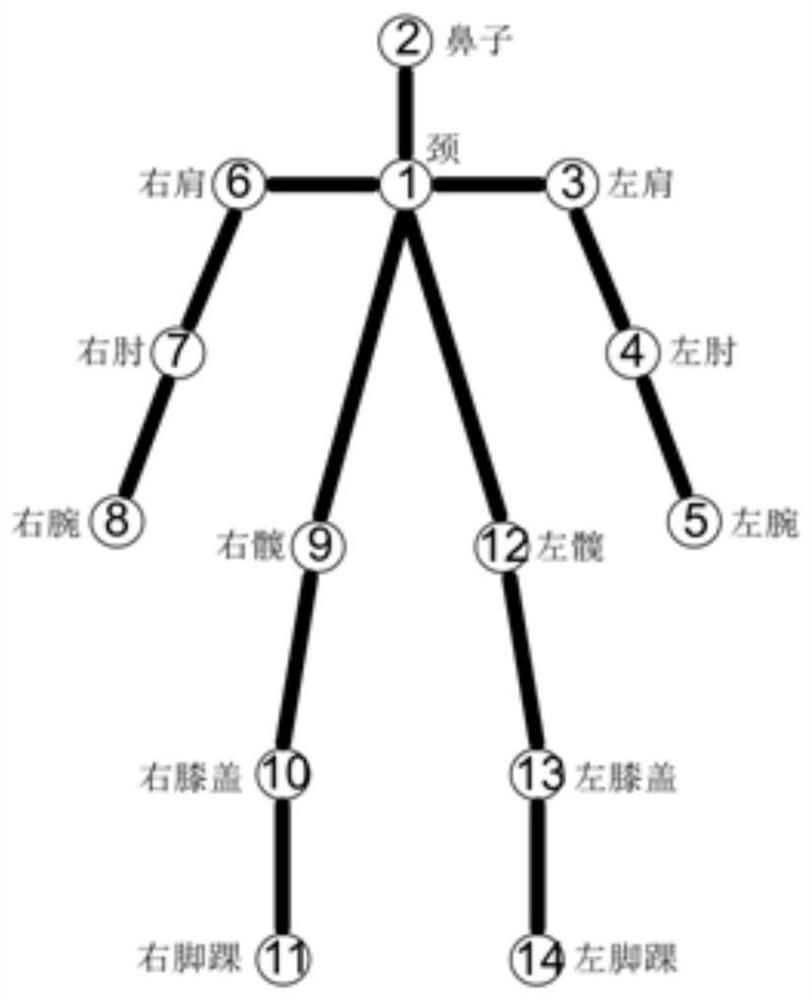
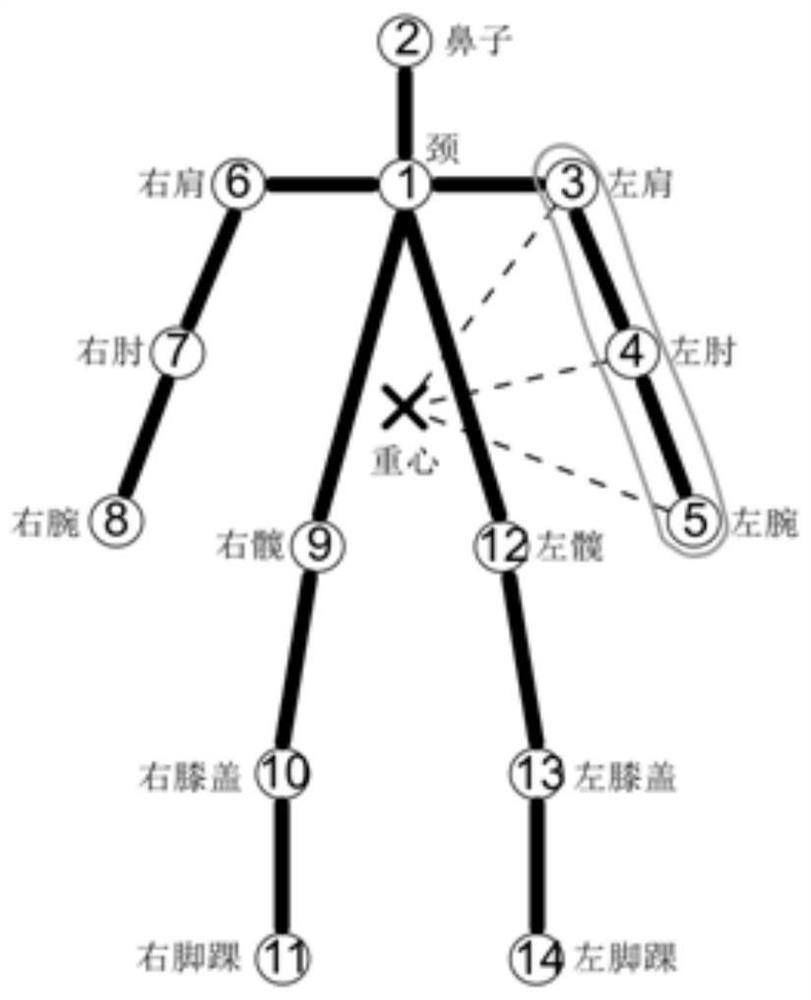
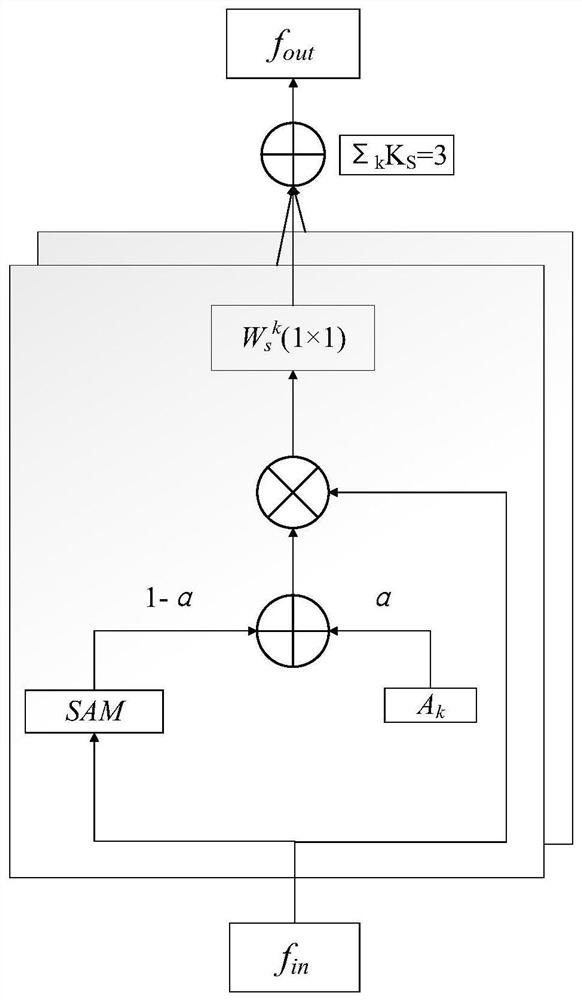
[0055] Such as Figure 1 to Figure 6 As shown, the human behavior recognition method based on multi-stream three-dimensional adaptive graph convolution provided in this embodiment includes the following steps:

[0056] 1) Use the camera to shoot videos containing different human behaviors. The angle of view is required to be taken from the front of the human body, and the human body is placed in the center of the screen. The resolution of the camera selected in this embodiment is 1080p.

[0057] Use the OpenPose algorithm to detect the key points of the human skeleton in the video, and use the partition strategy to construct the training set, including the following steps:

[0058] 1.1) Extract key points of human skeleton

[0059] Use the OpenPose algorithm to detect...

the structure of the environmentally friendly knitted fabric provided by the present invention; figure 2 Flow chart of the yarn wrapping machine for environmentally friendly knitted fabrics and storage devices; image 3 Is the parameter map of the yarn covering machine
Login to View More

PUM

No PUM Login to View More

Abstract

The invention discloses a human body behavior recognition method based on multi-stream three-dimensional adaptive graph convolution, and the method comprises the steps: 1) collecting a video containing a human body, and constructing a training set; 2) constructing an adaptive spatial domain attention matrix SAM and an adaptive time domain attention matrix TAM by using the training set; 3) constructing an adaptive spatial domain attention map convolution module ASAGCM, an adaptive time domain attention map convolution module ATAGCM, and a three-dimensional time-space domain map convolution module GCN-3d; 4) constructing an adaptive graph convolutional layer; 5) constructing an adaptive graph convolutional network by using the adaptive graph convolutional layer; 6) constructing a multi-stream three-dimensional adaptive graph convolutional network by using the adaptive graph convolutional network; 7) training the multi-stream three-dimensional adaptive graph convolutional network by using the training set; and 8) utilizing the trained multi-stream three-dimensional adaptive graph convolutional network to perform behavior recognition on the human body in the video. According to the invention, the accuracy of human behavior type identification can be effectively improved, and a good foundation is laid for various computer vision processing applications.

Description

technical field [0001] The present invention relates to the technical field of image pattern recognition and deep neural network, in particular to a human behavior recognition method based on multi-stream three-dimensional adaptive graph convolution. Background technique [0002] At present, human behavior recognition in video is one of the most active research topics in the field of computer vision. It has broad application prospects and potential economic benefits in intelligent video surveillance, human-computer interaction, content-based video retrieval, virtual reality, etc. value. [0003] Traditional behavior recognition algorithms mostly use RGB video as input, but when the RGB video has a lot of background dynamic interference, unstable lighting, and severe noise, the effect of traditional behavior recognition algorithms will be affected. In recent years, compared with traditional methods using RGB videos for recognition, skeleton-based action recognition has attra...

Claims

the structure of the environmentally friendly knitted fabric provided by the present invention; figure 2 Flow chart of the yarn wrapping machine for environmentally friendly knitted fabrics and storage devices; image 3 Is the parameter map of the yarn covering machine
Login to View More

Application Information

Patent Timeline
no application Login to View More
IPC IPC(8): G06K9/62G06K9/00G06N3/04G06F17/16
CPCG06F17/16G06N3/045G06F18/214Y02D10/00
Inventor 田联房余陆斌杜启亮向照夷
Owner SOUTH CHINA UNIV OF TECH
Features
  • R&D
  • Intellectual Property
  • Life Sciences
  • Materials
  • Tech Scout
Why Patsnap Eureka
  • Unparalleled Data Quality
  • Higher Quality Content
  • 60% Fewer Hallucinations
Social media
Patsnap Eureka Blog
Learn More