Unlock instant, AI-driven research and patent intelligence for your innovation.

Self-supervised monocular depth estimation method and device

A depth estimation and single-purpose technology, applied in the field of depth estimation, can solve problems such as low interpretability, hindering deployment and application, and achieve the effect of improving convergence ability, improving usability, and eliminating interference

Pending Publication Date: 2022-02-08
NAT INNOVATION INST OF DEFENSE TECH PLA ACAD OF MILITARY SCI
View PDF0 Cites 7 Cited by
  • Summary
  • Abstract
  • Description
  • Claims
  • Application Information

AI Technical Summary

Problems solved by technology

[0004] However, the problem of low interpretability inherent in deep learning still exists, hindering its deployment and application in real scenarios, in other words, how to apply uncertainty in monocular self-supervised depth estimation algorithms is still an open problem

Method used

the structure of the environmentally friendly knitted fabric provided by the present invention; figure 2 Flow chart of the yarn wrapping machine for environmentally friendly knitted fabrics and storage devices; image 3 Is the parameter map of the yarn covering machine
View more

Image

Smart Image Click on the blue labels to locate them in the text.
Viewing Examples
Smart Image
  • Self-supervised monocular depth estimation method and device
  • Self-supervised monocular depth estimation method and device
  • Self-supervised monocular depth estimation method and device

Examples

Experimental program
Comparison scheme
Effect test

Embodiment 1

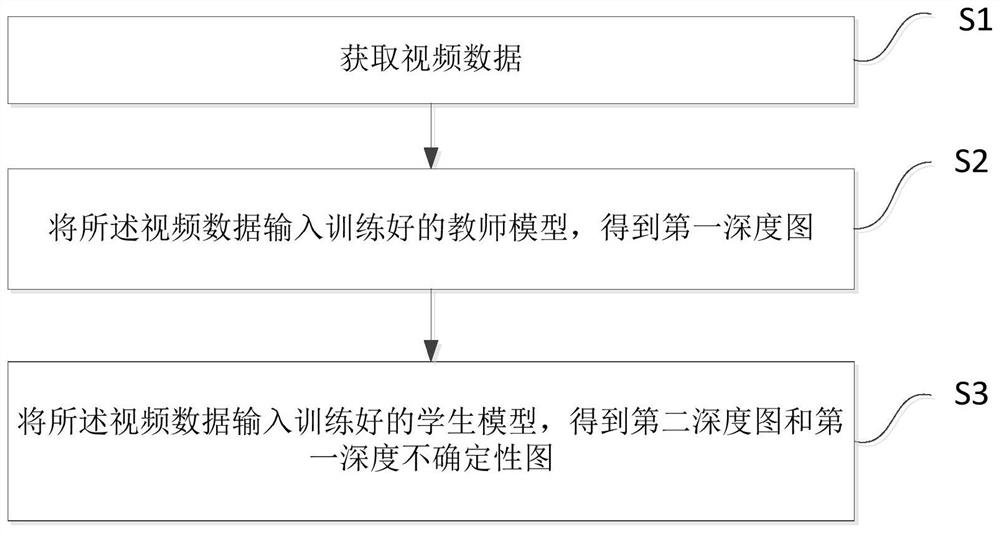
[0063] This embodiment implements a self-supervised monocular depth estimation method, such as figure 1 shown, including:

[0064] S1. Obtain video data;

[0065] S2. Input the video data into the trained teacher model to obtain the first depth map;

[0066] S3. Input the video data into the trained student model to obtain a second depth map and a first depth uncertainty map;

[0067] Wherein, the training method of the teacher model is a self-supervised training method, the training method of the student model is a supervised training method, and the teacher model and the student model adopt joint training.

[0068] Specifically, the teacher model and the student model adopt joint training, including:

[0069] Load unlabeled video data into the teacher model;

[0070] Adopt the self-supervised training method to train the teacher model, and predict the third depth map;

[0071] Create a depth estimation task dataset with pseudo-labels based on the third depth map;

[00...

Embodiment 2

[0089] This embodiment provides a self-supervised monocular depth estimation method, such as figure 2 As shown, first construct the teacher model, then load unlabeled video data into the teacher model, and then judge whether there is a depth uncertainty mask, if it exists, load the depth uncertainty mask, if not, load it Blank mask, and then conduct self-supervised training on the teacher model and predict the dense depth map, use the dense depth map to create a pseudo-data set, construct a student model and take supervised training on the student model, and judge whether the teacher model and the student model converge , if not converged, predict the depth uncertainty map and calculate the depth uncertainty mask based on the depth uncertainty map, and end if converged. In addition, the calculated uncertainty mask is used for the optimization of the teacher model, and the training is performed iteratively until both the teacher model and the student model are trained.

[009...

Embodiment 3

[0110] This embodiment provides a self-supervised monocular depth estimation method, comprising: acquiring video data; inputting the video data into a trained teacher model to obtain a first depth map; inputting the video data into a trained student model , to obtain the second depth map and the first depth uncertainty map; wherein, the training method of the teacher model is a self-supervised training method, the training method of the student model is a supervised training method, and the teacher model and the The above student models are trained jointly.

[0111] Specifically, the joint training adopts the self-boosting structure in the self-boosting mechanism, Figure 4 It is a schematic diagram of the working process of the self-elevating structure, such as Figure 4 As shown, the structure work process contains a training step and an optimization step. The training step adopts a self-training mechanism, using the prediction result of the teacher model as the data label...

the structure of the environmentally friendly knitted fabric provided by the present invention; figure 2 Flow chart of the yarn wrapping machine for environmentally friendly knitted fabrics and storage devices; image 3 Is the parameter map of the yarn covering machine
Login to View More

PUM

No PUM Login to View More

Abstract

The invention relates to the technical field of depth estimation, in particular to a self-supervised monocular depth estimation method and device. The method comprises the following steps: acquiring video data; inputting the video data into a trained teacher model to obtain a first depth map; inputting the video data into a trained student model to obtain a second depth map and a first depth uncertainty map, wherein the training mode of the teacher model is a self-supervised training mode, the training mode of the student model is a supervised training mode, and the teacher model and the student model adopt combined training. The invention can effectively estimate the depth map, can sense and shield the noise existing in the depth estimation result, enables the model to achieve better estimation precision, and brings obvious performance improvement. According to the invention, the size of the noise is evaluated in a mode of the depth uncertainty map, and the availability of the depth estimation method in various application scenes such as unmanned driving in real environments is improved.

Description

technical field [0001] The present application relates to the technical field of depth estimation, and more specifically, the present application relates to a self-supervised monocular depth estimation method and device. Background technique [0002] Depth estimation is an advanced application of almost all mobile robots, such as autonomous driving, etc. Although the existing traditional methods have more or less solved this problem through sensors such as binocular cameras, lidars, and millimeter-wave radars, these devices are often expensive and difficult to deploy, so people gradually pay attention to low-cost and easy-to-deploy , high-resolution monocular camera to achieve depth estimation has generated interest. [0003] Nowadays, deep learning based methods have shown strong performance in many image processing tasks. Neural networks can recover depth information directly from a single image through a supervised learning method. However, these methods require a larg...

Claims

the structure of the environmentally friendly knitted fabric provided by the present invention; figure 2 Flow chart of the yarn wrapping machine for environmentally friendly knitted fabrics and storage devices; image 3 Is the parameter map of the yarn covering machine
Login to View More

Application Information

Patent Timeline
no application Login to View More
Patent Type & Authority Applications(China)
IPC IPC(8): G06V20/40G06V10/764G06V10/82G06V10/774G06K9/62G06N3/04G06N3/08
CPCG06N3/084G06N3/088G06N3/045G06F18/2155G06F18/24
Inventor 史殿习聂欣雨陈旭灿苏雅倩文李睿豪张拥军
Owner NAT INNOVATION INST OF DEFENSE TECH PLA ACAD OF MILITARY SCI