Improved coherent signal DOA estimation method based on subarray transfer invariance
A coherent signal, DOA technology, applied in direction finders using radio waves, radio wave direction/bias determination systems, etc. The effect of improving the estimation accuracy
- Summary
- Abstract
- Description
- Claims
- Application Information
AI Technical Summary
Problems solved by technology
Method used
Image



Examples
Embodiment 1
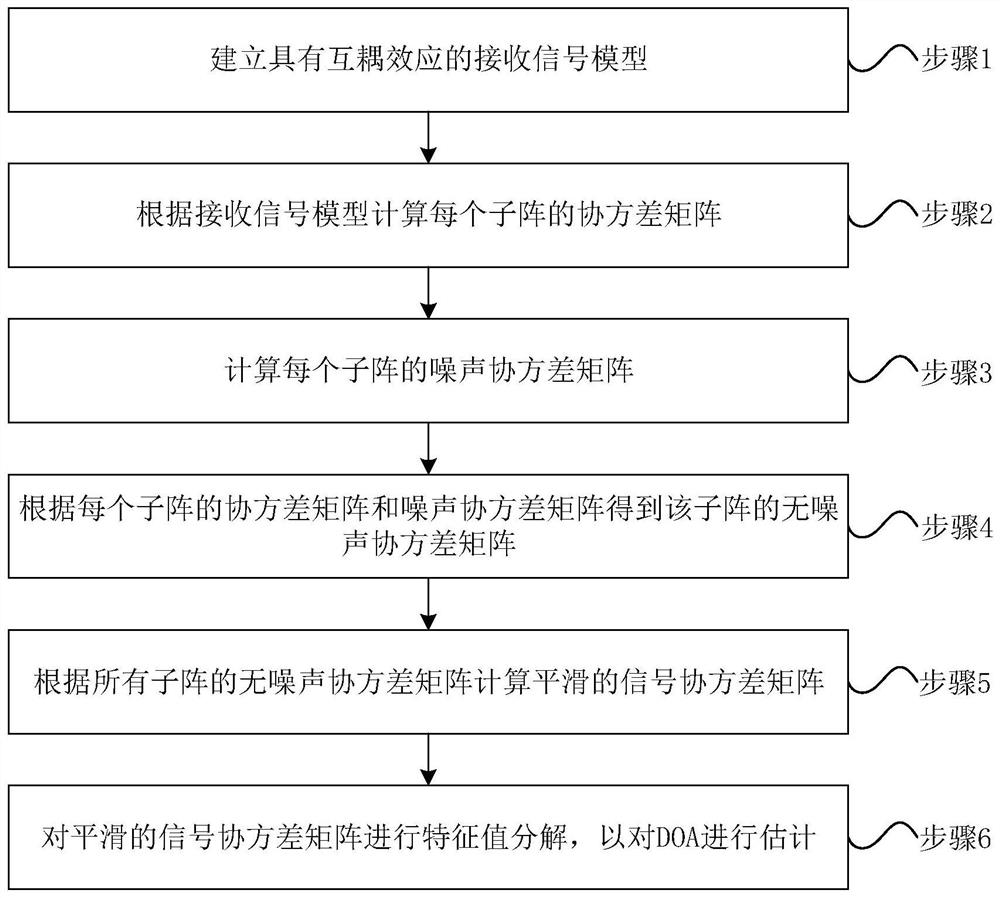
[0061] See figure 1 , figure 1 It is a schematic flowchart of an improved coherent signal DOA estimation method based on subarray transfer invariance provided by an embodiment of the present invention, which includes:
[0062] Step 1: Establish a received signal model with mutual coupling effects.
[0063] First, the equidistant linear array composed of M omnidirectional array elements is divided into K overlapping sub-arrays, each sub-array contains array elements, consider L coherent far-field narrowband signals at an angle θ 1 ,θ 2 ,,θ L acting on the array, then the received signal x of the kth sub-array k (t) can be expressed as:
[0064]
[0065] in, Yes Dimensional steering vector matrix, θ=[θ 1 ,θ 2 ,…,θ L ] is the direction of arrival of l signals, s(t)=[s 1 (t), s(t) 2 …s, L (t)] T =, [s(t)αs(t 1 )…α L s,(t 2 )] T Indicates the echo signal, (·) T represents a transpose operation, is the steering vector of the lth signal, λ is the wavelengt...
Embodiment 2
[0108] In order to further verify the beneficial effects of the present invention, the performance of the present invention will be compared and described below through a simulation test.
[0109] 1. Simulation conditions:
[0110] The simulation experiment adopts an equidistant linear array with 12 array elements, a half-wavelength spacing between array elements, and a length of 3 mutual coupling matrices. In order to measure the performance of DOA estimation, the root mean square error (RMSE) of direction of arrival estimation is defined as:
[0111]
[0112] Among them, K is the number of Monte Carlo experiments.
[0113] 2. Simulation content and result analysis
[0114] 2.1 Simulation test one
[0115] Assuming that three coherent signals act on the one-dimensional equidistant linear array at angles of {-10°, 0°, 20°}, the SNR changes from -5dB to 20dB, and compares the 500 snapshots passed under different signal-to-noise ratios (via 500 Monte Carlo experiments) si...
Embodiment 3
[0121] On the basis of the first embodiment above, this embodiment provides an improved device for estimating DOA of coherent signals based on subarray transfer invariance. See Figure 4 , Figure 4 It is a schematic structural diagram of an improved coherent signal DOA estimation device based on subarray transfer invariance provided by an embodiment of the present invention, which includes:
[0122] Model building module 1, used to build a received signal model with mutual coupling effects;
[0123] The first calculation module 2 is used to calculate the covariance matrix of each sub-array according to the received signal model;
[0124] The second calculation module 3 is used to calculate the noise covariance matrix of each sub-array;
[0125] The third calculation module 4 is used to obtain the noise-free covariance matrix of the sub-array according to the covariance matrix and the noise covariance matrix of each sub-array;
[0126] The fourth calculation module 5 is us...
PUM
 Login to View More
 Abstract
Description
Claims
Application Information
 Login to View More