Method for forming two conical sestion ring pieces by once cold rolling spreading
What is AI technical title?
AI technical title is built by Patsnap AI team. It summarizes the technical point description of the patent document.
A ring and conical technology, applied in the field of conical section ring forming, can solve the problems of time-consuming, waste of materials, discontinuous metal fibers, etc.
Inactive Publication Date: 2006-03-22
WUHAN UNIV OF TECH
View PDF0 Cites 13 Cited by
Summary
Abstract
Description
Claims
Application Information
AI Technical Summary
This helps you quickly interpret patents by identifying the three key elements:
Problems solved by technology
Method used
Benefits of technology
Problems solved by technology
This kind of processing technology not only wastes materials, but also takes time, resulting in low production efficiency and high cost, and the structure and performance of the product are not very good, and the metal fibers of the tapered cross-section ring are discontinuous
Method used
the structure of the environmentally friendly knitted fabric provided by the present invention; figure 2 Flow chart of the yarn wrapping machine for environmentally friendly knitted fabrics and storage devices; image 3 Is the parameter map of the yarn covering machine
View more
Image
Smart Image Click on the blue labels to locate them in the text.
Viewing Examples
Smart Image
Click on the blue label to locate the original text in one second.
Reading with bidirectional positioning of images and text.
Smart Image
Examples
Experimental program
Comparison scheme
Effect test
example 1
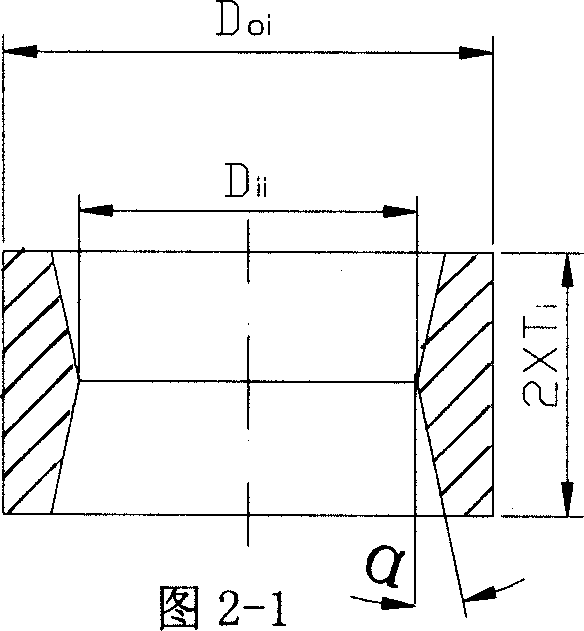
[0039] Example 1: It is integral rolling, that is, two ring blanks are designed together, rolled and expanded as a whole, and then divided into two by turning. A method for forming two tapered cross-section rings by one-time cold rolling, which comprises the steps:
[0040] 1). Cutting: cut the bar into sections, the length of which is L=(1-3)(2T i ), 2T i is the axial dimension of the overall ring blank.
[0041] 2). Blank making: heating the material section to the thermal deformation temperature, upsetting, and then punching, punching and connecting the skin to make the overall ring blank.
[0042] 3). Annealing: annealing the integral ring blank, the annealing temperature is 600°C-800°C, and the time is 1-3 hours.
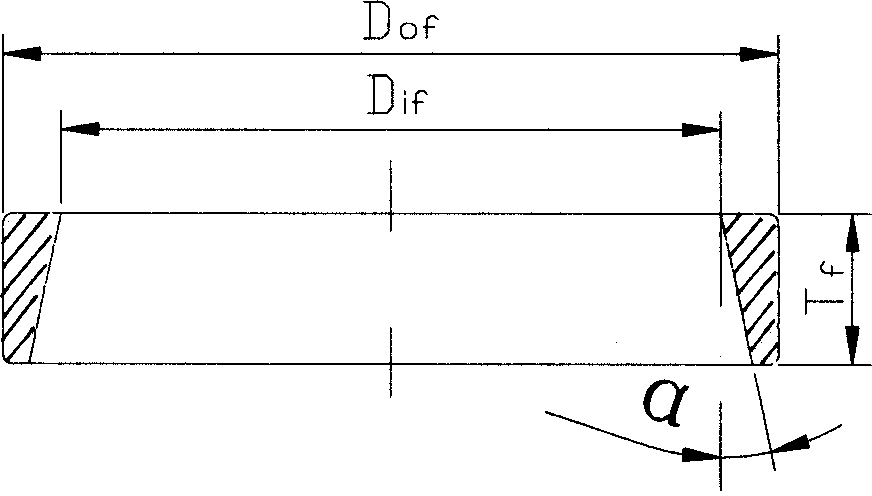
[0043] 4).Blank rough turning: the annealed integral ring blank is turned into an integral ring blank for rolling; see Picture 1-1 , the outer diameter of the tapered section ring product is D of , the inner diameter of the big end is D if , the cone angl...
example 2
[0057] Example 2: It is a split type rolling, that is, the two ring blanks are independent, and then rolled as a whole. A method for forming two tapered cross-section rings by one-time cold rolling, which comprises the steps:
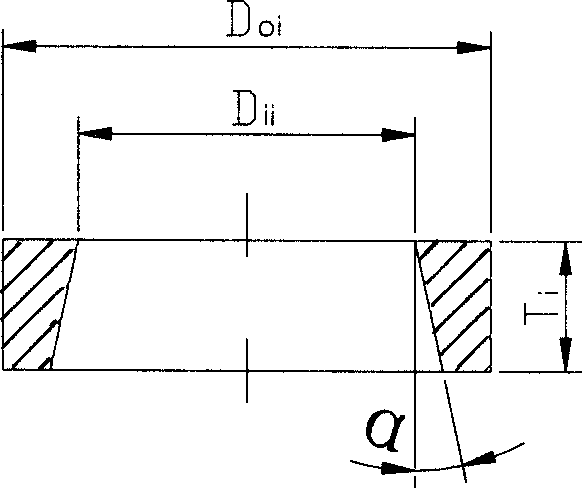
[0058] 1). Cutting separately: Cut the bar into two sections, the length of each section is L=(1-3)T i ,T i is the axial dimension of the ring blank;
[0059] 2). Blank making: heating the two sections of material to the thermal deformation temperature, then upsetting, then punching, punching and connecting skins to make 2 ring blanks;
[0060] 3). Annealing: annealing of two ring blanks, the annealing temperature is 600°C-800°C, and the time is 1-3 hours;
[0061] 4).Blank rough turning: the two ring blanks after annealing are turned into two ring blanks for rolling; the outer diameter of the tapered cross-section ring product is D of , the inner diameter of the big end is D if , the cone angle is α, and the axial dimension is T f , the equivalen...
the structure of the environmentally friendly knitted fabric provided by the present invention; figure 2 Flow chart of the yarn wrapping machine for environmentally friendly knitted fabrics and storage devices; image 3 Is the parameter map of the yarn covering machine
Login to View More
PUM
Login to View More
Abstract
The present invention relates to method of forming conic cross section ring and has two technological schemes adopted, including integral rolling and spreading and split rolling and spreading. The present invention features that the cold rolling and spreading process includes the following steps: cutting rod into material sections; heating the material section to heat deformation temperature, upsetting, punching hole and punching connecting sheet to form integral blank; annealing; coarse turning to form integral blank for rolling and spreading; cold rolling and spreading in a rolling and spreading machine with V-slot core roller to form two conic rings; and turning to obtain two conic cross section rings. The present invention has the features of low cost, high production efficiency and high product quality.
Description
technical field [0001] The invention relates to a method for forming a ring with a tapered section, in particular to a method for forming two rings with a tapered section at one time by cold rolling. Background technique [0002] Tapered cross-section ring products are widely used and demanded in industry, such as the inner and outer rings of tapered roller bearings, etc., which not only require high precision, but also require a long service life, and the key to these requirements lies in the tapered Forming quality of section rings. The forming of the existing tapered cross-section rings is often realized by machining methods such as turning. The traditional processing techniques are: blanking, upsetting, punching, annealing, rough turning and finishing turning of inner and outer diameters, and flat end faces. Such a processing technique not only wastes materials, but also takes time, resulting in low production efficiency and high cost, and the structure and performance ...
Claims
the structure of the environmentally friendly knitted fabric provided by the present invention; figure 2 Flow chart of the yarn wrapping machine for environmentally friendly knitted fabrics and storage devices; image 3 Is the parameter map of the yarn covering machine
Login to View More
Application Information
Patent Timeline
Application Date:The date an application was filed.
Publication Date:The date a patent or application was officially published.
First Publication Date:The earliest publication date of a patent with the same application number.
Issue Date:Publication date of the patent grant document.
PCT Entry Date:The Entry date of PCT National Phase.
Estimated Expiry Date:The statutory expiry date of a patent right according to the Patent Law, and it is the longest term of protection that the patent right can achieve without the termination of the patent right due to other reasons(Term extension factor has been taken into account ).
Invalid Date:Actual expiry date is based on effective date or publication date of legal transaction data of invalid patent.



 Login to View More
  Login to View More