
Optical system for spectrometers
a technology of optical system and spectrometer, which is applied in the direction of optical radiation measurement, instruments, spectrometry/spectrophotometry/monochromator, etc., can solve the problem of high wavelength ranges that are typically much more intense, and achieve the effect of reducing the number of detectors
- Summary
- Abstract
- Description
- Claims
- Application Information
AI Technical Summary
Benefits of technology
Problems solved by technology
Method used
Image

Examples
Embodiment Construction
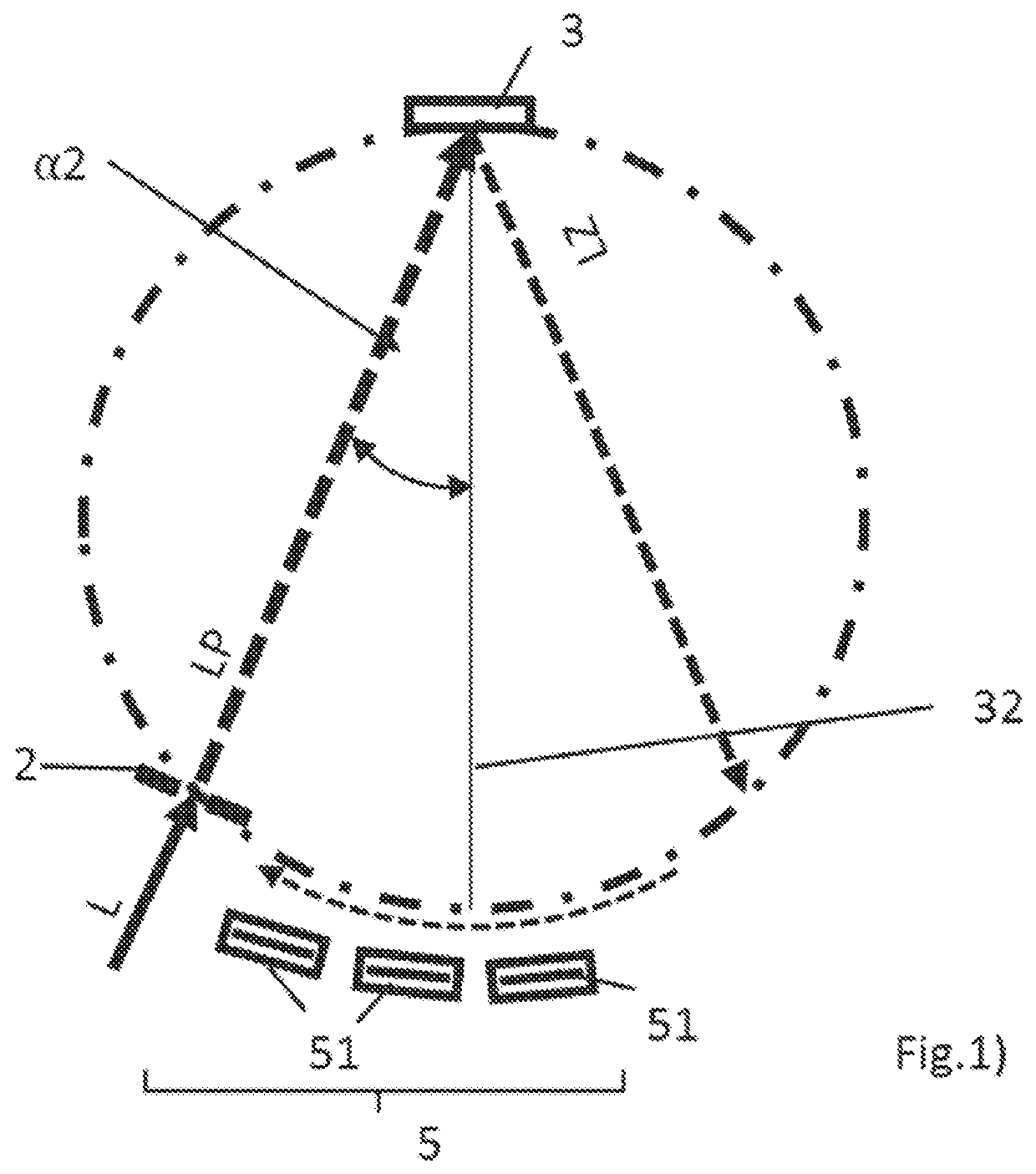
[0044]FIG. 1 shows an optical system 1 according to the prior art. In this structure the detectors 51 are arranged along the focal curve on each side of the normal 32 of the grating 3 to simultaneously measure the wavelength ranges R1, R2. In order to gain wavelength coverage and a good resolution a series of detectors are necessary.
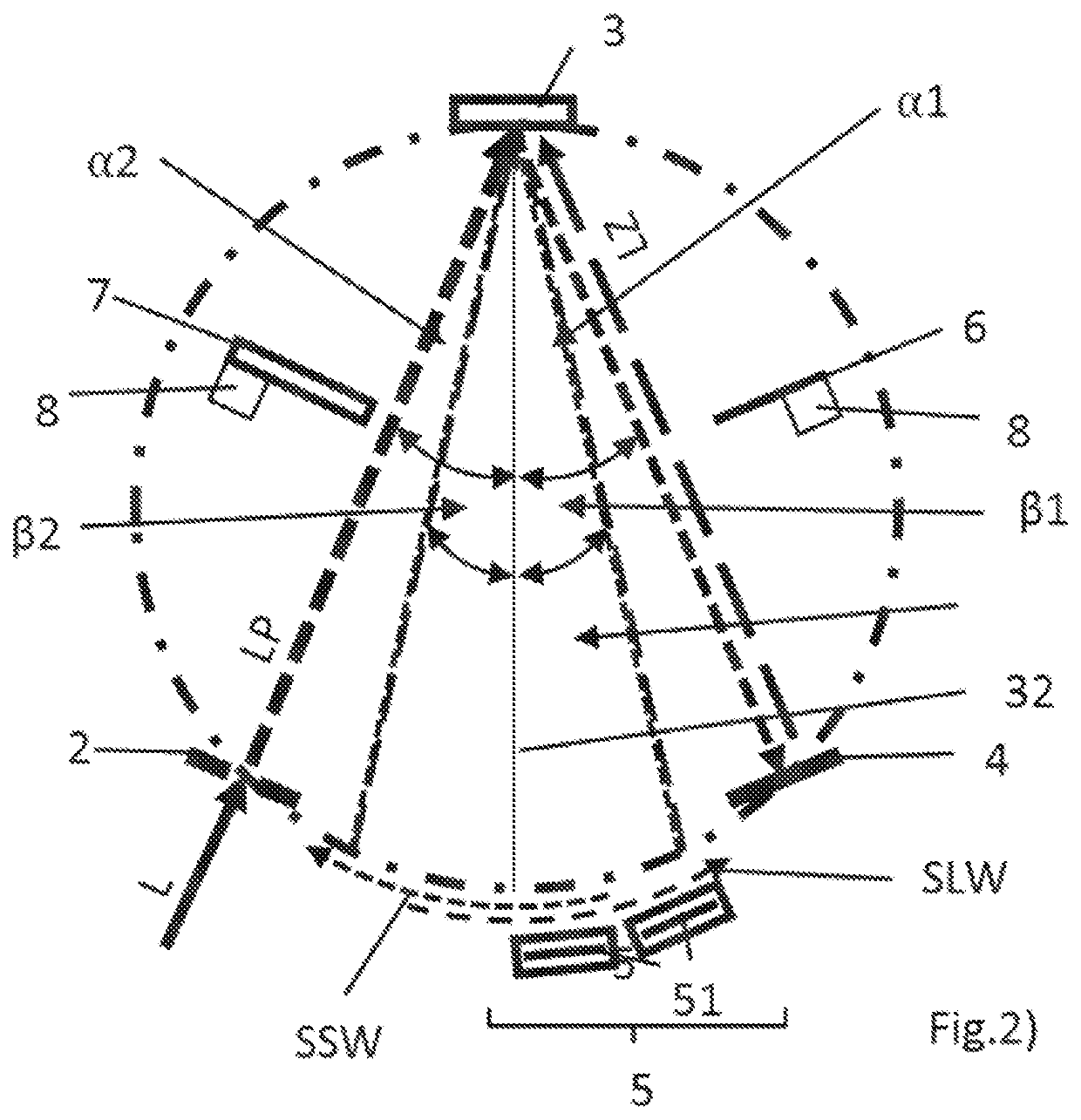
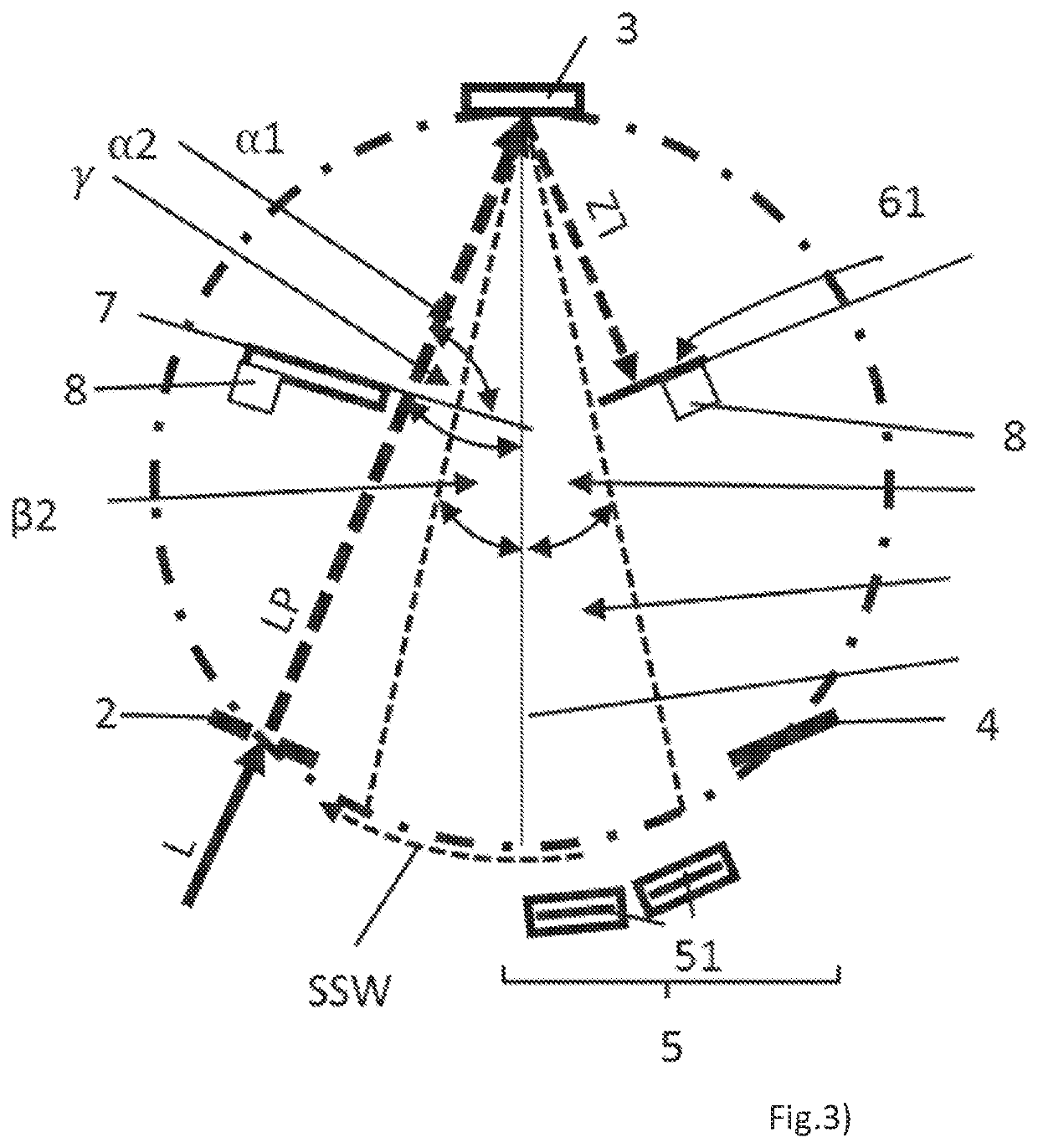
[0045]FIG. 2 shows the optical system 1 according to the invention with a decreased number of detectors 51 when it is measuring the first fan of diffracted light LD1 as well as the second fan of diffracted light LD2 simultaneously. In this mode the primary light beam LP forms a positive angle of incidence α2 and the back reflection results in a negative angle of incidence α1, each causing the respective angles of diffraction β1, β2 for wavelength λ. Thus two antidirectional spectra are formed which run in opposite directions and partly overlap each other. For the measurement, this overlap is eliminated by decomposing the wavelength ranges into their shor...
PUM
| Property | Measurement | Unit |
|---|---|---|
| wavelength | aaaaa | aaaaa |
| angles of diffraction | aaaaa | aaaaa |
| angles of diffraction | aaaaa | aaaaa |
Abstract
Description
Claims
Application Information
 Login to View More