

Dram cam cell with hidden refresh
a cam cell and cam technology, applied in the field of dynamic content addressable memory (dcam) cells, can solve the problems of dcam cells being temporarily unavailable for cam searches, destructive reads and slower performance, and scams are generally more vulnerable than dcams to soft errors,
- Summary
- Abstract
- Description
- Claims
- Application Information
AI Technical Summary
Problems solved by technology
Method used
Image

Examples
Embodiment Construction
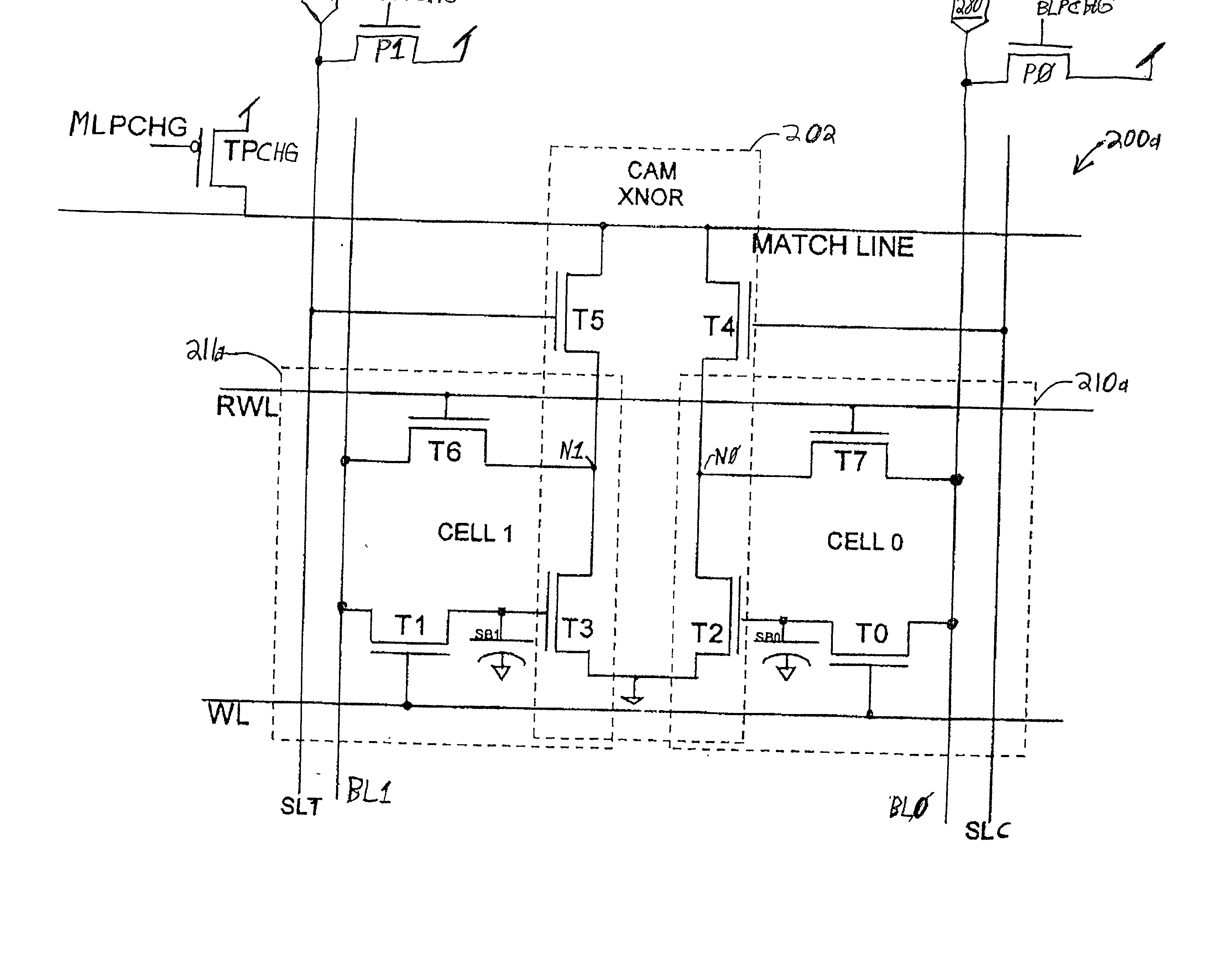
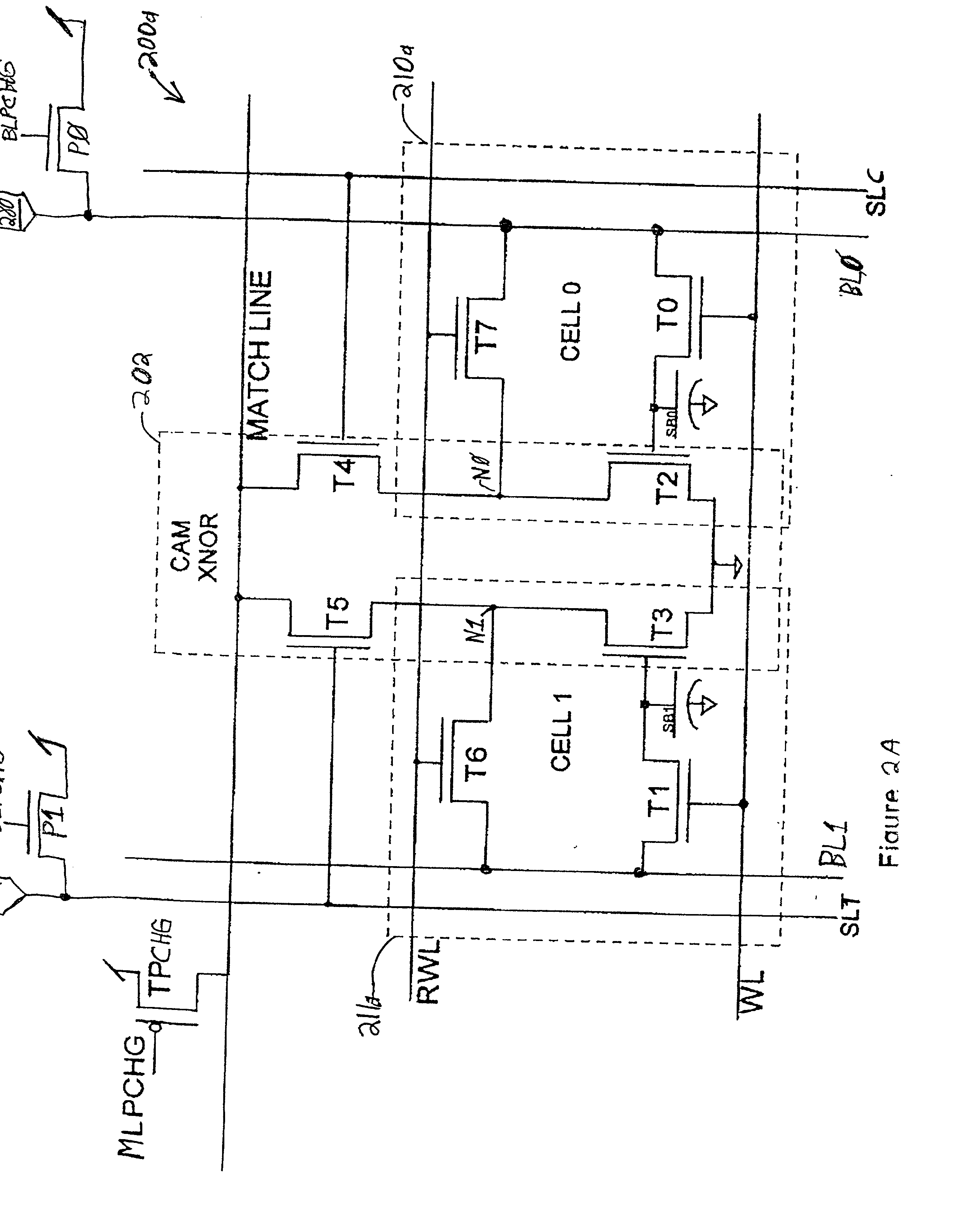
[0021] FIG. 2A depicts a circuit diagram of a ternary Dynamic Content Addressable Memory (DCAM) cell 200a in accordance with an embodiment of the present invention. The inventive ternary DCAM cell 200a includes two capacitors (SB0 and SB1) that function as data storage devices. Each of these capacitors is independently charged High to store a logical One ("1") or discharged Low to store a logical Zero ("0").
[0022] Ternary DCAM 200a further comprises two memory storage cells (CELL0=210a, CELL1=211a) each of which is merged with one of the two transistor stacks (T2-T4 and T3-T5 respectively) of the XNOR comparison circuit 202 that is connected between the MATCH LINE and ground. By storing a "1," or a "1" (preferably a "0") in both memory storage cells (e.g., 210a and 211a), the ternary DCAM cell 200a stores a "mask" state which allows a local mask logic value to be stored within a given word entry. The ability to store a "mask" logic state in each DCAM cell (e.g., 200a) in a DCAM entr...
PUM
 Login to View More
 Abstract
Description
Claims
Application Information
 Login to View More