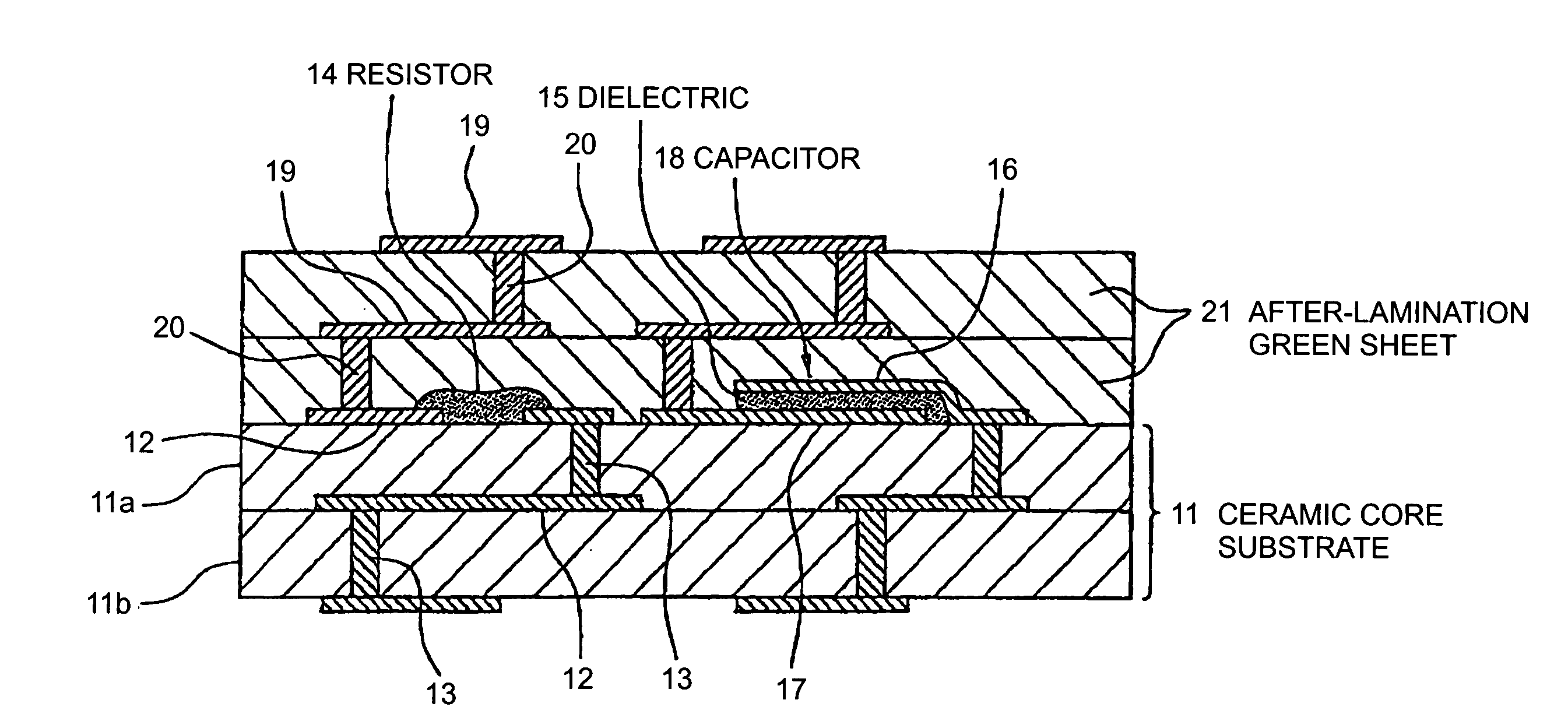
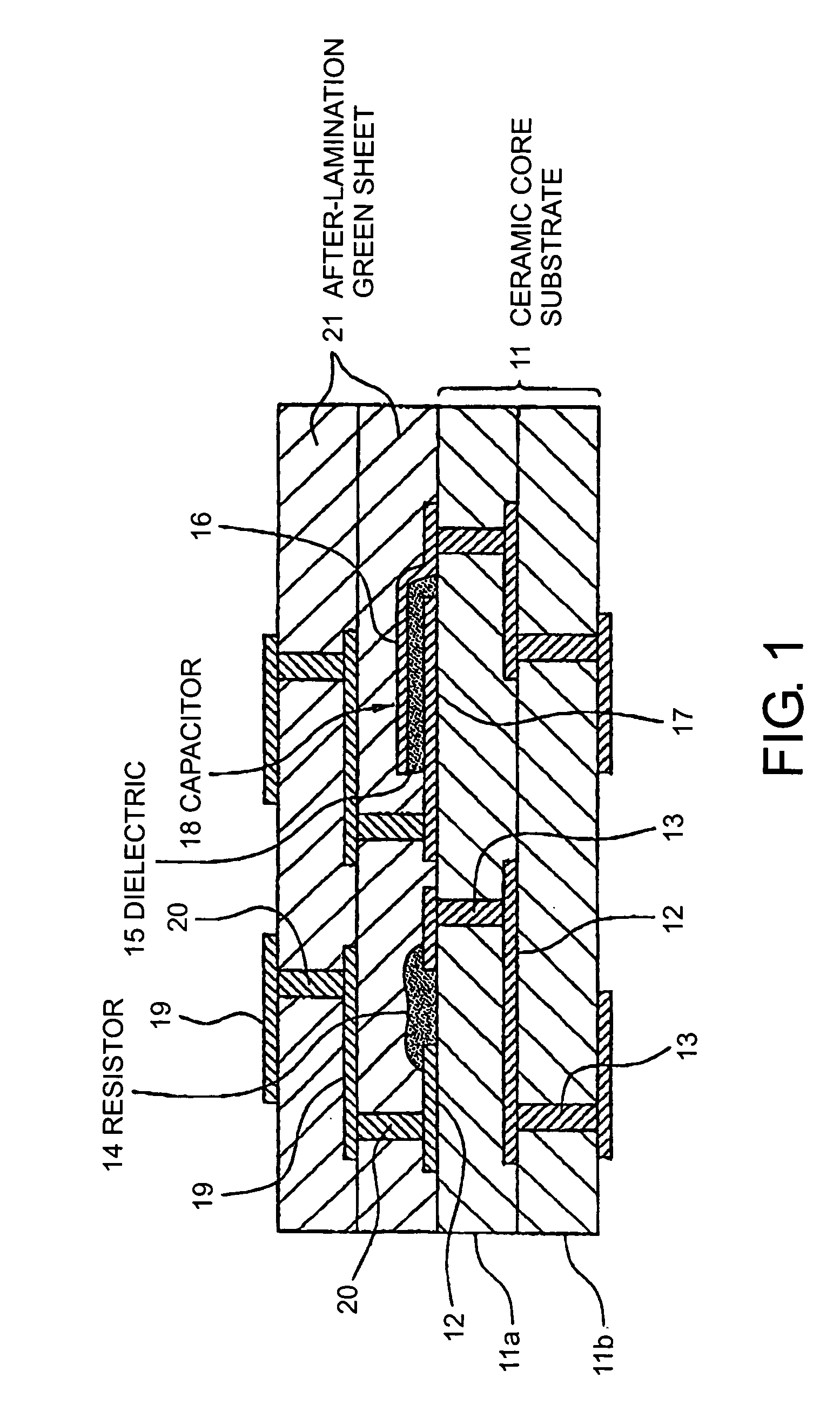
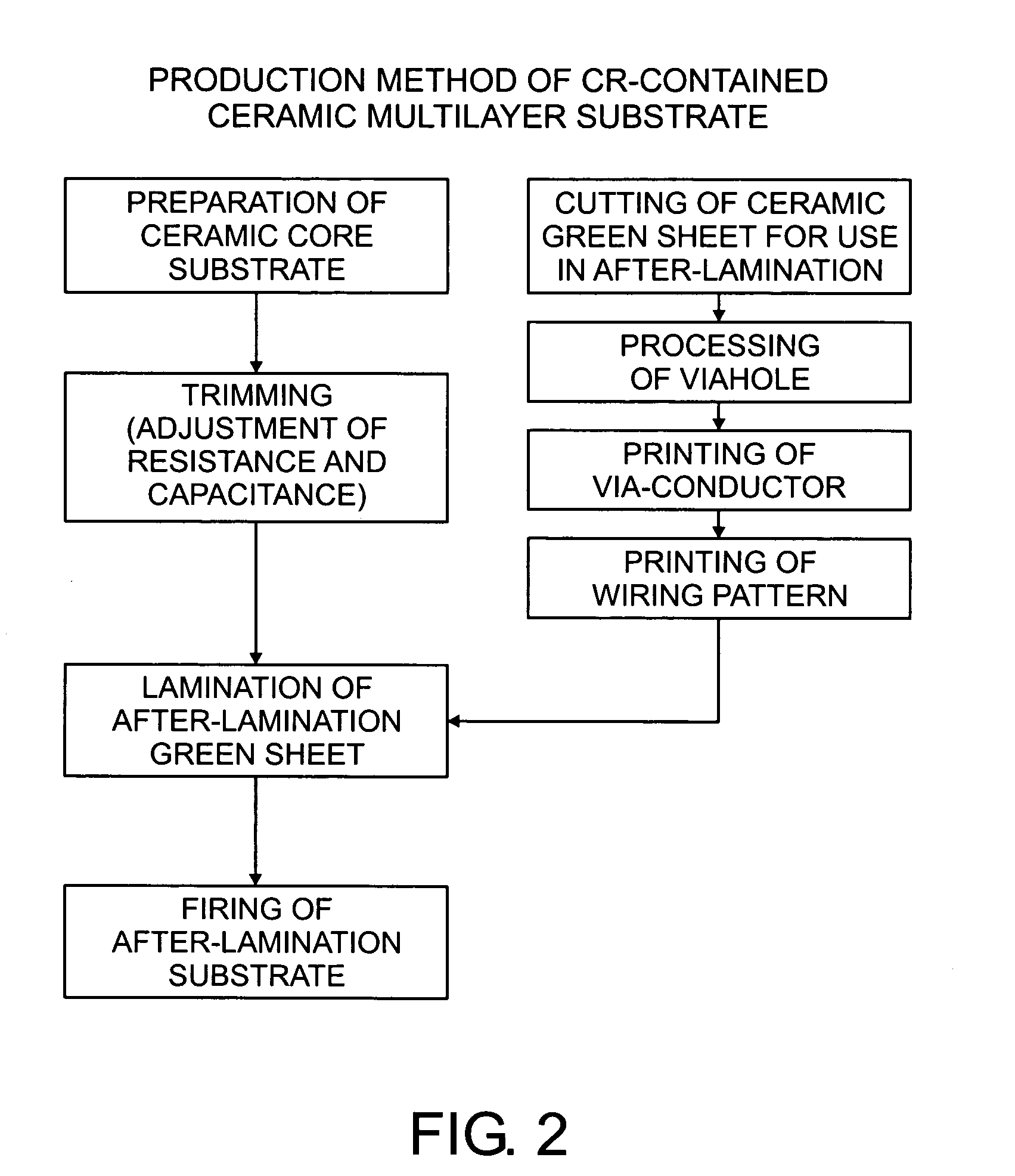
[0014] According to the method of producing a ceramic multilayer substrate of the present invention, after the resistor and the capacitor are fired simultaneously with the ceramic core substrate, or the resistor and the dielectric and electrodes of the capacitor are printed on the fired ceramic core substrate to be fired, the resistor and the capacitor are trimmed so that the resistance and the capacitance are adjusted. Thus, the resistance and the capacitance can be adjusted with high precision by trimming before the lamination. Thereafter, at least one after-lamination green sheet is laminated onto the surface of the ceramic core substrate. Thus, the after-lamination substrate is formed. The after-lamination substrate is fired at a temperature lower than the
sintering temperature of the resistor and the dielectric. Thus, the sintered resistor and dielectric can be prevented from being softened and melted when the after-lamination substrate is fired. Moreover, the
sintering states of the resistor and the dielectric can be prevented from being changed. The resistance and the capacitance accurately adjusted by trimming before the after-lamination substrate is fired (before the after-lamination green sheet is laminated) can be kept as they are, and not be changed by the firing. Thus, the ceramic multilayer substrate containing the resistor and the capacitor is a high quality one, and has less variations of the resistance and the capacitance.
[0015] Preferably, the firing temperature of the after-lamination substrate is set at a temperature which is lower than the glass yield point of a glass component contained in the resistor and / or the dielectric of the capacitor. Thereby, the sintered resistor and dielectric can be securely prevented from being softened and melted when the after-lamination substrate is fired. Thus, the dispersions of the resistance and the capacitance, which may be caused by the firing, can be securely reduced.
[0016] Also, preferably, the after-lamination green sheet is made from a SiO.sub.2--Al.sub.2O.sub.3--CaO--B.sub.2O.sub.3--Li.sub.2O type glass. The SiO.sub.2--Al.sub.2O.sub.3--CaO--B.sub.2O.sub.3--Li.sub.2O type glass has a glass yield point of 620.degree. C. Thus, the after-lamination substrate can be fired at a lower temperature (e.g., 700.degree. C.) compared to the glass yielding points of the resistor and the dielectric which contain a different glass. The variation of the resistance and the capacitance, which may be caused by firing, can thereby be securely reduced.
[0017] Also, preferably, the ceramic core substrate is made from a low-temperature firing ceramic which is fired at a temperature of about 800.degree. C. to 1000.degree. C. Thereby, advantageously, the ceramic core substrate, the resistor and the capacitor can be simultaneously fired. The number of firing processes can be reduced. In addition, as a wiring conductor which is fired simultaneously with the ceramic core substrate, metals with low melting points such as Ag type conductors having a
low resistance and superior electrical characteristics can be employed. Needless to say, the resistor and the dielectric and electrodes of the capacitor may be printed on the fired ceramic core substrate and then fired in the case in which the ceramic core substrate is made from a low temperature firing ceramic.
[0019] As a
countermeasure against the above-described problems, the ceramic core substrate may be formed to have a multilayer structure. Thus, the
mechanical strength of the ceramic core substrate can be enhanced so that the
distortion of the fired substrate is eliminated with the wiring-density of the ceramic core substrate being enhanced and also with the size being reduced.
[0020] Moreover, preferably, a constraining green sheet incapable of being sintered at the sintering temperature of the after-lamination green sheet is laminated onto the after-lamination green sheet laminated as the outermost layer of the after-lamination substrate. In the subsequent firing step, the after-lamination green sheet is constraininglyfired at the sintering temperature thereof with the after-lamination substrate being pressed via the constraining green sheet or not, so that the after-lamination substrate is integrated, and the remaining constraining-green sheet is removed. Accordingly, the firing shrinkage or
distortion in the X and Y directions of the after-lamination green sheet laminated onto the fired ceramic core substrate can be suppressed substantially uniformly on both of the sides of the after-lamination green sheet. A high-quality ceramic multilayer substrate having no
distortion can be produced.

 Login to View More