

Bolt and process for producing a protective layer on a bolt
a protective layer and bolt technology, applied in the direction of threaded fasteners, screws, fastening means, etc., can solve the problems of minor damage, parts which engage in one another becoming jammed, and screwed-together parts are particularly known to be prone to seizing, so as to achieve the effect of low tendency to seiz
- Summary
- Abstract
- Description
- Claims
- Application Information
AI Technical Summary
Benefits of technology
Problems solved by technology
Method used
Image

Examples
Embodiment Construction
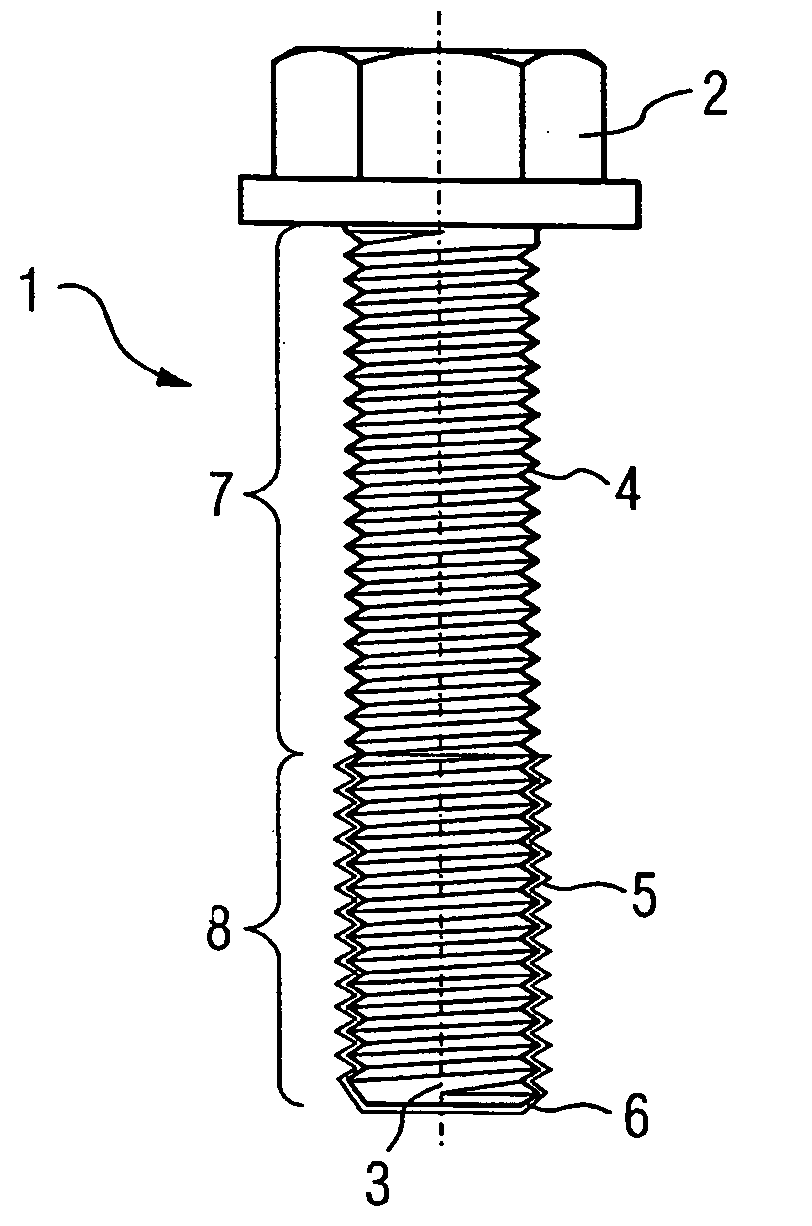
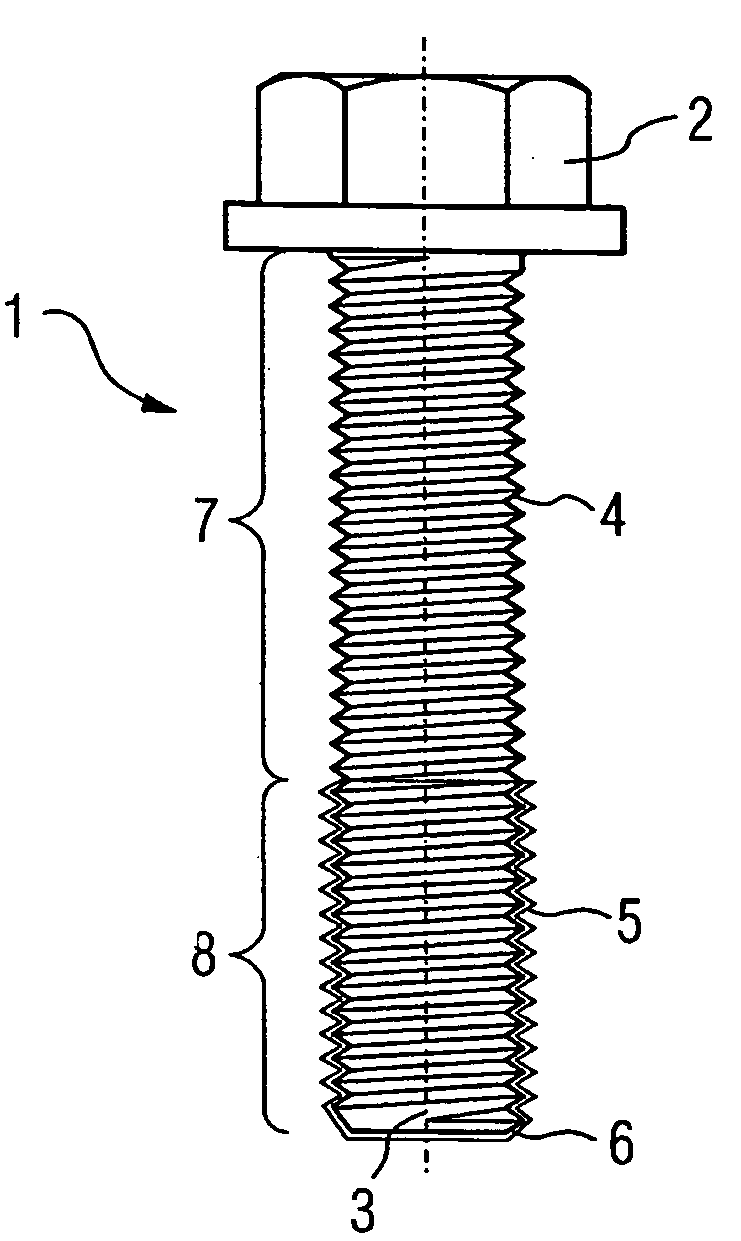
[0022] FIG. 1 shows a longitudinal section through a coated bolt 1. The bolt 1 has a head 2 and a screw thread 4 running along the longitudinal axis 3. In this exemplary embodiment, the thread 4 extends from the head 2 to the start of the bolt 6. The bolt 1 has an upper part 7 and a lower part 8 along its longitudinal axis 3, although the division between the upper part 7 and the lower part 8 of the bolt 1 may vary. Other embodiments of the bolt 1, such as for example a thread 4 which is only applied as a part of the longitudinal axis 3, can also be used. The bolts may, for example, consist of 12% strength chromium steel.
[0023] The bolt 1 can be used, inter alia, in steam turbine or gas turbine construction.
[0024] The bolt 1 is provided with an aluminum-containing high-temperature lacquer 5 over the entire thread 4. The aluminum-containing high-temperature lacquer does not have to be applied to the entire thread 4; for some applications, it is sufficient for the lower part 8 of the ...
PUM
 Login to View More
 Abstract
Description
Claims
Application Information
 Login to View More