Unlock instant, AI-driven research and patent intelligence for your innovation.

Metallic separator for fuel cell and manufacturing method therefor

a fuel cell and separator technology, applied in the direction of cell components, final product manufacturing, sustainable manufacturing/processing, etc., can solve the problems of repeated stresses increased surface pressure between the electrode assembly and the separator, etc., to reduce the effect of metal consumption, reducing contact resistance, and suppressing damage in the electrode assembly

Inactive Publication Date: 2005-05-05
HONDA MOTOR CO LTD
View PDF3 Cites 3 Cited by
  • Summary
  • Abstract
  • Description
  • Claims
  • Application Information

AI Technical Summary

Benefits of technology

[0010] It is therefore an object of the invention to provide a metallic separator for a fuel cell and to provide a manufacturing method therefor which can provide superior reducing effect of contact resistance by plating, minimizing the consumption of plating metal and reducing cost, and suppressing damage to the electrode assembly by a conductive intermetallic compound protruding from the surface.
[0014] In the metallic separator for a fuel cell having such a structure, the conductive inclusions form conductive paths, whereby the inclusions play a role in decreasing the contact resistance. Even if conductive inclusions with high hardness are protruding from the separator surface, since the surface is coated with a softer metal, the metal functions as a buffer material for the electrode assembly which is a facing member, and damage in surfaces of the electrode assembly is reduced. In the metallic separator for a fuel cell of the invention, the metal is deposed only on the conductive inclusions exposed on the separator surface, the consumption of metal is low, whereby the cost can be reduced. In the metallic separator for a fuel cell in the first aspect of the invention, since a base metal is precipitated, the cost can be substantially reduced. Further, since no oxide film is formed on the surface of the conductive inclusions, the metal adhesion is very high, whereby peeling of metal is suppressed, and the contact resistance is further reduced.
[0015] In the metallic separator for a fuel cell in the second aspect of the invention, since at least one kind of platinum and palladium is precipitated, the portion exposed to the gas passage which is not contacting the electrode assembly exhibits a catalytic function. That is, platinum or other catalyst is contained in the negative electrode catalyst layer of the electrode assembly, and by this catalyst, the fuel gas such as hydrogen gas is decomposed into protons (H+) and electrons. Therefore, by depositing platinum or the like in the separator, the reaction takes place before the fuel gas contacts with the negative electrode layer, so that the catalyst efficiency may be enhanced. In the metallic separator for a fuel cell in the third aspect of the invention, since a base metal or an alloy thereof and at least one kind of platinum and palladium are precipitated, the manufacturing cost is substantially reduced, and the catalyst function is enhanced.
[0016] The invention is not limited to a structure in which conductive inclusions protrude from the separator surface, and the invention includes a structure in which the inclusions are exposed at the separator surface without protruding. When the conductive inclusions protrude, the rate of conductive inclusions contacting with the electrode assembly is increased, whereby the contact resistance is further decreased. During operation of the fuel cell, the separator may be exposed to a corrosive environment of pH 3 or less due to ions being eluted from the electrode assembly, etc. Therefore, as a metal alloy to be precipitated on the conductive inclusions, Ni—B alloy, Ni—P alloy, or other amorphous metal having a high corrosion resistance may be effective, although the conductivity may be slightly reduced.
[0021] According to the invention, conductive inclusions are exposed on the surface with corrosion resistance, and metal is precipitated selectively on the exposed conductive inclusions, and therefore damage in the electrode assembly is suppressed, the reducing effect of contact resistance by metal can be opened up to the full extent, and the metal consumption is reduced and the cost can be reduced.

Problems solved by technology

As a result, the electrode assembly is expanded and swollen, and the surface pressure at the electrode assembly and separator is increased.
Thus, by the cycles of power generation and stopping, repetitive stresses occur between the electrode assembly and separator.
Therefore, by the repetitive stresses occurring between the electrode assembly and separator, the surface of the electrode assembly is damaged, whereby the contact resistance between the separator and electrode assembly is increased, resulting in degrading the current collecting function of the separator.
However, there is a problem in that the gold consumption is too great, and it is expensive.
However if the gold plating has defects such as pin holes, the nickel which is a component in the treatment for substrate may elute.
Elution of nickel lowers the performance, for example, the ion exchange capacity of the electrolyte membrane, and further leads to other problems such as peeling of gold plating or increase in contact resistance.

Method used

the structure of the environmentally friendly knitted fabric provided by the present invention; figure 2 Flow chart of the yarn wrapping machine for environmentally friendly knitted fabrics and storage devices; image 3 Is the parameter map of the yarn covering machine
View more

Image

Smart Image Click on the blue labels to locate them in the text.
Viewing Examples
Smart Image
  • Metallic separator for fuel cell and manufacturing method therefor
  • Metallic separator for fuel cell and manufacturing method therefor
  • Metallic separator for fuel cell and manufacturing method therefor

Examples

Experimental program
Comparison scheme
Effect test

embodiment 1

Preferred Embodiment 1

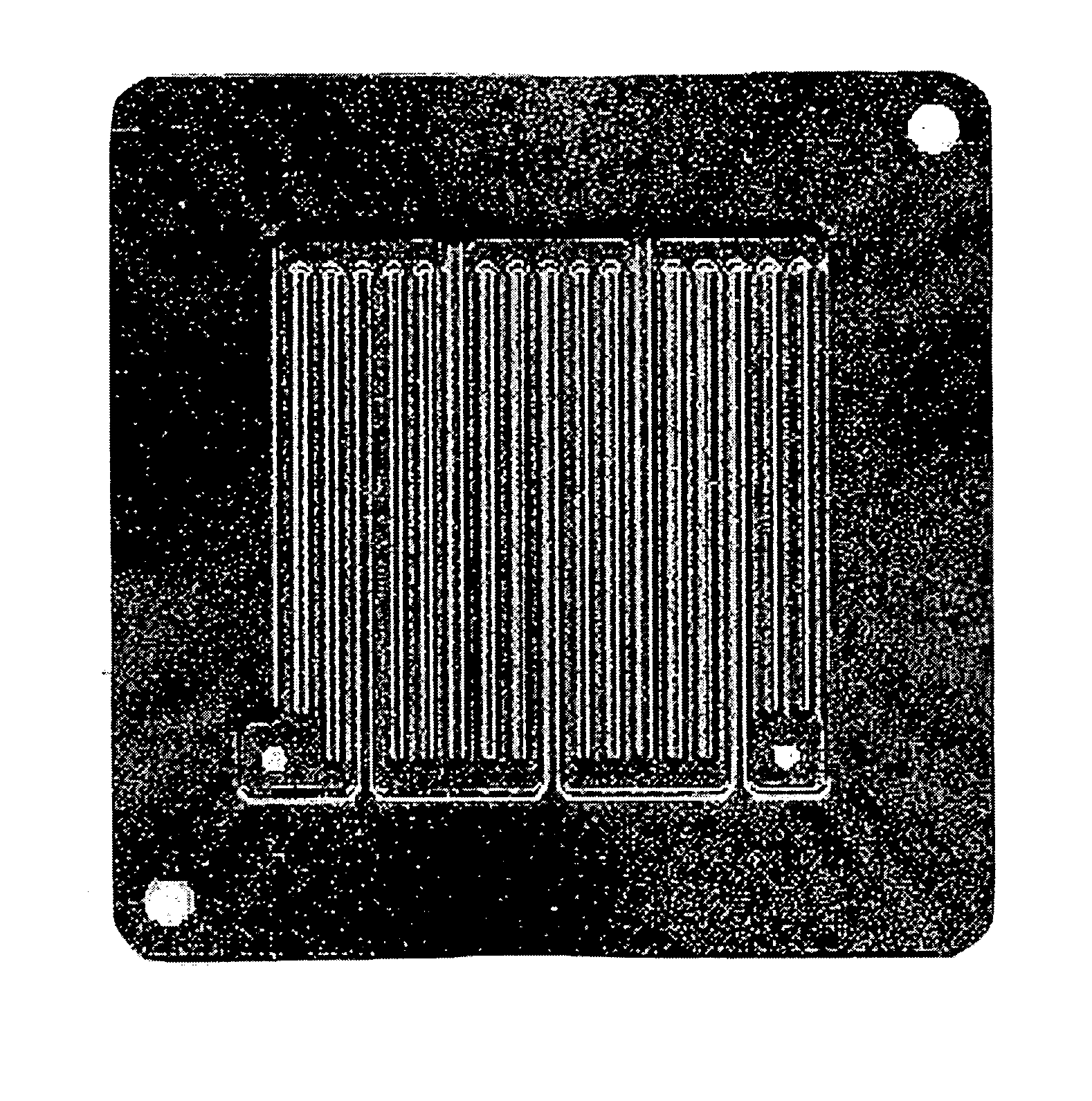
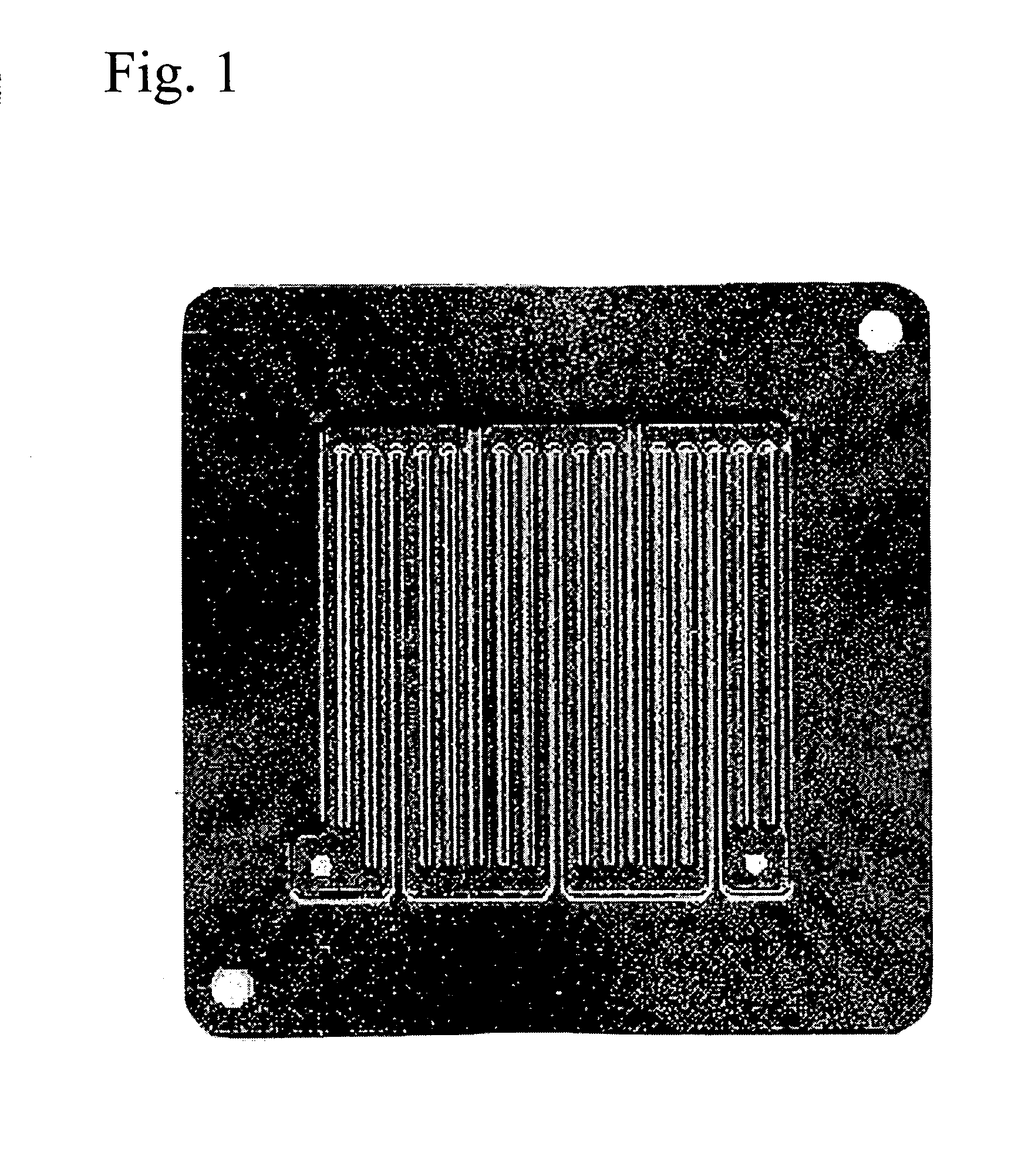
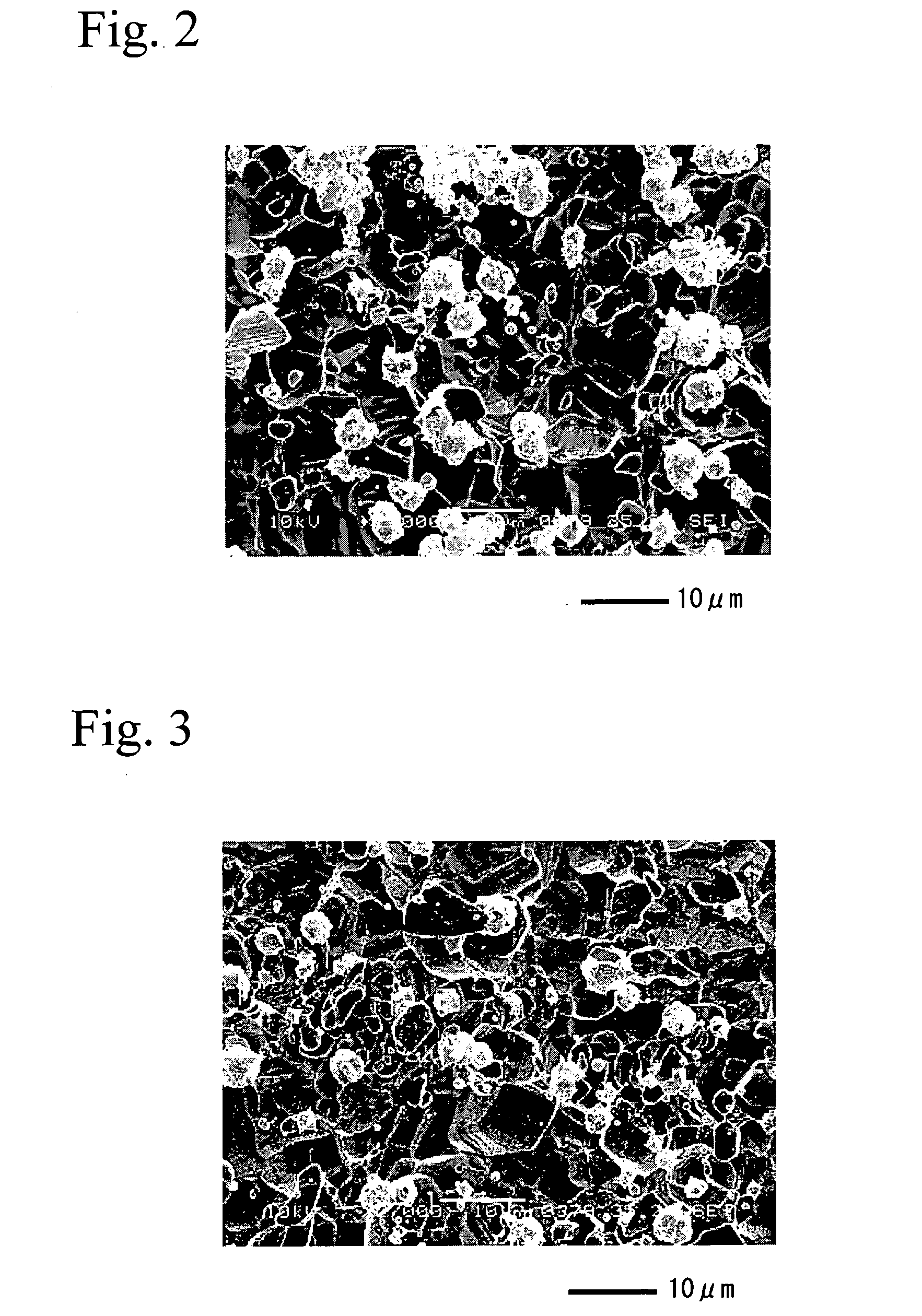
[0038] An austenitic stainless steel plate having the composition shown in Table 1 was rolled to a thickness of 0.2 mm, and a necessary number of square sheets of 100 mm×100 mm were cut out from the rolled steel. These thin sheets were press-formed, and a material plate for a separator as shown in FIG. 1 was obtained. This material plate has a power generating part in corrugated-section in the center, and has a flat edge in the periphery of the power generating part. In this material plate, B in component is precipitated in the metal structure as M2B and MB type boride and M23(C,B)6 type boride, and these borides are conductive inclusions forming conductive paths on the separator surface.

TABLE 1(wt %)CSiMnPSCuNiCrMoNbTiAlNB0.0730.280.130.0150.0010.1110.120.92.03——0.080.0300.60

[0039] Furthermore, both sides of the material plate were passivated, whereby firm oxide films were formed on the surface of parent metal. For passivation, the material plate was degreas...

embodiment 2

Preferred Embodiment 2

[0040] Six types of separators of preferred embodiment 2 were obtained under the same conditions as in preferred embodiment 1 except that copper plating was performed instead of silver plating. In each separator of preferred embodiment 2 also, conductive inclusions protruded at the surface. For copper plating, the material plate was immersed in a plating bath (pH 11) made by copper (I) cyanide (20 g / L), free sodium cyanide (25 g / L), sodium carbonate (20 g / L), potassium hydroxide (0.5 g / L), and Rochelle salt (15 g / L) held at 40° C. with current density set at 0.8 A / dm2. In this case, the immersion time was set in six periods, that is, 1, 2, 3, 4, 7, and 10 minutes, and the copper amount per unit area increased as the immersion time was increased. After copper plating, the material plate was washed by water in ordinary temperature twice for 10 minutes each time.

embodiment 3

Preferred Embodiment 3

[0041] Six types of separators of preferred embodiment 3 were obtained under the same conditions as in preferred embodiment 1 except that nickel plating was performed instead of silver plating. In each separator of preferred embodiment 3 also, conductive inclusions protruded at the surface. For nickel plating, the material plate was immersed in a plating bath (pH 5.5) made by nickel sulfate (250 g / L), nickel chloride (38 g / L), boric acid (30 g / L), cobalt sulfate (12 g / L), and formalin (1.5 g / L) held at 40° C. with current density set at 0.8 A / dm2. In this case, the immersion time was set in six periods, that is, 1, 2, 3, 4, 7, and 10 minutes, and the nickel amount per unit area increased as the immersion time was increased. After nickel plating, the material plate was washed by water in ordinary temperature twice for 10 minutes each time.

the structure of the environmentally friendly knitted fabric provided by the present invention; figure 2 Flow chart of the yarn wrapping machine for environmentally friendly knitted fabrics and storage devices; image 3 Is the parameter map of the yarn covering machine
Login to View More

PUM

PropertyMeasurementUnit
temperaturesaaaaaaaaaa
thicknessaaaaaaaaaa
thicknessaaaaaaaaaa
Login to View More

Abstract

A metallic separator for a fuel cell (and a manufacturing method therefore) can reduce damage to an electrode assembly, open up the maximum capacity of the reducing effect of contact resistance due to coating of gold by gold plating or the like, and reduce consumption of gold to lower the cost. Conductive inclusions are exposed at the surface with corrosion resistance, and at least one kind of metal or an alloy thereof selected from silver, copper, nickel, and tin is precipitated on the exposed conductive inclusions. From the viewpoint of reducing contact resistance, the conductive inclusions preferably protrude from the separator surface.

Description

BACKGROUND OF THE INVENTION [0001] 1. Field of the Invention [0002] The present invention relates to a metallic separator for a solid high polymer type fuel cell, and relates to a manufacturing method therefor. [0003] 2. Description of the Related Art [0004] A solid high polymer type fuel cell is formed as a fuel cell stack by laminating a plurality of units, one unit being a laminated body having separators laminated on both sides of a flat electrode assembly (MEA: Membrane Electrode Assembly). The electrode assembly has a three-layer structure having an electrolyte membrane made of ion exchange resin or the like enclosed between a pair of gas diffusion electrodes composing a positive electrode (cathode) and a negative electrode (anode). The gas diffusion electrodes have gas diffusion layers formed at the outside of an electrode catalyst layer contacting with the electrode membrane. The separators are laminated so as to contact with the gas diffusion electrodes of the electrode ass...

Claims

the structure of the environmentally friendly knitted fabric provided by the present invention; figure 2 Flow chart of the yarn wrapping machine for environmentally friendly knitted fabrics and storage devices; image 3 Is the parameter map of the yarn covering machine
Login to View More

Application Information

Patent Timeline
no application Login to View More
Patent Type & Authority Applications(United States)
IPC IPC(8): H01M8/02B05D5/12B32B15/01B32B15/20H01M8/10
CPCB32B15/01B32B15/015B32B15/018C25D5/02H01M8/0206Y10T428/12903H01M8/0228Y02E60/50Y10T428/12944Y10T428/12896Y10T428/12708H01M8/0223Y02P70/50
Inventor TSUJI, MAKOTOINOUE, MASAJIROUTSUNOMIYA, MASAOOTANI, TERUYUKIKUWAYAMA, TAKASHITAKAI, TAKAHIRO
Owner HONDA MOTOR CO LTD