
Hydroxygallium phthalocyanine pigment and process for the production thereof, process for the production of photosensitive layer-forming coating solution, electrophotographic photoreceptor, process cartridge, electrophotographic device and image formation method
a technology coating solution, which is applied in the direction of electrographic process, electrophotographic photoreceptor, process cartridge, etc., can solve the problems that the electrophotographic properties of hydroxygallium phthalocyanine pigments are not necessarily satisfactory, and the image quality defects such as fogging and black or white spots, etc., to achieve stable image quality, good photoresolution, and sufficient sensitivity.
- Summary
- Abstract
- Description
- Claims
- Application Information
AI Technical Summary
Benefits of technology
Problems solved by technology
Method used
Image

Examples
synthesis example 1
[Synthesis of I Type Hydroxygallium Phthalocyanine]
[0325] 30 parts by weight of 1,3-diiminoisoindoline and 9.1 parts by weight of gallium trichloride are added to 230 parts by weight of dimethyl sulfoxide. The mixture is then reacted at 160° C. with stirring for 6 hours to obtain a reddish purple crystal. The crystal thus obtained is washed with dimethyl sulfoxide, washed with ion-exchanged water, and then dried to obtain 28 parts by weight of a crude crystal of an I type chlorogallium phthalocyanine.
[0326] Subsequently, a solution obtained by thoroughly dissolving 10 parts by weight of the crude crystal of the I type chlorogallium phthalocyanine thus obtained in 300 parts by weight of sulfuric acid (concentration: 97%) which had been heated to 60° C. is added dropwise to a mixture of 600 parts by weight of a 25% aqueous ammonia and 200 parts by weight of ion-exchanged water to cause crystallization of hydroxygallium phthalocyanine. The crystal thus obtained is collected by filtra...
example 1
[0336] 6 parts by weight of the I type chlorogallium phthalocyanine pigment obtained in Synthesis Example 1 are subjected to wet grinding together with 90 parts by weight of N,N-dimethyl formamide and 350 parts by weight of spherical glass media having an outer diameter of 0.9 mm using a glass ball mill at 25° C. for 48 hours. During this procedure, the progress of crystal transformation is monitored by the measurements of absorption wavelength of the wet-grinding process solution to confirm that the maximum peak wavelength (λMAX) of the hydroxygallium phthalocyanine pigment after subjected to wet grinding step in optical absorption spectrum in a wavelength range of from 600 nm to 900 nm is 827 nm.
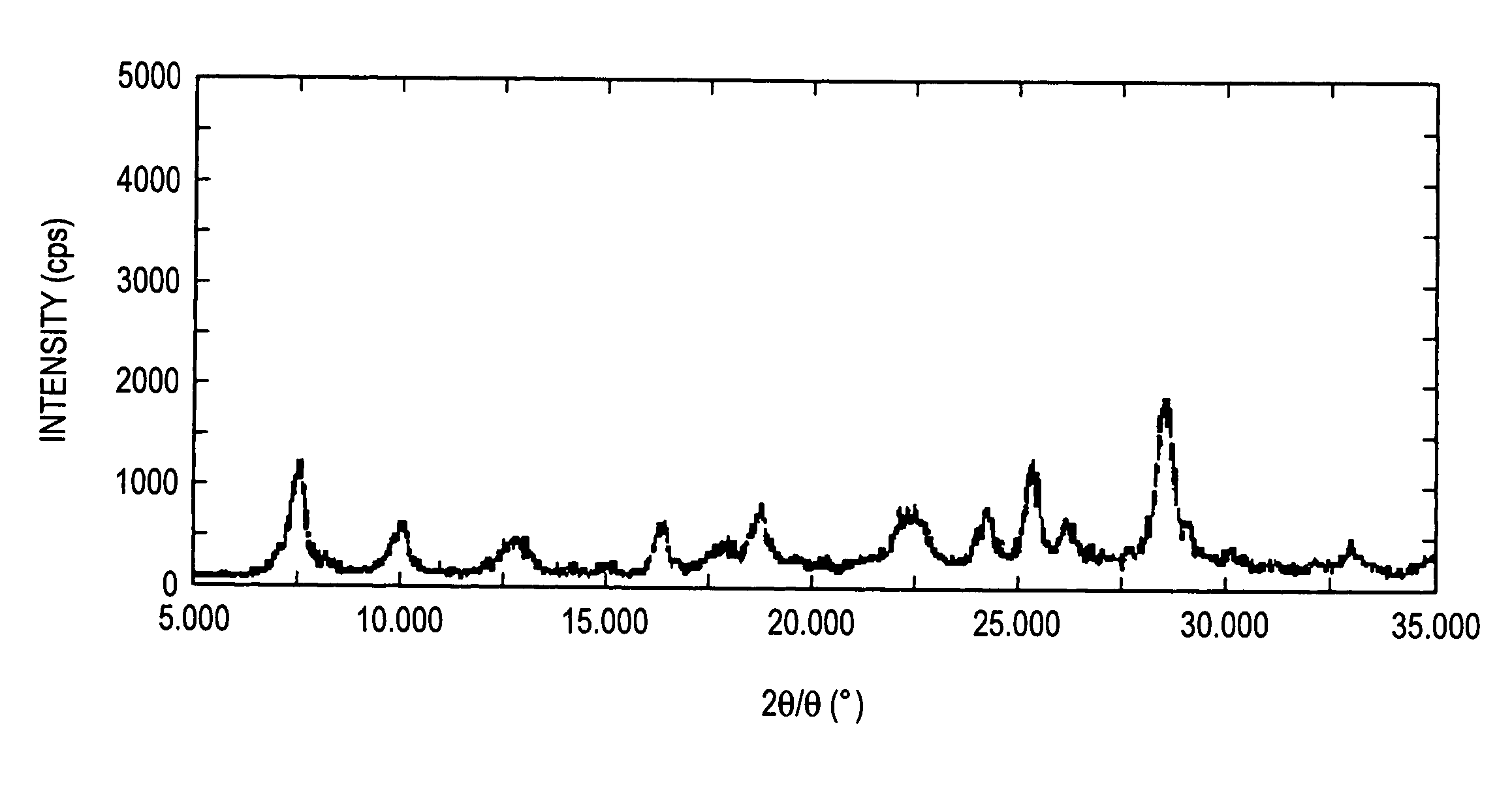
[0337] Subsequently, the crystal thus obtained is washed with acetone, and then dried to obtain 5.5 parts by weight of a hydroxygallium phthalocyanine pigment having diffraction peaks at positions of 7.5°, 9.9°, 12.5°, 16.3°, 18.6°, 25.1° and 28.3° in a Bragg angle (2θ±0.2°) of X-ray diff...
example 2
[0339] The procedure of Example 1 is followed except that the wet grinding time is changed from 48 hours to 96 hours. As a result, 5.5 parts by weight of a hydroxygallium phthalocyanine pigment satisfying the requirements for diffraction peak in X-ray diffraction spectrum as defined in Example 1 are obtained. The maximum peak wavelength (λMAX) of the hydroxygallium phthalocyanine pigment wet-ground in optical absorption spectrum in a wavelength range of from 600 nm to 900 nm during the monitoring of the progress of crystal transformation after the wet-grinding step is 825 nm. X-ray diffraction spectrum, optical absorption spectrum and transmission electron microphotograph of the hydroxygallium phthalocyanine pigment thus obtained are shown in FIGS. 8, 13 and 20, respectively.
PUM
| Property | Measurement | Unit |
|---|---|---|
| wavelength | aaaaa | aaaaa |
| wavelength | aaaaa | aaaaa |
| BET specific surface area | aaaaa | aaaaa |
Abstract
Description
Claims
Application Information
 Login to View More