Transient simulation using adaptive piecewise constant model

a piecewise constant model and simulation technology, applied in the field of transient simulators, can solve the problems of difficult to balance performance and accuracy available in other simulators, inability to adapt to timing step capability, and conservative level of accuracy

US20050273307A1Inactive Publication Date: 2005-12-08GLOBALFOUNDRIES INC
13 Cites 10 Cited by

Patent Information

Authority / Receiving Office
US · United States
Current Assignee / Owner
Publication Date
2005-12-08
Estimated Expiration
Not applicable · inactive patent

Smart Images

  • Figure 1
    Figure 1
  • Figure 2
    Figure 2
  • Figure 3
    Figure 3
Patent Text Reader

Abstract

A transient simulation system, methods and program product that implement an adaptive piecewise constant (PWC) model are disclosed. The invention evaluates an error criteria to determine a maximum allowable change in one of a current and a voltage; and simulates the transient conditions by implementing an adaptive step in the PWC model according to the maximum allowable change. The invention allows dynamic or static adaptation of a PWC model according to an error criteria.
Need to check novelty before this filing date? Find Prior Art

Description

BACKGROUND OF INVENTION

[0001] 1. Technical Field

[0002] The present invention relates generally to transient simulators, and more particularly, to a transient simulation system, methods and program product that implement an adaptive piecewise constant model.

[0003] 2. Related Art

[0004] With the continuing miniaturization of very large scale integrated (VLSI) circuitry, interest in conducting formal circuit tuning using circuit transient simulation for gradient calculation is increasing. “Transient simulation” is the analysis of a circuit during time-varying conditions. “Tuning” includes optimization of a number of circuit parameters, e.g., device widths, to maximize circuit performance relative to circuit parameters. A challenge for circuit transient simulation is improving simulator performance, i.e., run time. Tuning also requires conducting another simulation to determine “gradients” for the circuit, which are circuit measurement sensitivities to other circuit parameters, e.g.,...

Examples

Embodiment Construction

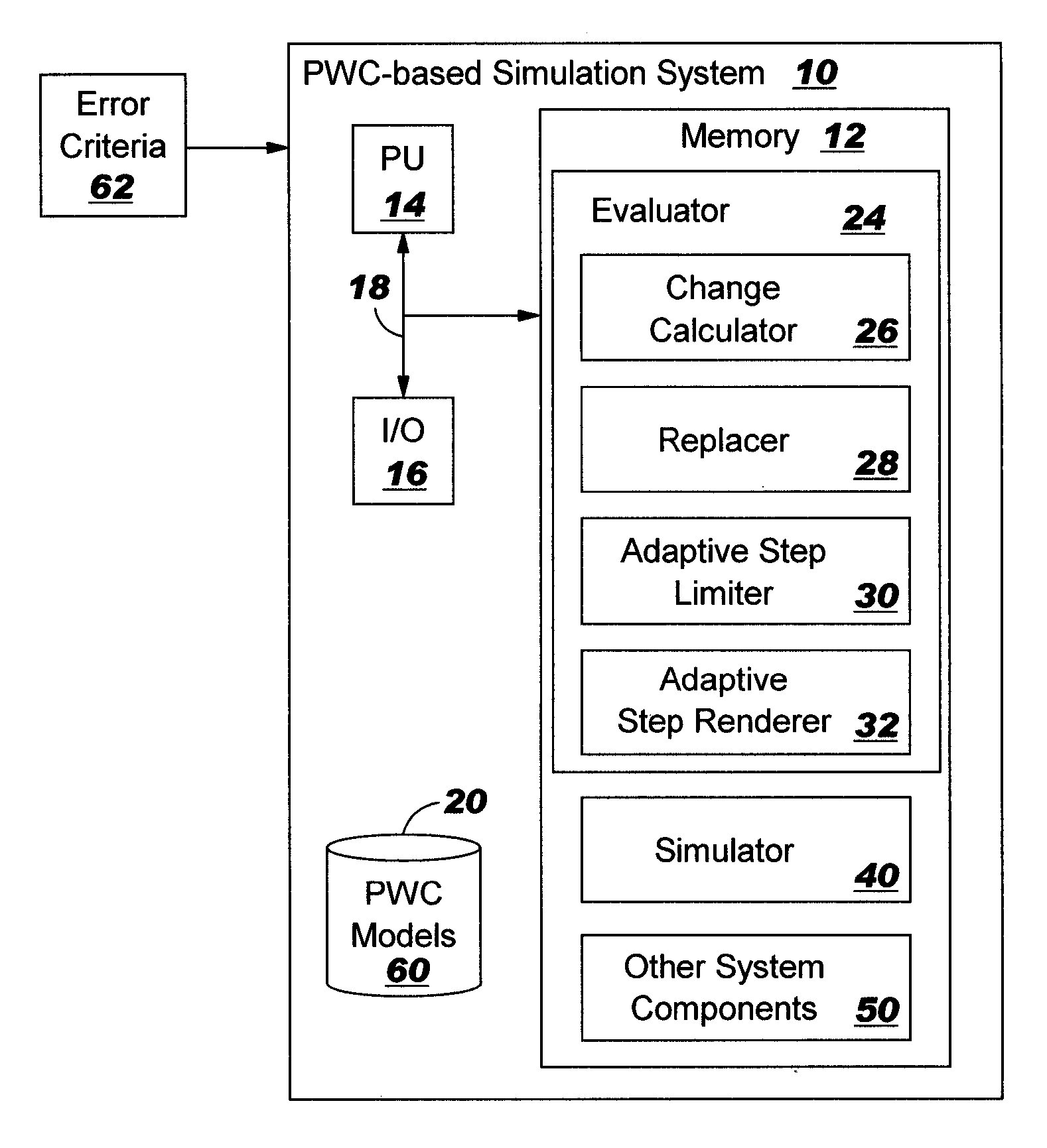
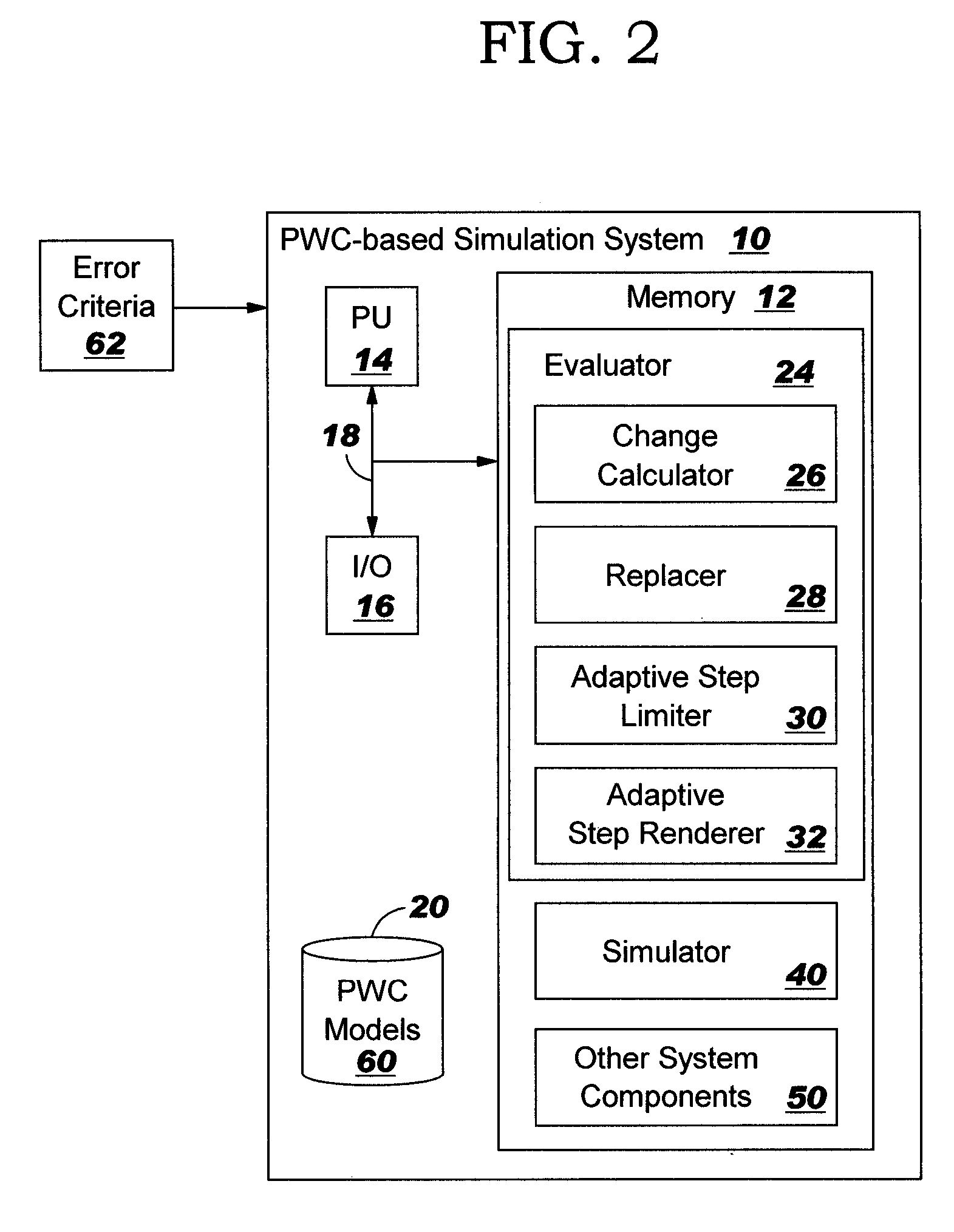
[0023] For purposes of clarity only, the detailed description includes the following outline: I. PWC-based Simulation System Overview; II. Operational Methodology; and Ill. Conclusion.

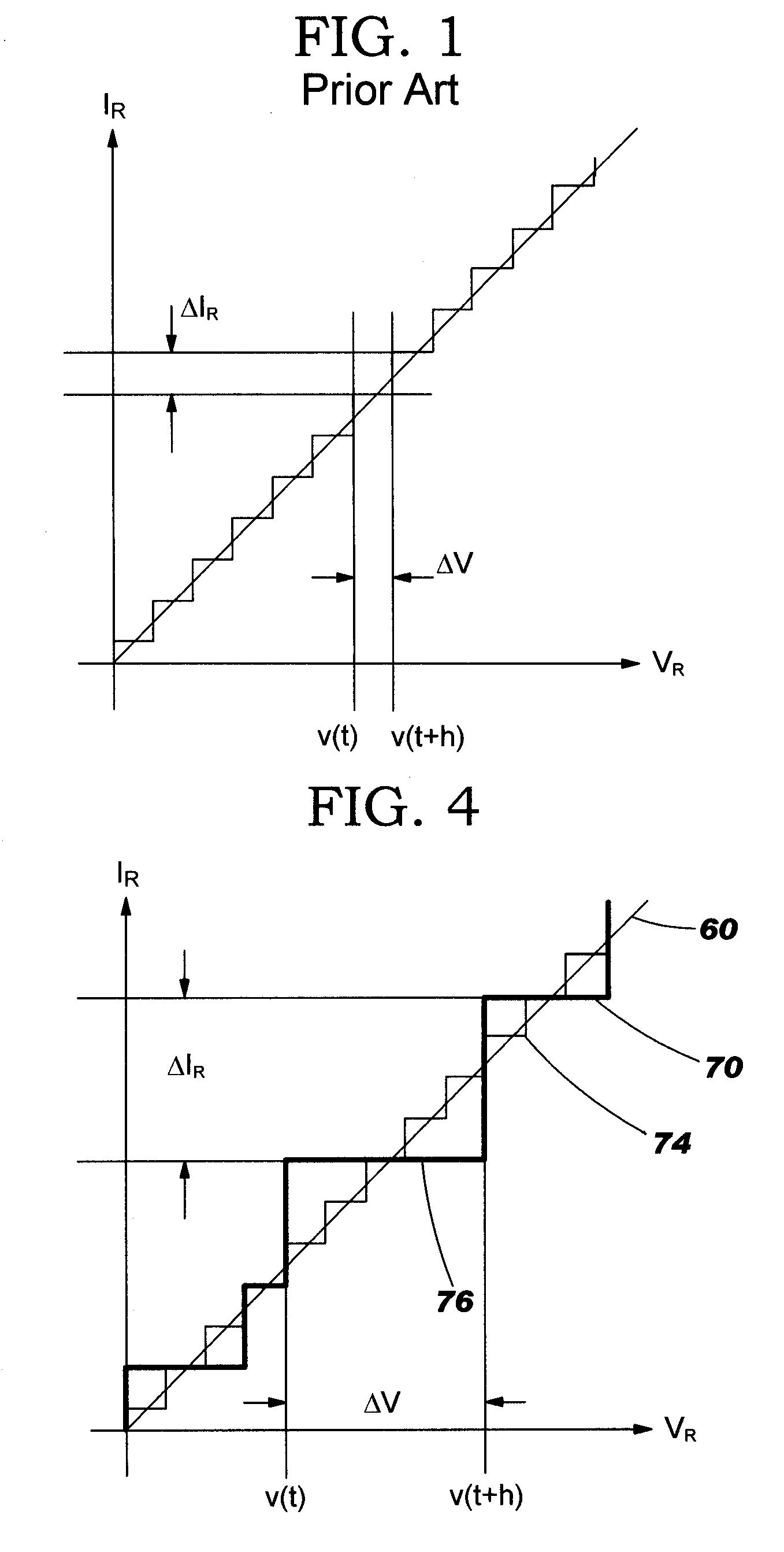
[0024] The present invention includes a system, methods and program product to achieve a performance / accuracy tradeoff while using a piecewise constant (PWC) simulation approach. As the integration scheme of PWC-based simulators is essentially locked into the corresponding PWC models (as described above), the invention provides a way to define adaptive PWC models, with the step size adapting as needed to satisfy error criteria. The invention allows the simulation software to make small steps in critical regions to maintain accuracy, while allowing larger steps where possible for performance. The invention also allows a single model to be used to represent all linear elements (such as resistors in the case of electrical simulation), as the optimal step size automatically adapts with element value. Thes...