Method and device for determining the resistivity in a geological formation crossed by a cased well

US20060015258A1Inactive Publication Date: 2006-01-19SCHLUMBERGER TECH CORP

Image

Smart Image Click on the blue labels to locate them in the text.
Viewing Examples
Smart Image
  • Method and device for determining the resistivity in a geological formation crossed by a cased well
  • Method and device for determining the resistivity in a geological formation crossed by a cased well
  • Method and device for determining the resistivity in a geological formation crossed by a cased well

Examples

Experimental program
Comparison scheme
Effect test

Embodiment Construction

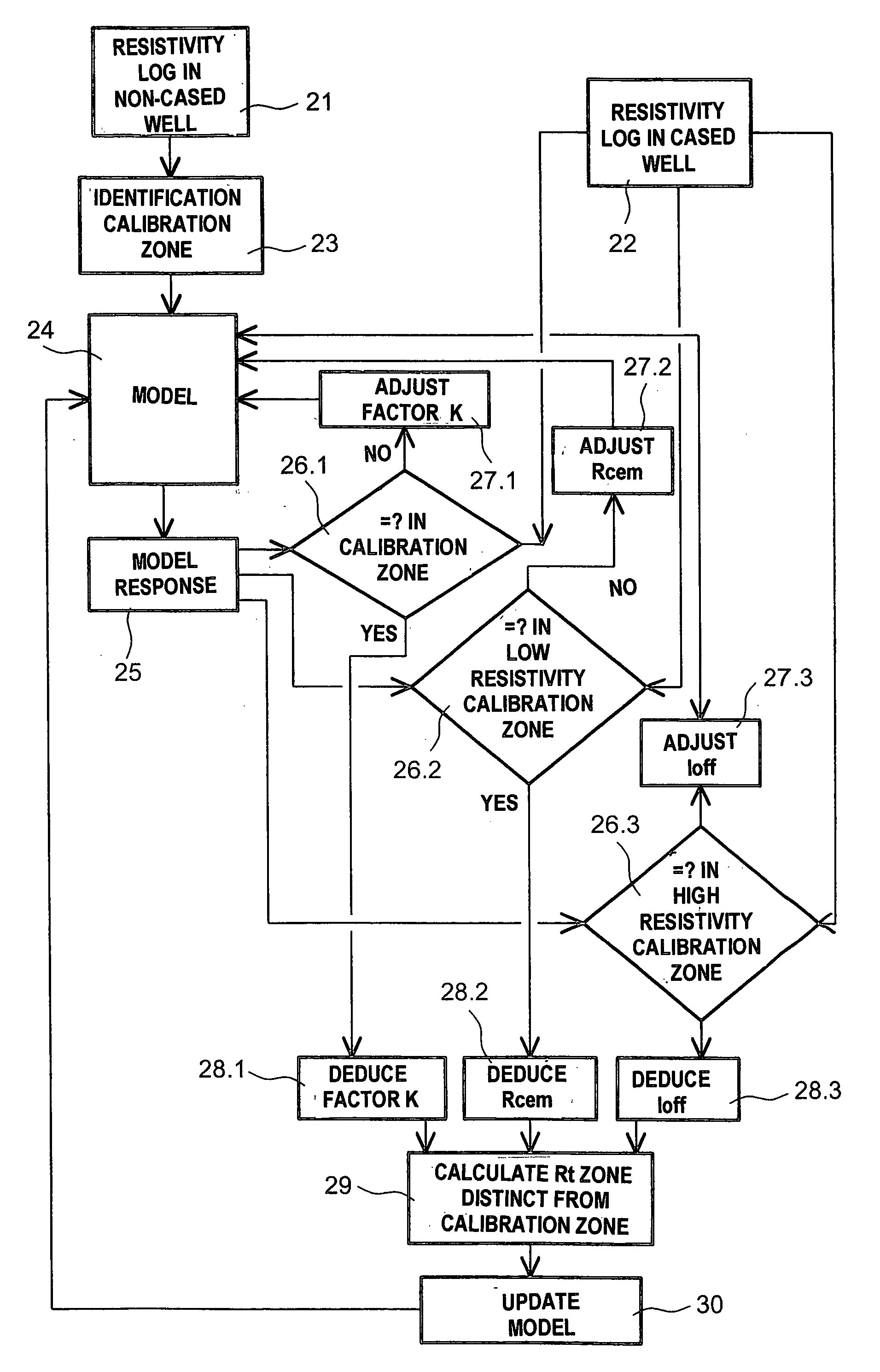
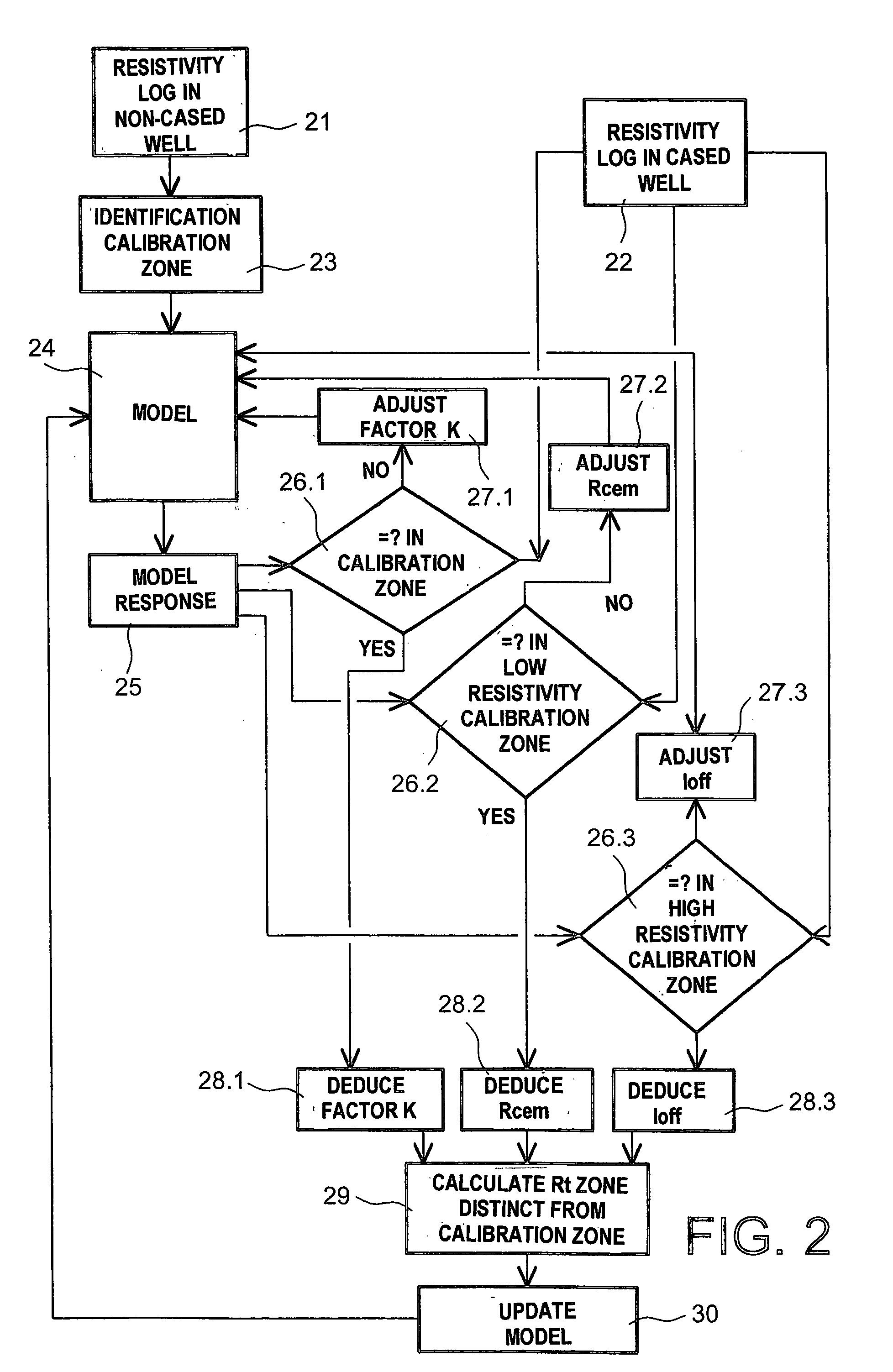
[0016] The aim of the present invention is to propose a method for determining the resistivity of a formation crossed by a cased well that leads to a much better precision than that obtained through traditional methods. The aim is to better evaluate the geometric factor k in order to improve the resistivity precision and to take account, in an effective manner, of the effect relating to the cement and the offset current.

[0017] In order to achieve these aims, the present invention proposes carrying out at least one resistivity log in the cased well and using the results of at least one log in the non-cased well, carried out in the same well, in at least one zone of the formation in which the resistivity has not changed between the cased condition and non-cased condition in order to deduce the value of a geometric factor k conditioning the resistivity and in order to determine, by means of this geometric factor k and the log in the cased well, the resistivity in at least one zone dif...

the structure of the environmentally friendly knitted fabric provided by the present invention; figure 2 Flow chart of the yarn wrapping machine for environmentally friendly knitted fabrics and storage devices; image 3 Is the parameter map of the yarn covering machine
Login to View More

PUM

No PUM Login to View More

Abstract

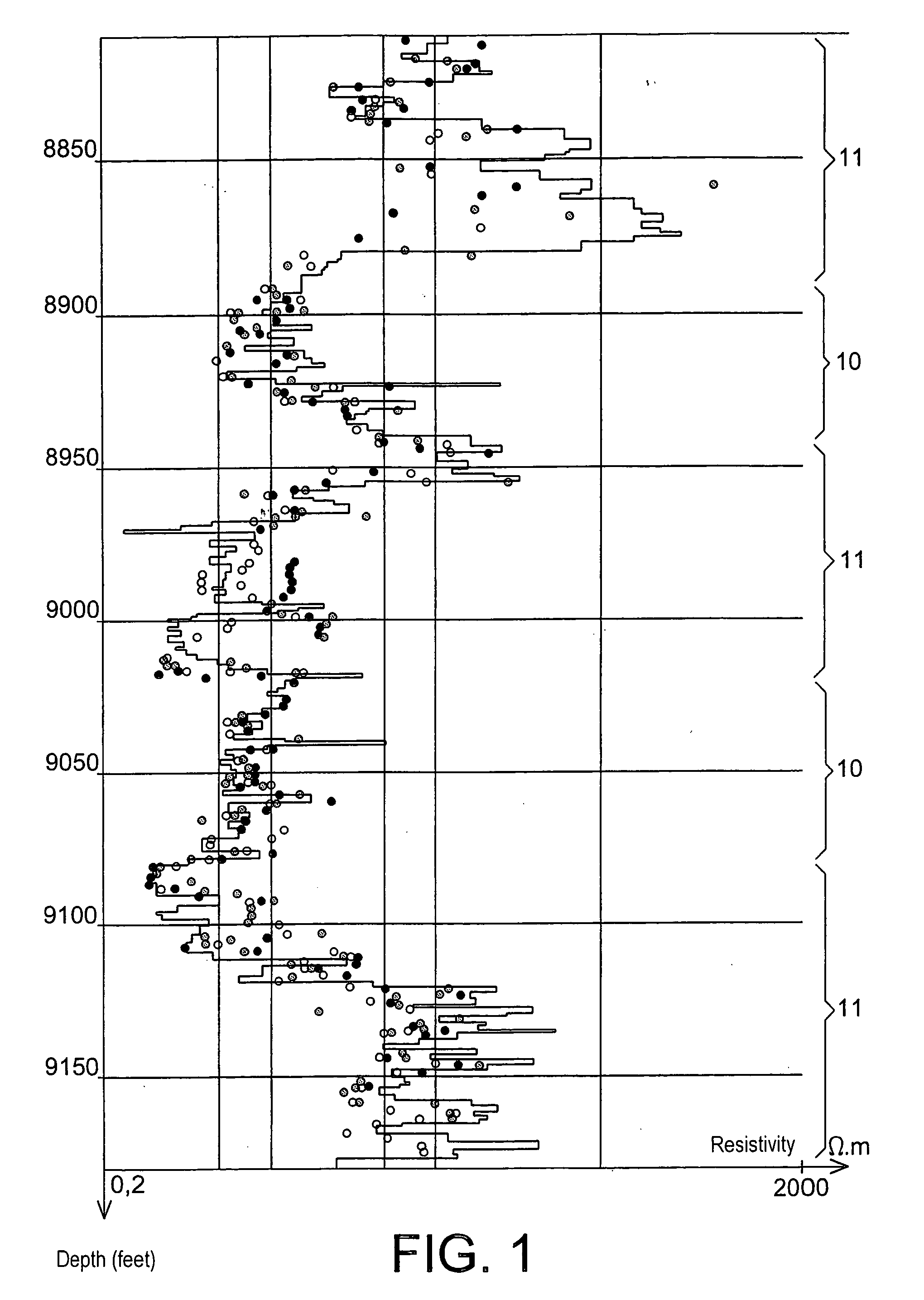
The invention concerns a method for determining the resistivity in a formation crossed by a cased well, in which one carries out at least one resistivity log in the cased well and one uses the results of at least one resistivity log in the non-cased well, carried out in the same well previously, in order to, in at least one zone (10) of the formation in which the resistivity has not changed between the cased and non-cased condition, deduce the value of a geometric factor k conditioning the resistivity and for determining, by means of said geometric factor k and the log in the cased well, the resistivity in at least one zone (11) different to the calibration zone, in which the resistivity has varied between the non-cased condition and the cased condition.

Description

TECHNICAL FIELD [0001] The invention concerns the determination of the resistivity in a geological formation crossed by a cased well. [0002] The importance of resistivity logs in oil exploration no longer needs to be demonstrated. It is known that the resistivity of a formation essentially depends on the fluid that it contains. A formation containing salty water, which is conductive, has a much lower resistivity than a formation full of hydrocarbons and, as a consequence, resistivity measurements have an indispensable value in locating hydrocarbon deposits. Resistivity logs have been very widely practised for a long time by means of electrode devices in non-cased wells, known as open holes. The presence in the well of a metallic casing that has an infinitesimal resistivity compared to the typical values for geological formations (around 2.10−7 Ω.m for a steel casing compared to 1 to 103 Ω.m for a formation) represents a barrier to sending electrical currents in the formations surrou...

Claims

the structure of the environmentally friendly knitted fabric provided by the present invention; figure 2 Flow chart of the yarn wrapping machine for environmentally friendly knitted fabrics and storage devices; image 3 Is the parameter map of the yarn covering machine
Login to View More

Application Information

Patent Timeline
19 Jan 2006
Publication
US20060015258A1
IPC
G06F19/00; G01V3/20
CPC
G01V3/20
Inventors
DUBOURG, ISABELLE; FAIVRE, OLLIVIER