Check patentability & draft patents in minutes with Patsnap Eureka AI!

System and method for progressively transform coding digital data

a digital data and coding technology, applied in the field of digital data processing, can solve the problems of low bit rate, dct producing irregularities and discontinuities in a reconstructed image, tiling or blocking artifacts, etc., and achieve the effect of fast processing and easy implementation

Inactive Publication Date: 2006-04-13
MICROSOFT TECH LICENSING LLC
View PDF3 Cites 16 Cited by
  • Summary
  • Abstract
  • Description
  • Claims
  • Application Information

AI Technical Summary

Benefits of technology

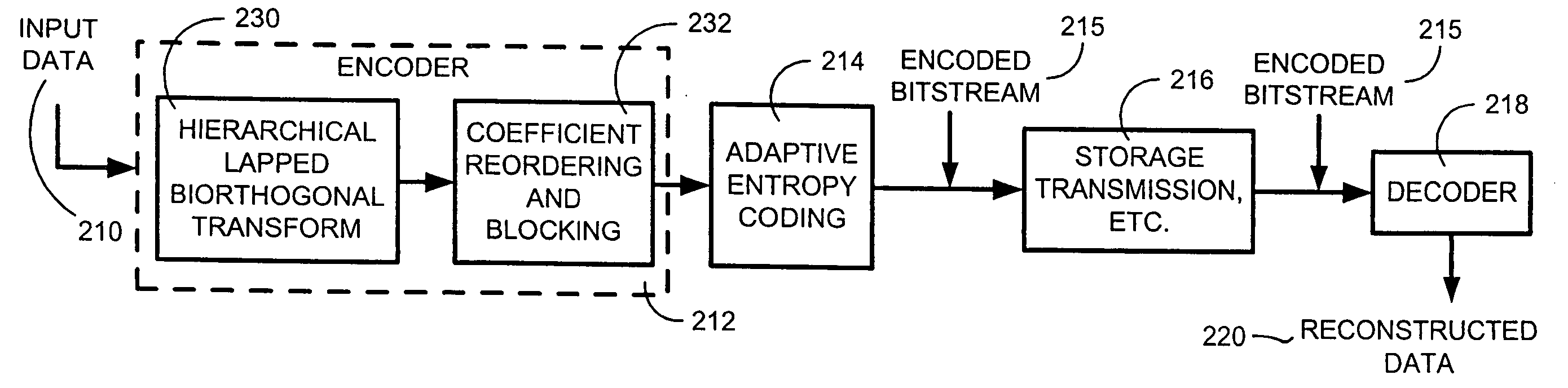
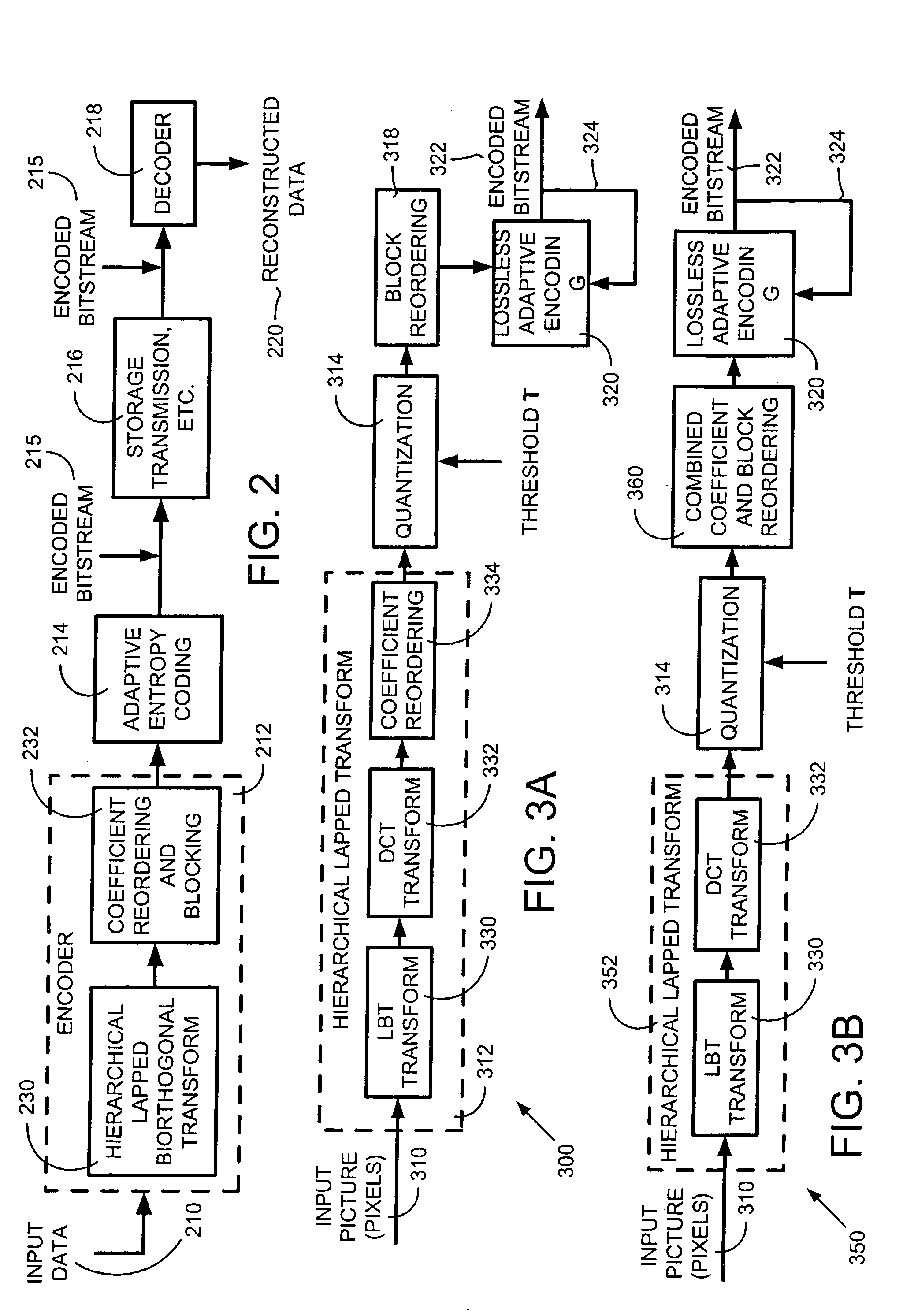
The present invention is a system and method for compressing image data using a lapped biorthogonal transform (LBT). This approach allows for efficient compression of image data at any desired ratio and utilizes existing software and hardware modules. The LBT allows for data compression without producing blocking artifacts and is faster than wavelet-based compression. The invention does not use zerotrees or other data-dependent data structures, simplifying the implementation process. The invention includes a transformation module, quantization module, reordering module, and encoding module, which work together to compress the image data. The invention also includes a method for decompressing the compressed data to obtain the original image data. The technical effects of the invention include improved image data compression and reduced blocking artifacts.

Problems solved by technology

Usually it is necessary to compress the digital images due to storage constraints and the desire to decrease access or download time of the picture.
For example, one disadvantage of JPEG is that at low bit rates the DCT produces irregularities and discontinuities in a reconstructed image (known as tiling or blocking artifacts).
These blocking artifacts cause an undesirable degradation in image quality.
Another disadvantage of JPEG is that JPEG cannot perform image reconstruction that is progressive in fidelity.
In other words, if an image is encoded at a certain fidelity and a lower fidelity is later desired (for example, due to limited bandwidth or storage availability), the image must be decoded and re-encoded.
These types of encoding, however, can be quite complex and use, for example, complex symbol tables (such as in adaptive Huffman encoding) or complex data structures (such as zerotree data structures) that depend on the data types.
Thus, most current WT-based techniques are complex and difficult to implement.
However, progressive WT-based compression still may be difficult to implement in some applications.
This additional cost and time associated with implementation can reduce the attractiveness of progressive WT-based compression.

Method used

the structure of the environmentally friendly knitted fabric provided by the present invention; figure 2 Flow chart of the yarn wrapping machine for environmentally friendly knitted fabrics and storage devices; image 3 Is the parameter map of the yarn covering machine
View more

Image

Smart Image Click on the blue labels to locate them in the text.
Viewing Examples
Smart Image
  • System and method for progressively transform coding digital data
  • System and method for progressively transform coding digital data
  • System and method for progressively transform coding digital data

Examples

Experimental program
Comparison scheme
Effect test

working example

VI. WORKING EXAMPLE

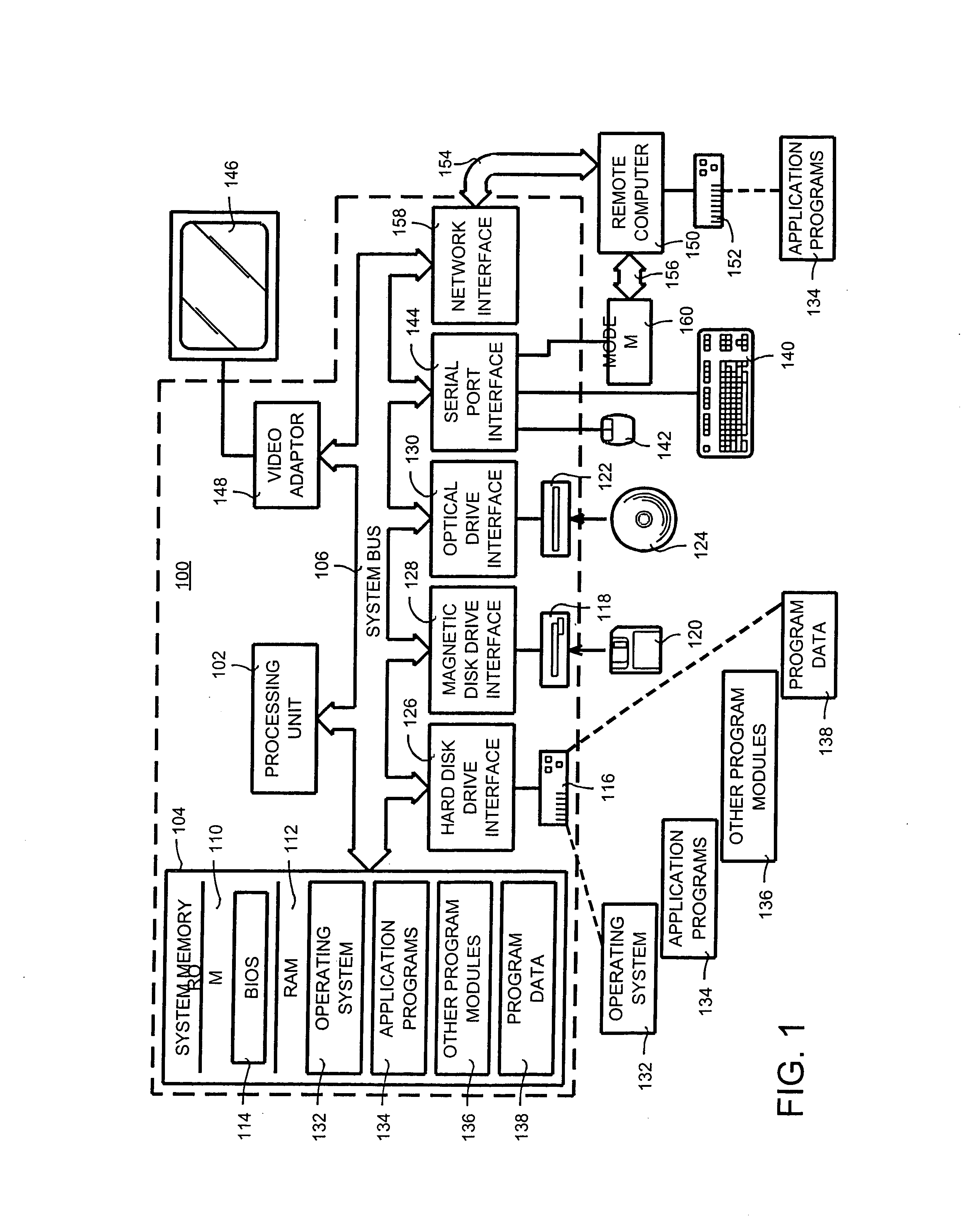
[0065]FIG. 7 is a working example represented by a flow diagram illustrating the detailed operation of the components of the hierarchical lapped transform (HLT) processor 500 of FIGS. 5 and 6. The HLT processor 500 begins and reads a buffer containing pixel data. In this example, the data within the buffer is grouped into K blocks of length N. The LBT module 510 takes the data within the buffer one block at a time (by setting a pointer) and computes K LBT transform blocks and LBT operators for the data pointed to by the pointer.

[0066] Next, in box 710, a number of DCT operators, L, is determined by dividing the number of blocks K by the number of DCT coefficients M. In addition, a vector u of length M is allocated in memory to receive the computed DCT coefficients. The HLT processor 500 then proceeds to the DCT module 520 where the DCT operators are computed and used to construct the vector u. In loop of box 720, a block is selected and a loop of box 730 is enter...

the structure of the environmentally friendly knitted fabric provided by the present invention; figure 2 Flow chart of the yarn wrapping machine for environmentally friendly knitted fabrics and storage devices; image 3 Is the parameter map of the yarn covering machine
Login to View More

PUM

No PUM Login to View More

Abstract

The present invention is embodied in a system and method for compressing image data using a lapped biorthogonal transform (LBT). The present invention encodes data by generating coefficients using a hierarchical LBT, reorders the coefficients in a data-independent manner into groups of similar data, and encodes the reordered coefficients using adaptive run-length encoding. The hierarchical LBT computes multiresolution representations. The use of the LBT allows the present invention to encode image data in a single pass at any desired compression ratio and to make use of existing discrete cosine transform (DCT) software and hardware modules for fast processing and easy implementation.

Description

BACKGROUND OF THE INVENTION [0001] 1. Field of the Invention [0002] The present invention relates in general to processing digital data, and in particular, to a system and method for progressively transform coding image data using hierarchical lapped transforms for compression of the image data. [0003] 2. Related Art [0004] Digital images are widely used in several applications such as, for example, imaging software, digital cameras, Web pages and digital encyclopedias. Usually it is necessary to compress the digital images due to storage constraints and the desire to decrease access or download time of the picture. Higher compression of a digital image means that more digital images can be stored on a memory device (such as diskette, hard drive or memory card) and these images can be transferred faster over limited bandwidth transmission lines (such as telephone lines). Thus, efficient and effective compression of images is highly important and desirable. [0005] One of the most pop...

Claims

the structure of the environmentally friendly knitted fabric provided by the present invention; figure 2 Flow chart of the yarn wrapping machine for environmentally friendly knitted fabrics and storage devices; image 3 Is the parameter map of the yarn covering machine
Login to View More

Application Information

Patent Timeline
no application Login to View More
Patent Type & Authority Applications(United States)
IPC IPC(8): G06K9/36G06T9/00
CPCG06F17/147H04N19/93H04N19/172H04N19/30H04N19/13H04N19/647H04N19/63H04N19/129H04N19/61H04N19/60H04N19/12H04N19/132H04N19/136H04N19/184H04N19/42H04N19/86H04N19/176
Inventor MALVAR, HENRIQUE S.
Owner MICROSOFT TECH LICENSING LLC
Features
  • R&D
  • Intellectual Property
  • Life Sciences
  • Materials
  • Tech Scout
Why Patsnap Eureka
  • Unparalleled Data Quality
  • Higher Quality Content
  • 60% Fewer Hallucinations
Social media
Patsnap Eureka Blog
Learn More