

User established variable image sizes for a digital image capture device
a digital image and image capture technology, applied in the field of digital image capture devices, can solve the problems of creating undesired image artifacts, unable to easily and automatically create images of non-standard sizes, etc., to achieve a higher quality, better high resolution image, and improved image quality
- Summary
- Abstract
- Description
- Claims
- Application Information
AI Technical Summary
Benefits of technology
Problems solved by technology
Method used
Image

Examples
third embodiment
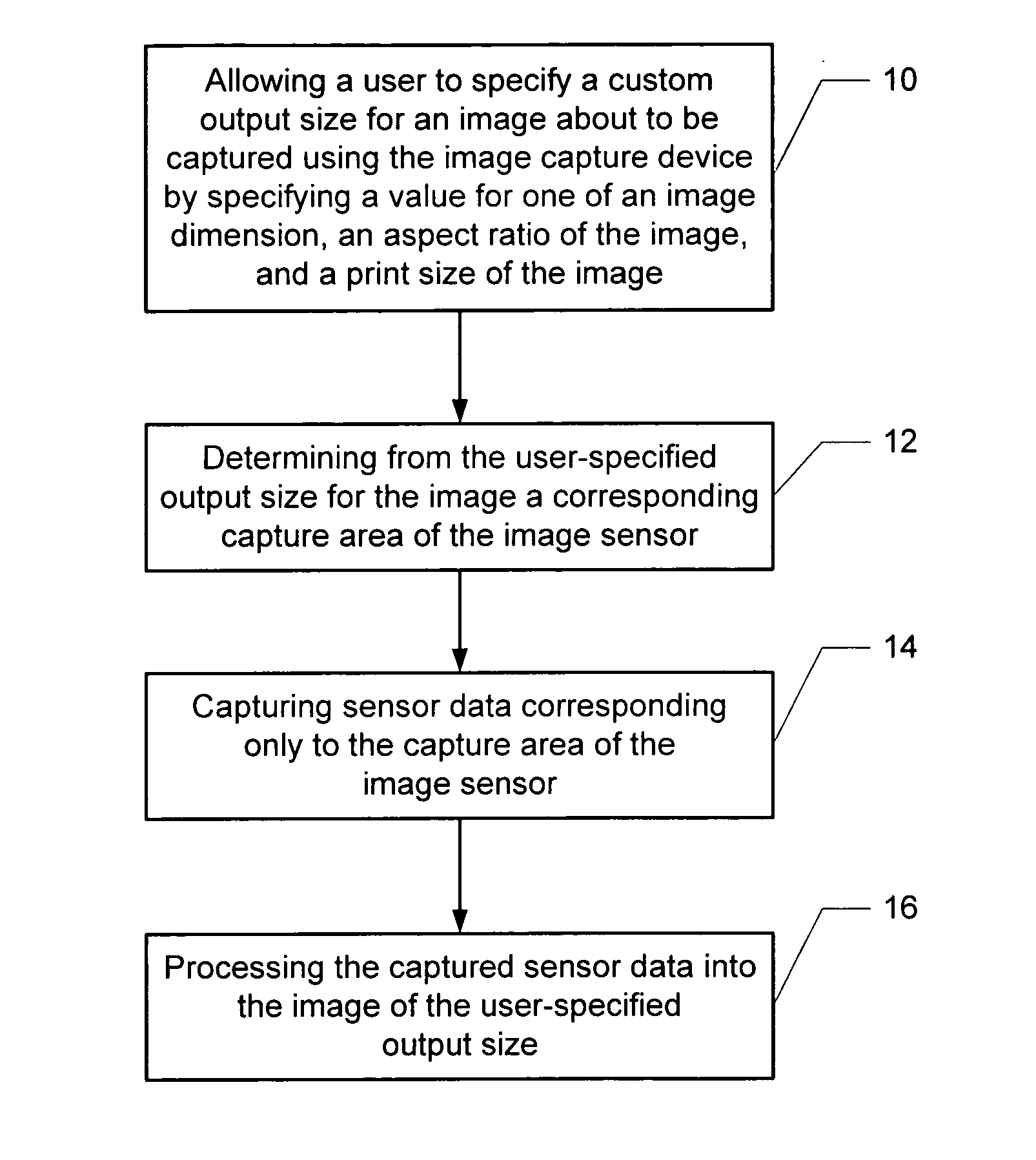
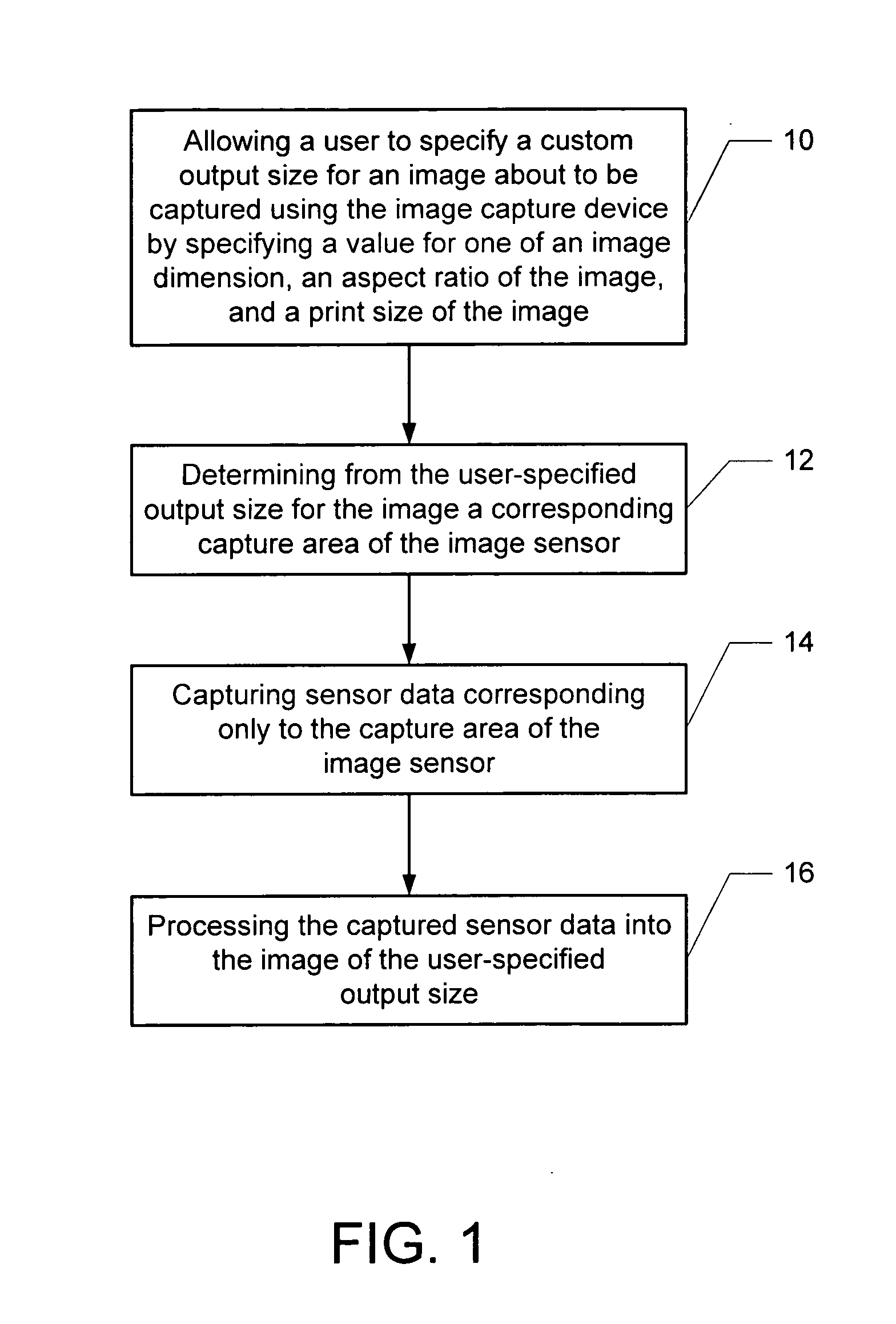
[0040] Alternatively, an aspect ratio field may be displayed on the Custom Size screen in lieu of, or in addition to, the pixel dimension fields 130 In this case, the pixel dimensions would be automatically calculated to use the maximum area of the sensor data consistent with the aspect ratio. In a third embodiment, all three fields can be shown, where the value in the aspect ratio field is calculated from pixel input from the user, and pixel values are calculated from the aspect ratio field. In this case, the user may enter either the pixel values or the aspect ratio value, and automatically view the calculation displayed in the other fields.
[0041] Referring again to FIG. 3, after the Custom Size screen is displayed, the user specifies the custom size by entering values in the displayed fields in step 206. In step 208, the processor 106 determines whether the user entered an invalid custom size. In embodiment, this is done by comparing the image size entered by the user with the ma...
second embodiment
[0045] In the present invention, the image capture data is provided with the ability to upscale or downscale the image data directly from the raw sensor data, rather than having to interpolate the data after image capture. The image data may be upscaled in the case where the user has specified a custom pixel size larger than the image sensor, or the image data may be downscaled in the case where the user specifies a size smaller than the image sensor. In the case where the custom size is larger than the image sensor, the image capture device calculates the aspect ratio from the custom size, and captures the image by only digitizing pixel values for the largest area of the image sensor possible that maintains the calculated aspect ratio, rather than process the entire pixel array. The raw data will be available to the interpolation / scaling algorithm to make maximum use of the sensor data to create the output image. Because the raw sensor data is available, and the scaling function ca...
PUM
 Login to View More
 Abstract
Description
Claims
Application Information
 Login to View More