
Control device of vehicular fuel cell system and related method
a fuel cell and control device technology, applied in climate sustainability, propulsion parts, process and machine control, etc., can solve problems such as incorrect discrimination, and achieve the effect of improving the fuel saving performance of a fuel cell powered vehicle and saving energy for warm-up
- Summary
- Abstract
- Description
- Claims
- Application Information
AI Technical Summary
Benefits of technology
Problems solved by technology
Method used
Image

Examples
first embodiment
[0021] First, referring to FIGS. 1 to 7, a control device of a vehicular fuel cell system and its related method of a first embodiment according to the present invention are described below in detail.
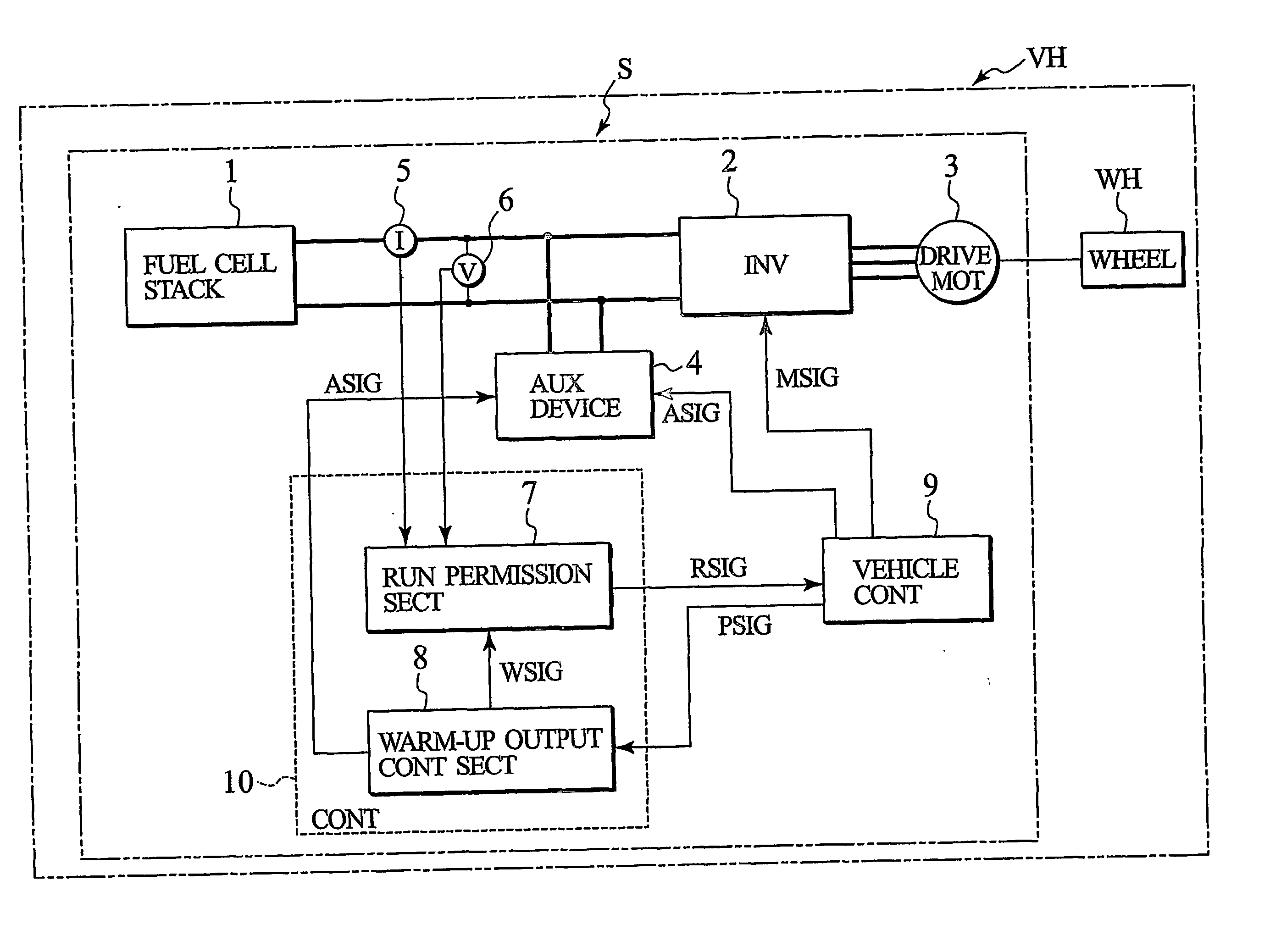
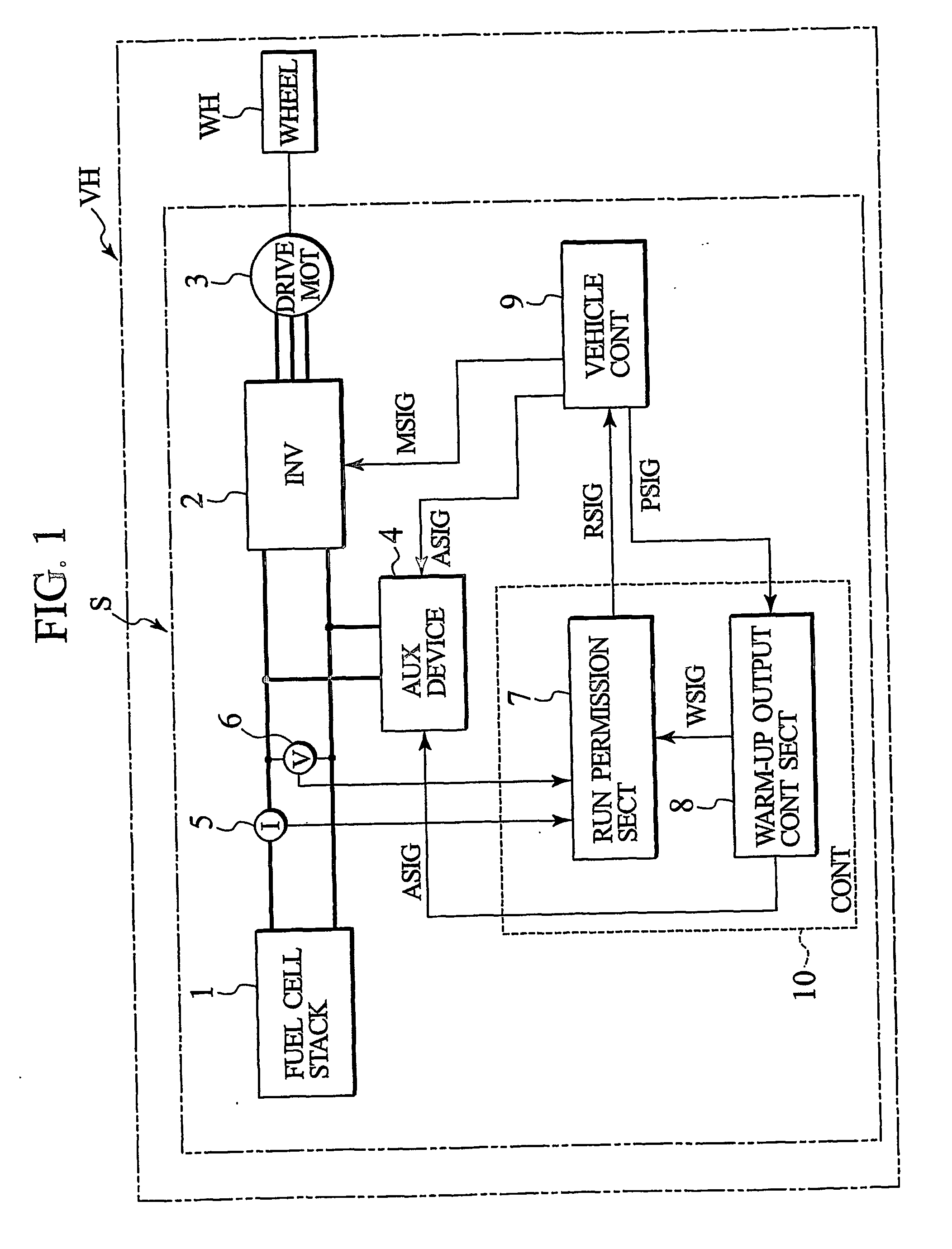
[0022]FIG. 1 is a block diagram showing a schematic structure of the vehicular fuel cell system of the presently filed embodiment.
[0023] In FIG. 1, the vehicular fuel cell system S is comprised of a fuel cell stack 1 that is supplied with fuel gas (hydrogen containing gas) and air (oxygen containing gas) to generate electric power, an inverter 2 converting DC power, delivered from the fuel cell stack 1, to AC power, a drive motor 3 supplied with AC power from the inverter 2 to drive wheels WH of a vehicle VH, an auxiliary device 4 that supplies the fuel cell stack 1 with air and coolant, an ammeter 5 that detects electric current of electric power generated by the fuel cell stack 1, a voltmeter 6 that detects voltage of electric power generated by the fuel cell stack 1, and a vehicle ...
second embodiment
[0074] Now, referring to FIGS. 8 to 10, detailed description is made of a control device of a vehicular fuel cell system and its related method of a second embodiment according to the present invention.
[0075]FIG. 8 is a flowchart showing the flow of start-up operation of a control device of a fuel cell system of the presently filed embodiment; FIG. 9 is a timing diagram illustrating variations in stack output, stack voltage and coolant temperature in terms of time during execution of start-up operation shown in FIG. 8; and FIG. 10 is a view illustrating the relationship between stack voltage and run available current of the presently filed embodiment. Also, start-up operation of the presently filed embodiment is executed in the same manner as that of the first embodiment shown in FIG. 1 except for operations in step S9 and step S10. Therefore, in the following description, description is mainly made of operations in step S9a and step S10a, associated with start-up operation of fuel...
PUM
| Property | Measurement | Unit |
|---|---|---|
| temperature | aaaaa | aaaaa |
| electric power | aaaaa | aaaaa |
| temperatures | aaaaa | aaaaa |
Abstract
Description
Claims
Application Information
 Login to View More