
Pharmaceutical compositions comprising factor VII polypeptides and factor XI polypeptides
a technology of polypeptides and pharmaceutical compositions, applied in the direction of drug compositions, peptide/protein ingredients, extracellular fluid disorder, etc., can solve the problems of multiple organ failure including impaired lung and kidney function, high levels of fxi, and the risk of transferring human viruses, so as to improve coagulation, improve the effect of coagulation, and enhance the formation of stable haemostatic plugs
- Summary
- Abstract
- Description
- Claims
- Application Information
AI Technical Summary
Benefits of technology
Problems solved by technology
Method used
Image

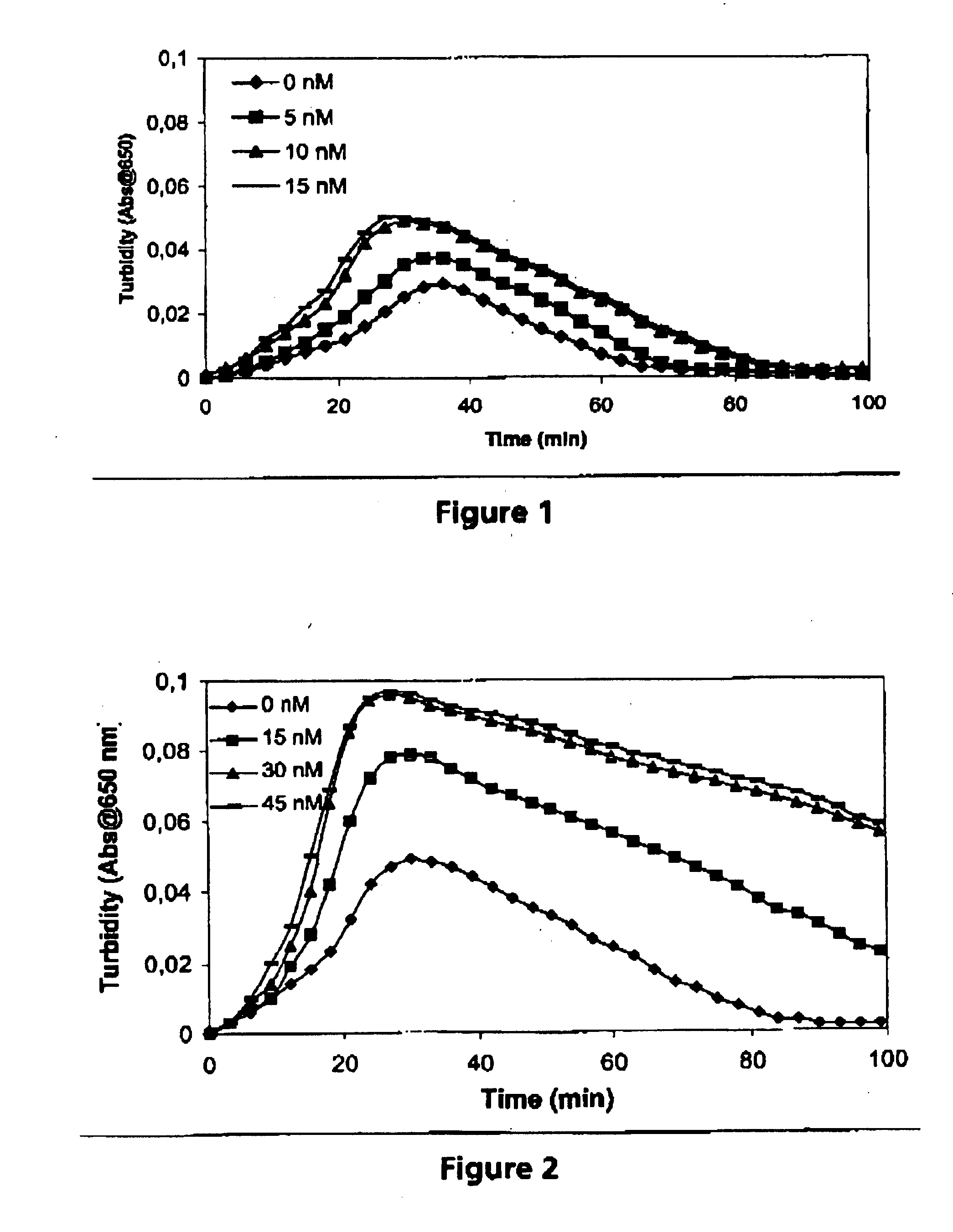
Examples
example 1
Improving Haemostatic Clot Stability by Combining Coagulation Factors VIIa and XI
Methods:
[0264] Clot lysis assay: Normal human plasma diluted 10-fold with buffer (20 mM HEPES, 150 mM NaCl, 5 mM CaCl, pH 7.4) containing Innovin (Dade Behring, 2000-fold dilution), rFVIIa (Novo Nordisk A / S, Bagsvaerd, Denmark; various concentrations) and t-PA (American Diagnostics, 8 nM) was added to 96-well ELISA plates and turbidity at 650 nm was measured over time at room temperature. Where indicated, purified human FXI (Haematologic Technologies, various concentrations) was included.
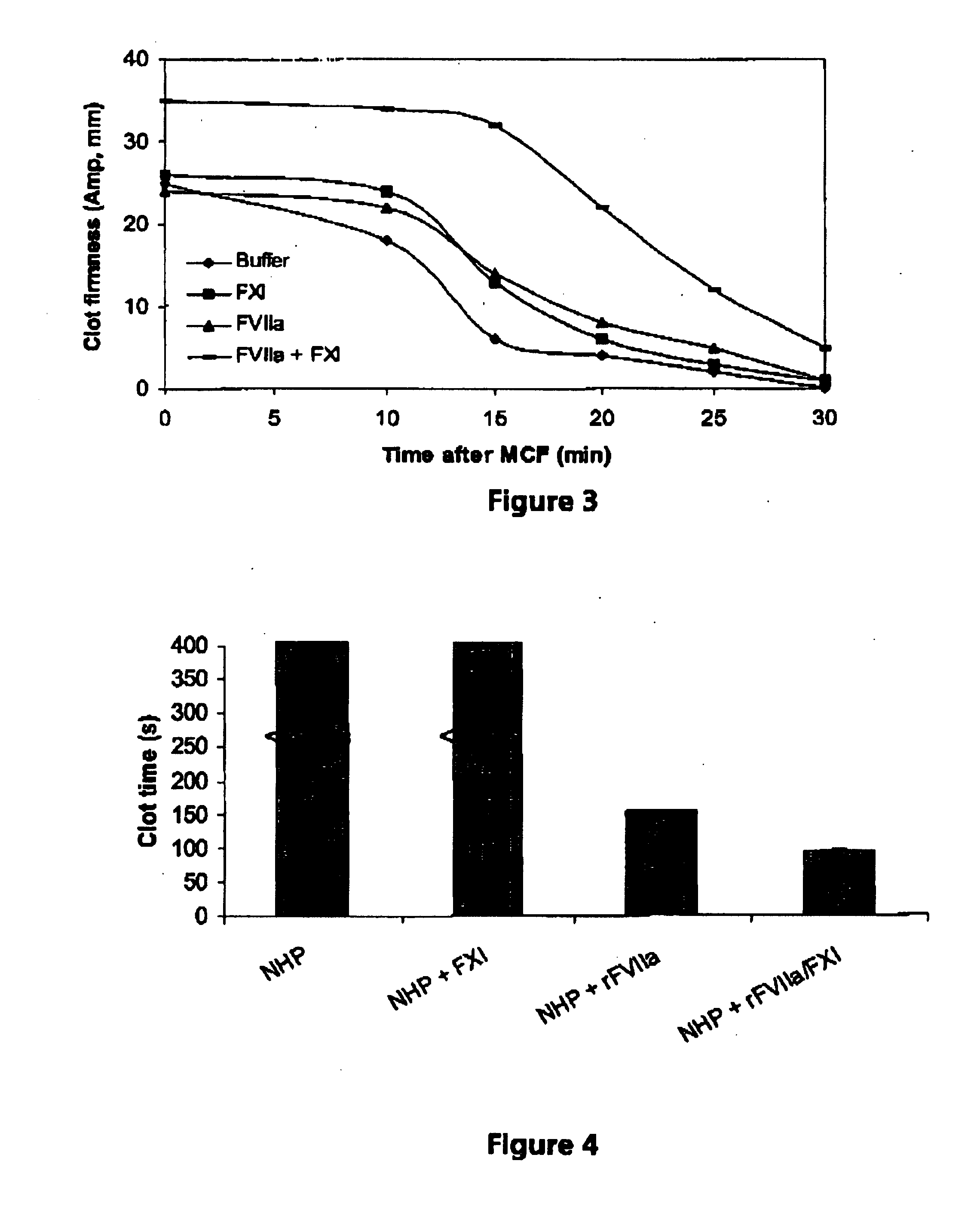
[0265] Rotatonal thromboelastography (roTEG): Measurements was conducted on citrated normal human plasma added 5 nM t-PA and the effect of addition of 1 nM FVIIa alone or in combination with 30 nM FXI (Haematologic Technologies) was analyzed. Clotting was initiated by addition of Innovin (final concentration 2000-fold diluted, Dade Behring # 526945) and calcium (final concentration 15 mM) in a 20 mM HEPES, 150 mM N...
example 2
Shortening the Clotting Time in Normal Human Plasma by Combining Coagulation Factors VIIa and XI
Methods:
[0269] Clot assay: Aliquots (55 μl) of rFVIIa (1 μg / ml) alone, FXI (25 nM) alone, or rFVIIa and FXI in 50 mM Pipes, 100 mM NaCl, 2 mM EDTA, 1% BSA, pH 7.2, were incubated for 5 min with a 55 μl aliquot containing 100 pM PC / PS vesicles and 50 mM CaCl2 in the same buffer. A 55 μl aliquot of normal human plasma (NHP) was then added and clotting followed for 400 seconds in an ACL clotting machine using the standard APTT program.
Results:
[0270] Clot assay: Prior to addition of rFVIIa or FXI, NHP did not clot within the 400 seconds monitoring time. Following addition of FXI (25 nM) the clotting time was still longer than 400 s. Addition of FVIIa (1 μg / ml) reduced the clot time to 159.4±1.4 seconds (FIG. 4). Addition of both FVIIa (1 μg / ml) and FXI (25 nM) reduced the clot time to 95.0±1.4 seconds (FIG. 4).
Conclusion:
[0271] These results demonstrate that FVIIa and FXI addition t...
PUM
| Property | Measurement | Unit |
|---|---|---|
| time | aaaaa | aaaaa |
| time | aaaaa | aaaaa |
| concentration | aaaaa | aaaaa |
Abstract
Description
Claims
Application Information
 Login to View More