
Aminoglycoside-polyamine displacers and methods of use in displacement chromatography
a technology of polyamine displacer and displacer molecule, which is applied in the field of aminoglycosidepolyamine, can solve the problems of low molecular weight displacers employed to date that possess moderate to high affinities, and cannot displace highly retained proteins on a variety of hydrophilic and hydrophobic resins
Inactive Publication Date: 2007-03-01
RENESSELAER POLYTECHNIC INST
View PDF6 Cites 2 Cited by
- Summary
- Abstract
- Description
- Claims
- Application Information
AI Technical Summary
Benefits of technology
[0004] A second aspect of the present invention is a method for separating one or more components of a biomolecule mixture by means of an ion exchange chromatographic system operated in the displacement mode, said
Problems solved by technology
However, the major obstacle in implementing this technique is the lack of a sufficient diversity of appropriate displacer candidates that are applicable across a wide spectrum of bioseparation demands.
Low molecular weight displacers employed to date possess moderate to high affinities, yet are unable to displace highly retained proteins on a variety of hydrophilic and hydrophobic resins.
Method used
the structure of the environmentally friendly knitted fabric provided by the present invention; figure 2 Flow chart of the yarn wrapping machine for environmentally friendly knitted fabrics and storage devices; image 3 Is the parameter map of the yarn covering machine
View moreImage
Smart Image Click on the blue labels to locate them in the text.
Smart ImageViewing Examples

Examples
Experimental program
Comparison scheme
Effect test
second embodiment
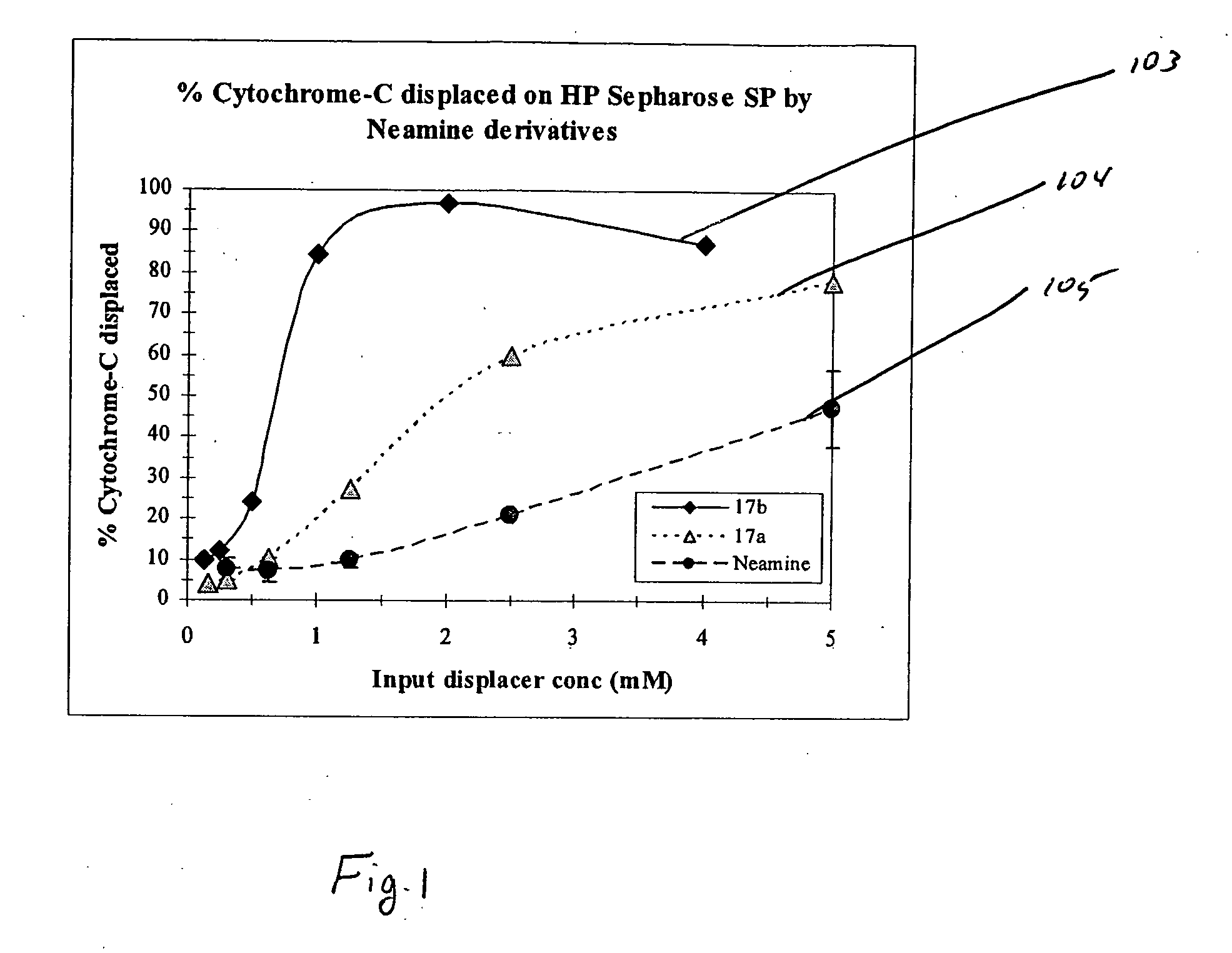
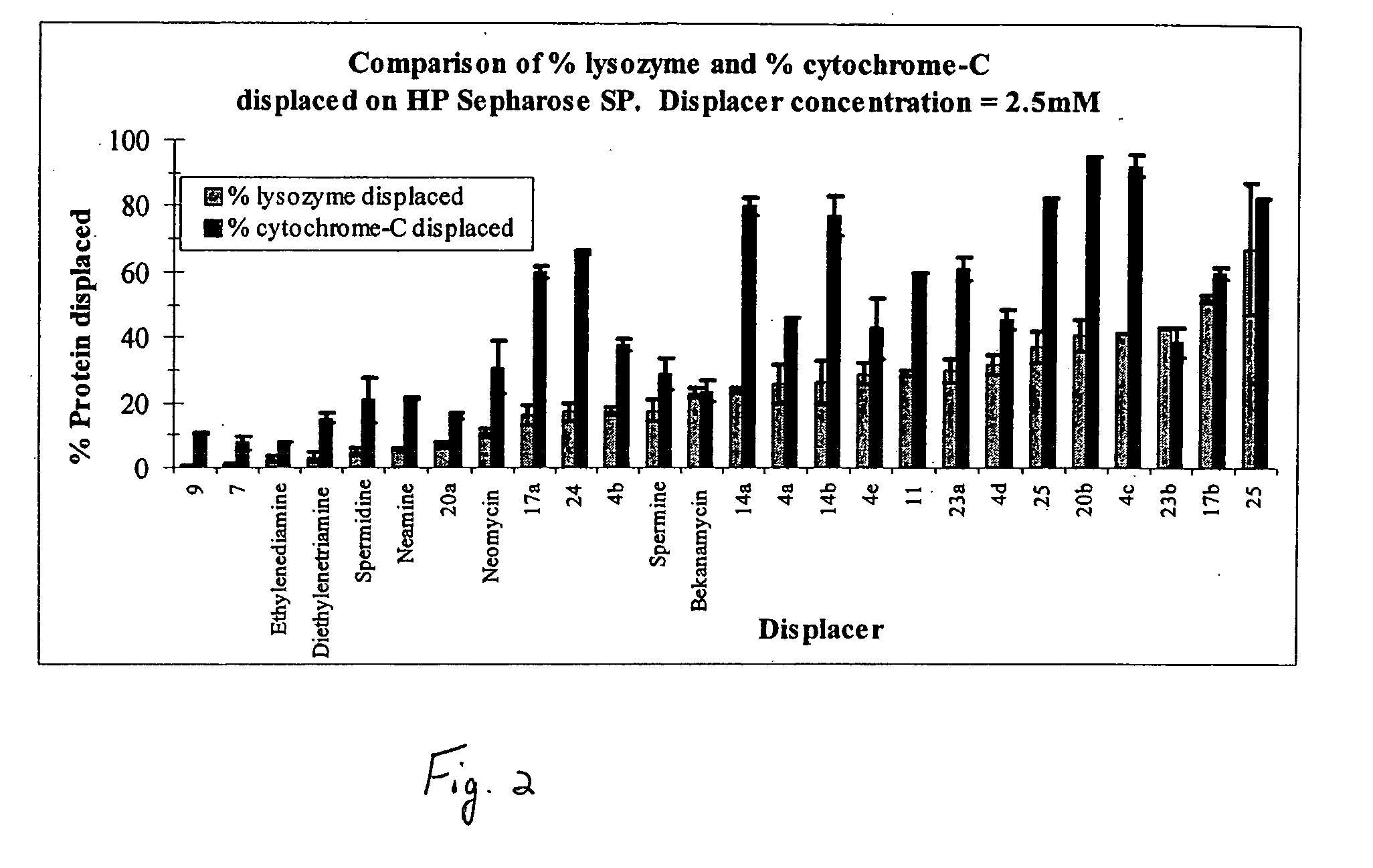
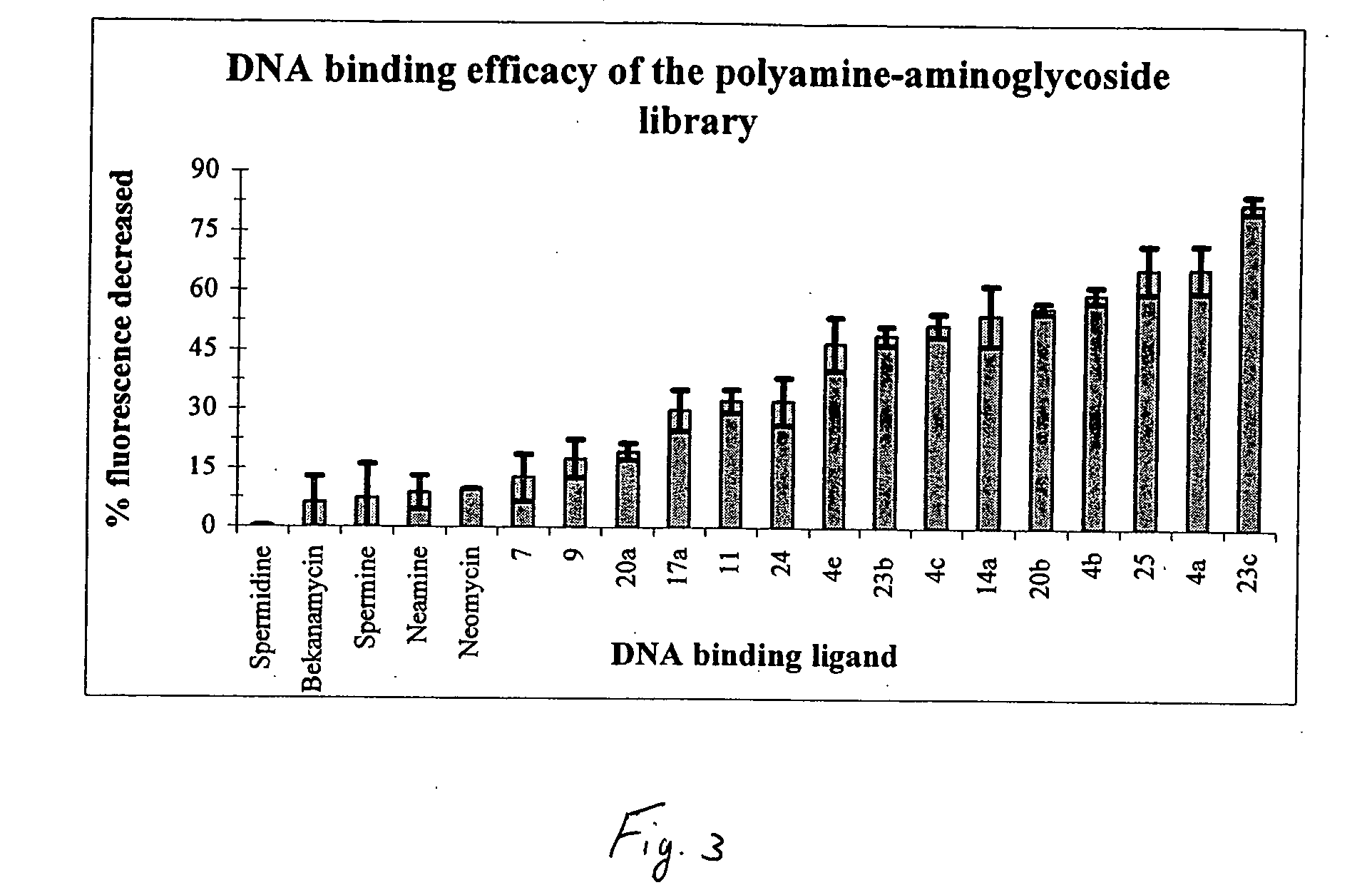
[0036] In the present invention, derivatives of the carbohydrate 2′-deoxyadenosine having the group of formula I are presented wherein R1 is —CH2CH2CH2NH(CH2)4NH(CH)3— and R2 is —NH2 (7); R1 is —CH2CH2CH2NH(CH2)4NH(CH)3— and R2 is —NH2 (9); and R1 is —CH2CH2CH2NH(CH2)4NH(CH)3— and R2 is —NH2 (11).
third embodiment
[0037] In the present invention, derivatives of the carbohydrate neomycin having the group of formula I are presented wherein R1 is —CH2CH2— and R2 is —NH2 (14a), and R1 is —CH2CH2NHCH2CH2— and R2 is —NH2 (14b).
fourth embodiment
[0038] In the present invention, derivatives of the carbohydrate neamine having the group of formula I are presented wherein R1 is —CH2CH2— and R2 is —NH2 (17a), and R1 is —CH2CH2CH2NH(CH2)4NH(CH2)3— and R2 is —NH2 (17b)
the structure of the environmentally friendly knitted fabric provided by the present invention; figure 2 Flow chart of the yarn wrapping machine for environmentally friendly knitted fabrics and storage devices; image 3 Is the parameter map of the yarn covering machine
Login to View More PUM
| Property | Measurement | Unit |
|---|---|---|
| Molar density | aaaaa | aaaaa |
| Concentration | aaaaa | aaaaa |
Login to View More
Abstract
Aminoglycoside-polyamines are disclosed along with methods of use thereof in displacement chromatography and as DNA-binding ligands. The aminoglycoside-polyamines are derivatives of carbohydrates, such as sugars, amino sugars, deoxysugars, glycosides, nucleosides and their substituted counterparts. The subject polyamines possess a group in place of at least one hydrogen atom of at least one hydroxyl group of the carbohydrate compound. In these compounds R1 is an alkyl group or an azaalkyl group, and R2 is a primary or secondary amino group.
Description
FIELD OF THE INVENTION [0001] The invention relates to aminoglycoside-polyamines, and methods of use thereof in displacement chromatography and as DNA-binding ligands. BACKGROUND OF THE INVENTION [0002] Displacement chromatography has attracted significant attention as a powerful technique for the purification of biotherapeutic proteins and oligonucleotides. In particular, low molecular weight (MW<2000) displacers have been shown to have significant advantages for high-resolution protein purification. Displacement chromatography enables simultaneous concentration and purification in a single step, which is significant in the purification of biopharmaceuticals. However, the major obstacle in implementing this technique is the lack of a sufficient diversity of appropriate displacer candidates that are applicable across a wide spectrum of bioseparation demands. Low molecular weight displacers employed to date possess moderate to high affinities, yet are unable to displace highly ret...
Claims
the structure of the environmentally friendly knitted fabric provided by the present invention; figure 2 Flow chart of the yarn wrapping machine for environmentally friendly knitted fabrics and storage devices; image 3 Is the parameter map of the yarn covering machine
Login to View More Application Information
Patent Timeline
 Login to View More
 IPC IPC(8): C07H21/00C07H19/16C08B37/00C07K1/10
CPCB01D15/362B01D15/422C07H13/04C07H15/224C07H21/00C07H15/232C07H15/236C07H19/16C07H15/226
InventorREGE, KAUSHALHU, SHANGHUIDORDICK, JONATHAN S.CRAMER, STEVEN M.
OwnerRENESSELAER POLYTECHNIC INST