
Metal oxynitride electrode catalyst
a technology of metal oxynitride and electrode catalyst, which is applied in the direction of metal/metal-oxide/metal-hydroxide catalyst, physical/chemical process catalyst, cell component, etc., can solve the problem of no attempts to use metal oxynitrides as electrode catalysts, and achieve high corrosion resistance
Inactive Publication Date: 2007-06-07
JAPAN SCI & TECH CORP
View PDF18 Cites 11 Cited by
- Summary
- Abstract
- Description
- Claims
- Application Information
AI Technical Summary
Benefits of technology
The present invention provides an electrode catalyst composed of metal oxynitrides that exhibits high corrosion resistance and oxygen reduction catalytic activity. The metal oxynitrides can be used at a potential of 0.4 V or higher relative to the reversible hydrogen electrode potential in an acidic electrolyte. The metal oxynitride electrode catalyst is dispersed as fine particles on a catalyst carrier which is an electronically conductive powder. The metal oxynitride electrode catalyst is used as an electrode catalyst for fuel cells using an acidic electrolyte.
Problems solved by technology
However, because of the high cost and limited reserves of platinum and since electrode catalysts having higher activity are required for fuel cells, alternative materials to platinum catalysts have been desired.
However, there have been no attempts to use metal oxynitrides as electrode catalysts.
Method used
the structure of the environmentally friendly knitted fabric provided by the present invention; figure 2 Flow chart of the yarn wrapping machine for environmentally friendly knitted fabrics and storage devices; image 3 Is the parameter map of the yarn covering machine
View moreImage
Smart Image Click on the blue labels to locate them in the text.
Smart ImageViewing Examples

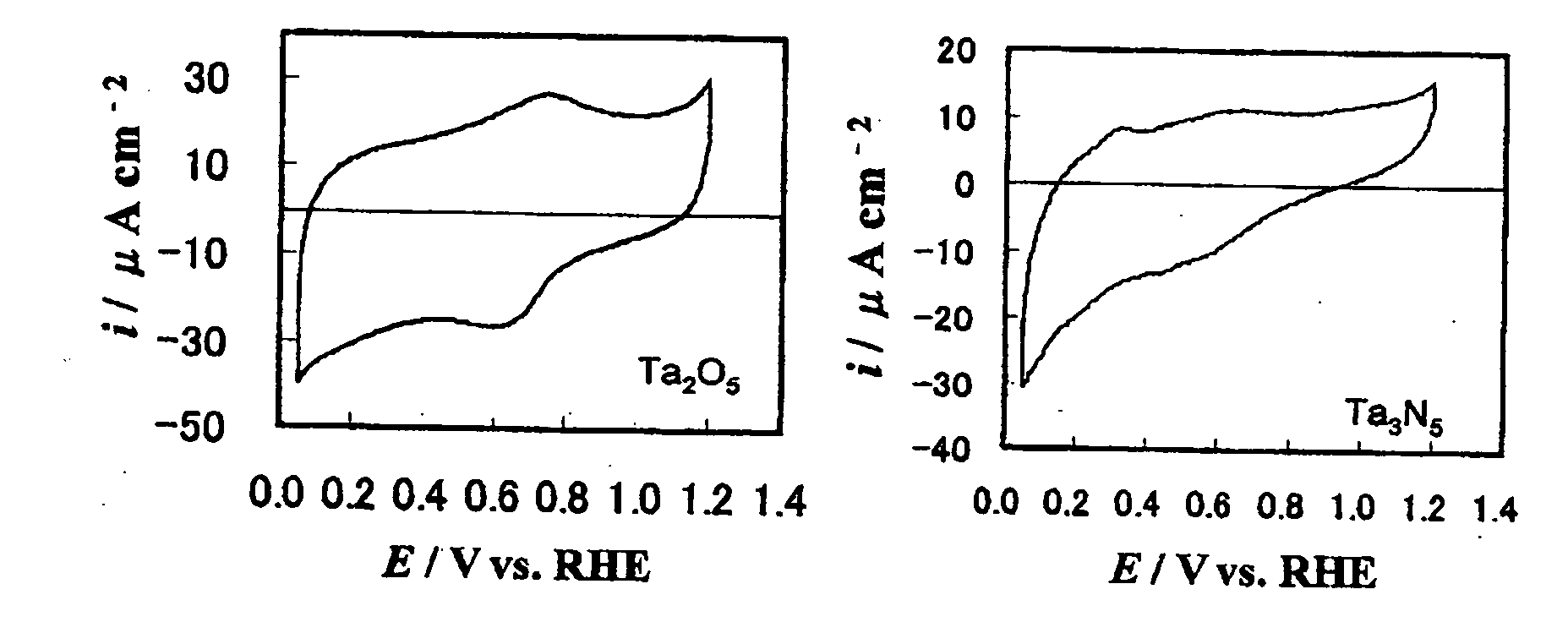
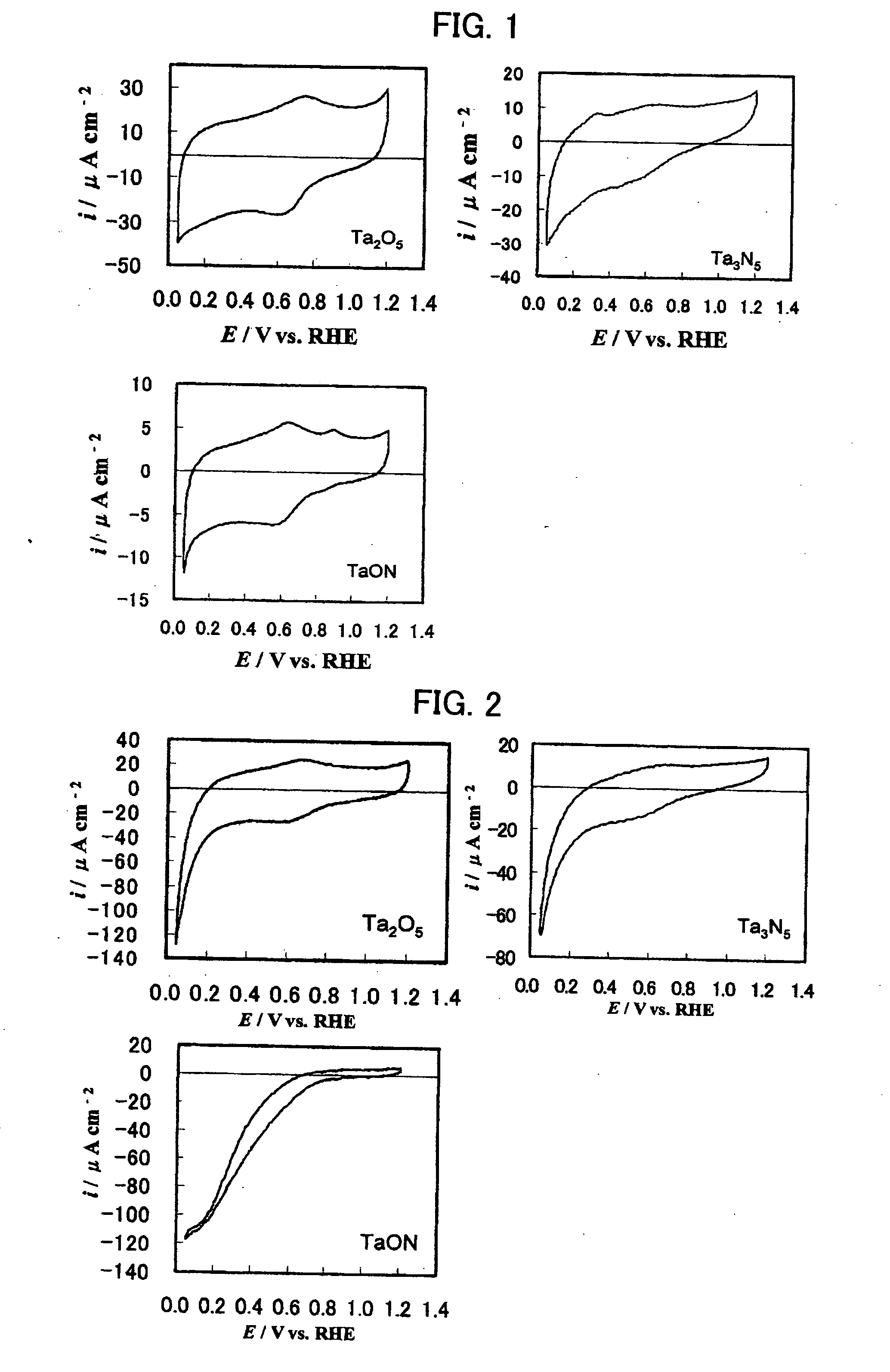
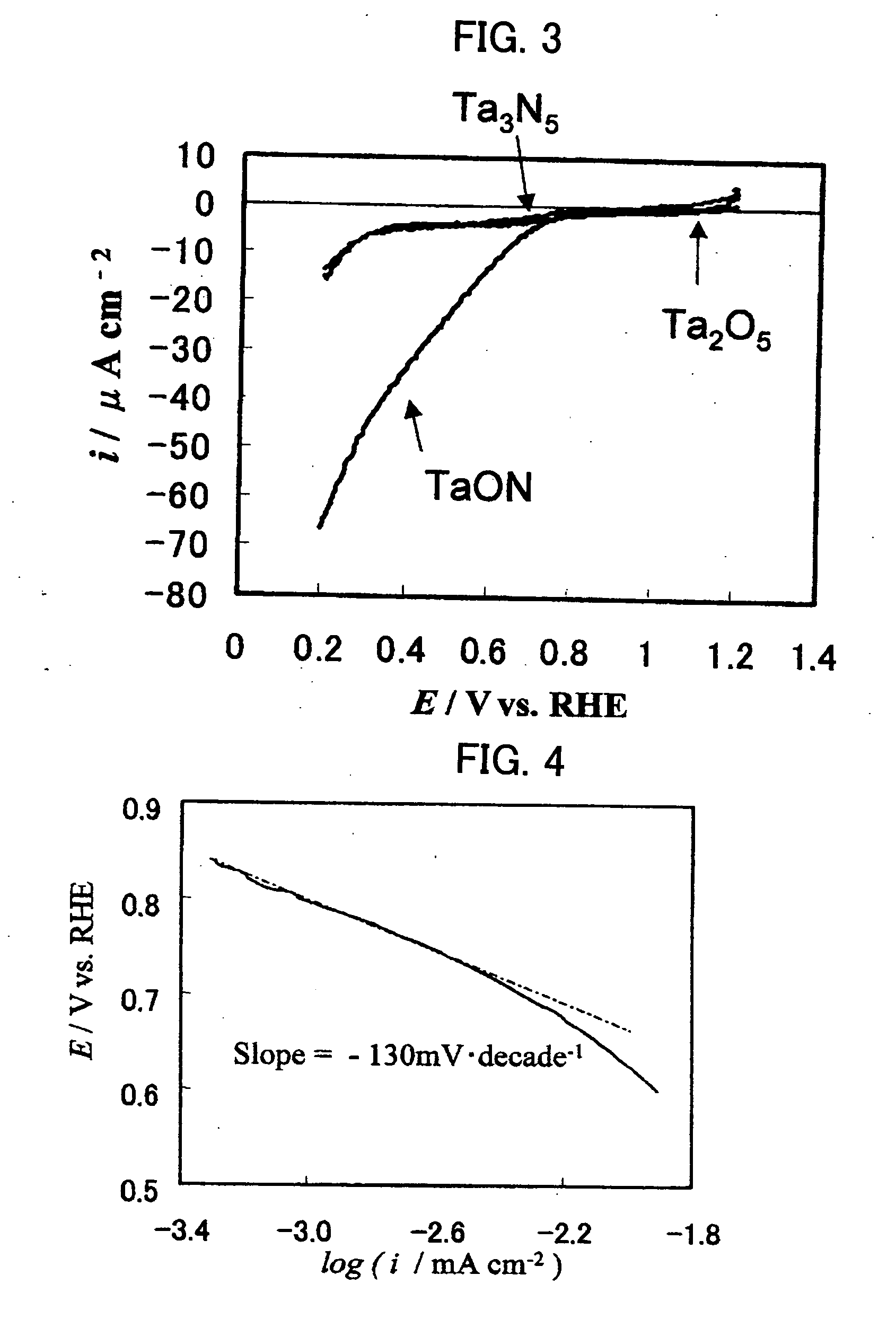
Examples
Experimental program
Comparison scheme
Effect test
example 1
[0025] A tantalum oxide Ta2O5 powder (manufactured by KOJUNDO CHEMICAL LABORATORY CO., LTD., purity 99.9%, average particle size 0.5 μm) was used as a starting material, enveloped in quartz wool so as to readily pass ammonia gas, and retained in a reaction tube. A mixed gas of ammonia (purity 99.999%), water vapor, and nitrogen was introduced into the reaction tube and left to stand until the gas flow became substantially steady (for about 60 minutes). Subsequently, nitriding was performed at 850° C. (heating rate: 10° C. / min), and the introduction of the mixed gas was stopped before nitriding completely proceeded. A tantalum oxynitride powder with a size of several hundred nanometers was obtained.
the structure of the environmentally friendly knitted fabric provided by the present invention; figure 2 Flow chart of the yarn wrapping machine for environmentally friendly knitted fabrics and storage devices; image 3 Is the parameter map of the yarn covering machine
Login to View More PUM
| Property | Measurement | Unit |
|---|---|---|
| reversible hydrogen electrode potential | aaaaa | aaaaa |
| electrode potential | aaaaa | aaaaa |
| temperature | aaaaa | aaaaa |
Login to View More
Abstract
[Problems] Carbides and many other non-platinum-based compounds are activated and dissolved and cannot be stably present in an acidic electrolyte under conditions of an electrode potential as high as 0.4 V or above, and thus, the application range of these compounds as an electrode catalyst is limited to low electrode potentials. There has been need for development of an electrode catalyst that maintains catalytic activity under these conditions and exhibits improved stability. [Means for Solving Problems] To provide a metal oxynitride electrode catalyst composed of an oxynitride containing at least one transition metal element selected from the group consisting of La, Ta, Nb, Ti, and Zr, the metal oxynitride electrode catalyst being used at a potential of 0.4 V or higher relative to the reversible hydrogen electrode potential in an acidic electrolyte. The metal oxynitride electrode catalyst is useful as an electrode catalyst for electrochemical systems used in acidic electrolytes in the fields of water electrolysis, organic electrolysis, fuel cells, etc.
Description
TECHNICAL FIELD [0001] The present invention relates to electrode catalysts for electrochemical systems used in acidic electrolytes in the fields of water electrolysis, organic electrolysis, fuel cells, etc. BACKGROUND ART [0002] Noble metals, in particular, platinum, are stable at high electrical potentials and have high catalytic activity for various reactions, and thus are used as electrode catalysts for various electrochemical systems. However, because of the high cost and limited reserves of platinum and since electrode catalysts having higher activity are required for fuel cells, alternative materials to platinum catalysts have been desired. [0003] Metal oxynitrides have been developed as photocatalysts that decompose water under visible light (e.g., Non-Patent Document 1 and Patent Document 1). However, there have been no attempts to use metal oxynitrides as electrode catalysts. [0004] Non-Patent Document 1: M. Hara et al., Catal. Today., 78,555 (2003) [0005] Patent Document ...
Claims
the structure of the environmentally friendly knitted fabric provided by the present invention; figure 2 Flow chart of the yarn wrapping machine for environmentally friendly knitted fabrics and storage devices; image 3 Is the parameter map of the yarn covering machine
Login to View More Application Information
Patent Timeline
 Login to View More
 Patent Type & AuthorityApplications(United States)
IPC IPC(8): H01L21/31B01J27/24C25B11/06H01M4/90H01M8/08
CPCB01J27/24H01M4/90H01M4/9016H01M8/086Y02E60/50C25B11/04C25B11/037C25B11/073B01J21/063B01J21/066B01J23/20
InventorOTA, KENICHIROKAMIYA, NOBUYUKIMITSUSHIMA, SHIGENORIISHIHARA, AKIMITSUDOUMEN, KAZUNARIHARA, MICHIKAZU
OwnerJAPAN SCI & TECH CORP