

1,4-Disubstituted Naphthalenes as Inhibitors of P38 Map Kinase
a technology naphthalene, which is applied in the field of 1,4-disubstituted naphthalene as inhibitors of p38 map kinase, can solve the problems of acute or chronic cellular stress that can lead to excess, unregulated, prolonged, or otherwise aberrant expression of pro-inflammatory cytokines
- Summary
- Abstract
- Description
- Claims
- Application Information
AI Technical Summary
Benefits of technology
Problems solved by technology
Method used
Image

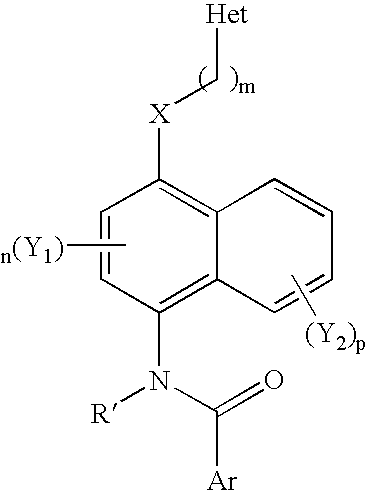
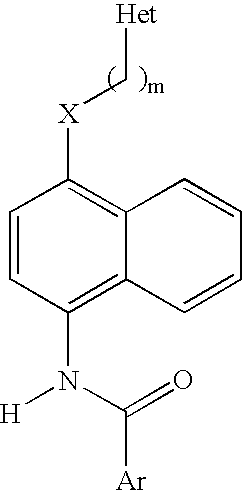
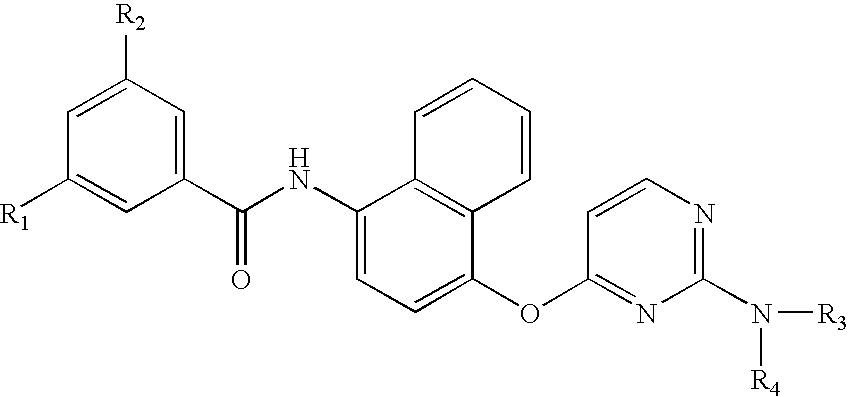
Examples
example 1
Step 1
[0154]
4-[2-(4-Nitro-naphthalen-1-yloxy)-ethyl]-morpholine. A mixture of 4-nitro-1-hydroxynaphthalene (10.0 g, 52.8 mmol), 4-(2-chloroethyl)-morpholine hydrochloride (13.77 g, 74.0 mmol), NaOH (3.0 g, 74.0 mmol), K2CO3 (17.53 g, 126.8 mmol) and 1-methyl-2-pyrrolidinone (400 ml) is heated to 90-100° C. and held for 2-3 hours. The mixture is cooled to 40° C. and water (300 ml) is added. The mixture is cooled to 0° C. and held for 4 hours. The product is collected by filtration, washed with water, cyclohexane and dried under vacuum to constant weight to yield 4-[2-(4-nitro-naphthalen-1-yloxy)-ethyl]-morpholine 14.73 g, 92.6%. 1H NMR (300 MHz, CDCl3) δ 8.80 (d, 1H), 8.38 (t, 2H), 7.75 (t, 1H), 7.63 (t, 1H), 6.84 (d, 1H), 4.40 (t, 2H), 3.75 (t, 4H), 3.0 l (t, 2H), 2.66 (t, 4H). MS: 303 (M+1).
Step 2
[0155]
4-(2-Morpholin-4-yl-ethoxy)-naphthalen-1-ylamine. A mixture of 4-[2-(4-nitro-naphthalen-1-yloxy)-ethyl]-morpholine (10 g, 33.0 mmol), MeOH (80 ml) and Pd / C (10%, 1.0 g) is shaken ...
example 2
Step 1
[0158]
3-Bromo-N-[4-(2-morpholin-4-yl-ethoxy)-naphthalen-1-yl]-benzamide. To a 40 ml vial is added 4-(2-morpholin-4-yl-ethoxy)-naphthalen-1-amine (1.5 g, 5.50 mmol), 3-bromobenzoic acid (1.66 g, 8.2 mmol), HBTU (3.13 g, 8.2 mmol) and Hunig's base (2.0 ml, 11.0 mmol). The mixture is dissolved in DMF (10 ml), flushed with argon, sealed and agitated at room temperature for 8 hrs. The crude mixture is diluted with water (100 ml) and partitioned with EtOAc (100 ml). The organic layer is washed with water (100 ml). The combined aqueous layers are extracted with EtOAc (2×50 ml). The combined organic layers are dried over sodium sulfate, filtered and concentrated under reduced pressure. The residue is purified by flash column chromatography (5% MeOH in ethyl acetate) to afford 3-bromo-N-[4-(2-morpholin-4-yl-ethoxy)-naphthalen-1-yl]-benzamide (1.27 g, 48%). MS: 455 (M+1).
General Procedure B
Step 2
[0159]
N-[4-(2-Morpholin-4-yl-ethoxy)-naphthalen-1-yl]-3-piperidin-1-yl-benzamide (Compou...
example 3
Step 1
[0160]
t-Butyl (4-hydroxy-1-naphthyl)carbamate. A mixture of 4-amino-1-naphthol hydrochloride (25.0 g, 128 mmol) and Amberlyst A-21 ion-exchange resin (37.0 g) in THF (600 ml) is stirred at room temperature for 4 h. Di-t-butyldicarbonate (27.9 g, 128 mmol) is then added. The mixture is stirred at room temperature for 18 h and filtered. The filtrate is concentrated and purified by silica gel column chromatography (30% EtOAc in hexane) to give t-butyl (4-hydroxy-1-naphthyl)carbamate (17.0 g) as a deep red solid. Mp: 172-174° C. MS: 260 (M+1).
Step 2
[0161]
t-Butyl (4-{[2-(methylthio)pyrimidin-4-yl]oxy}-1-naphthyl)carbamate. A mixture of t-butyl (4-hydroxy-1-naphthyl)carbamate (5.0 g, 19.3 mmol), 4-iodo-2-methylthiopyrimidine (4.86 g, 19.3 mmol) and cesium carbonate (7.52 g, 23.1 mmol) in DMF (25 ml) is heated at 70° C. for 20 h. The resulting mixture is diluted with CH2Cl2 (50 ml), washed with water (25 ml×3), dried over Na2SO4 and concentrated. This residue is dissolved in minim...
PUM
| Property | Measurement | Unit |
|---|---|---|
| concentration | aaaaa | aaaaa |
| concentration | aaaaa | aaaaa |
| concentration | aaaaa | aaaaa |
Abstract
Description
Claims
Application Information
 Login to View More