
Polymorphic forms of nateglinide
a nateglinide, polymorphic technology, applied in the separation/purification of carboxylic acid amides, applications, peptide/protein ingredients, etc., can solve the problems of unstable b-type crystals and easy change during grinding
- Summary
- Abstract
- Description
- Claims
- Application Information
AI Technical Summary
Benefits of technology
Problems solved by technology
Method used
Image

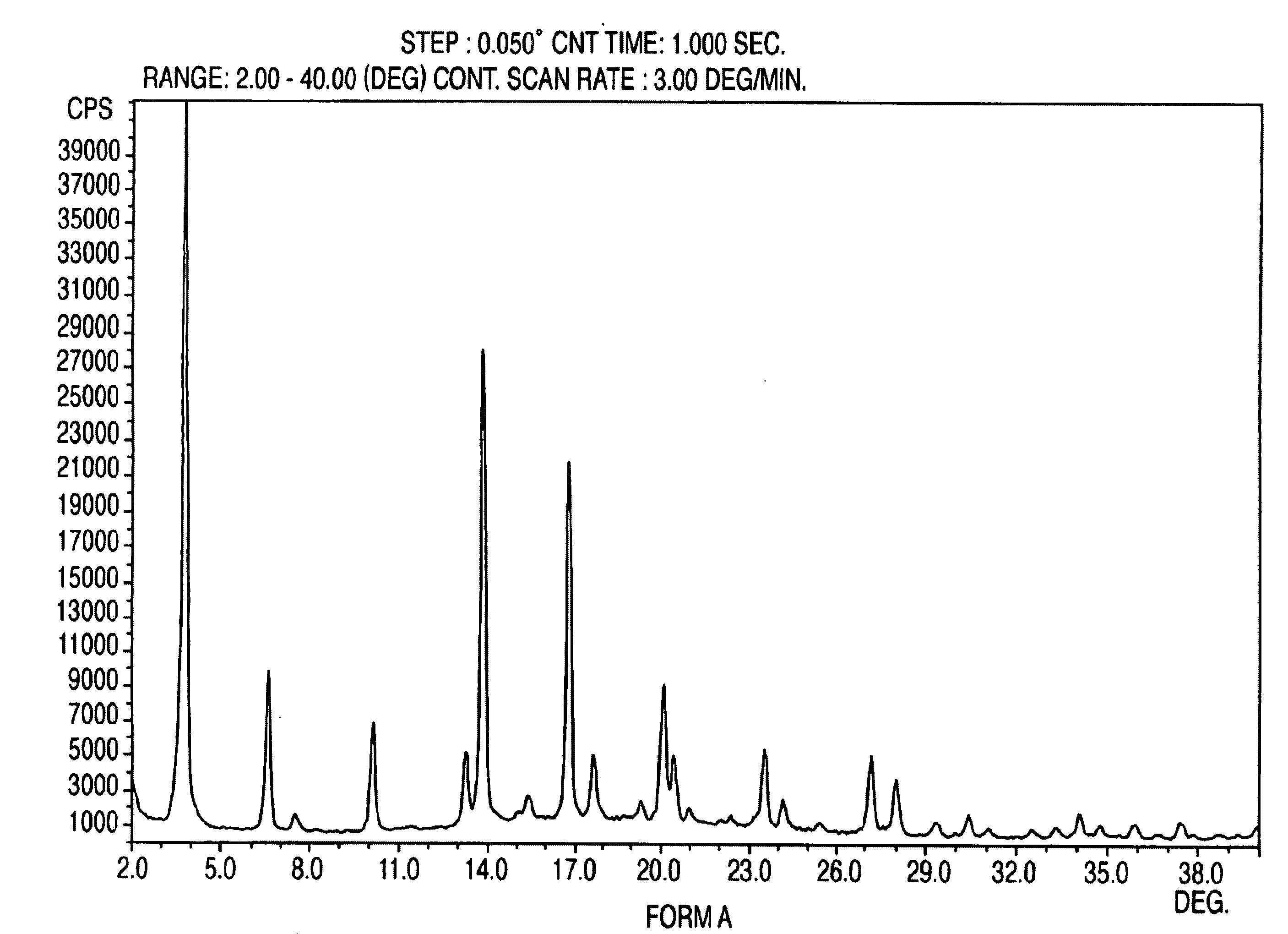
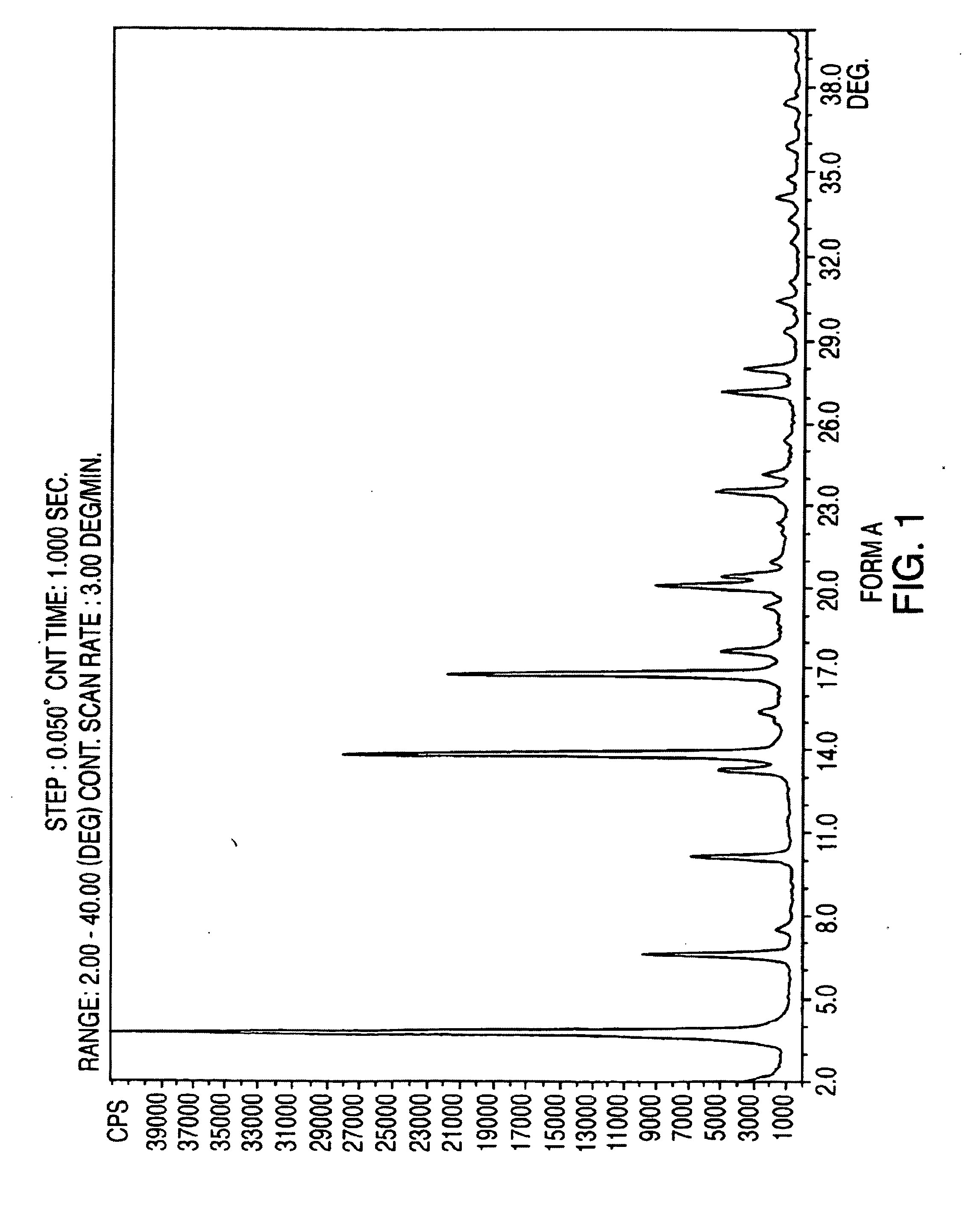
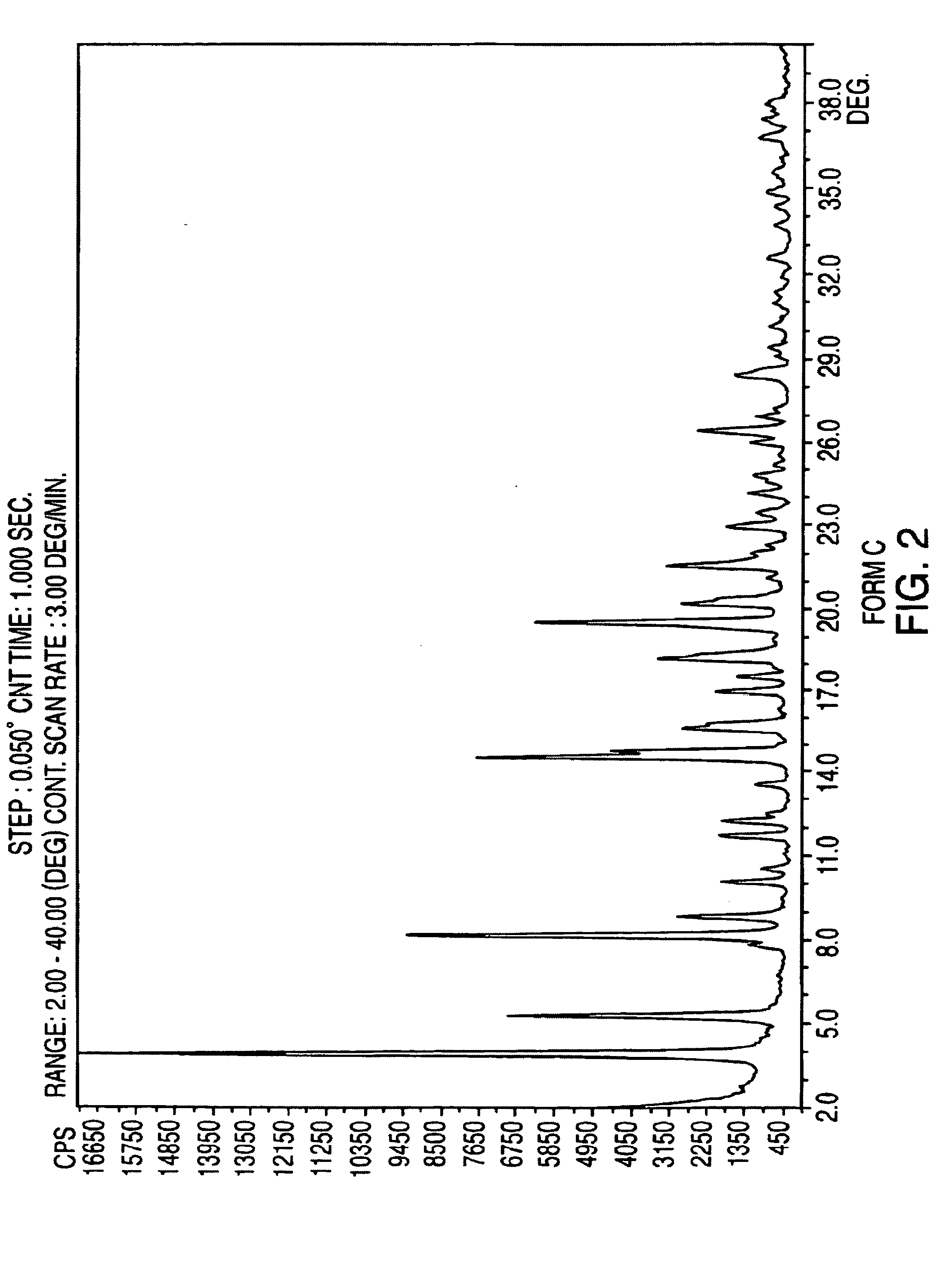
Examples
example 1
This Example Illustrates Preparation of Various Forms of Nateglinide from a Solution
[0174]Nateglinide (5 g) was placed into an erlenmeyer flask and heated to the specified temperature. The solvent was added in 1-ml portions (in some cases, the solvent was added in 5-ml portions) until a clear solution was obtained. If a clear solution was not obtained after addition of 150 ml of the solvent, the hot mixture was filtered.
[0175]The clear solution was left to crystallize at room temperature. If crystallization did not happen or was poor, the solution was refrigerated at 3° C. The precipitate was filtered off (at RT or at 5° C. depending on the temperature of the crystallization), weighed and divided into 2 equal parts. One part was dried at 50° C. under reduced pressure (20-30 mmHg) to constant weight (±0.01 g) for about 3-10 hours. Details are presented in Table IV.
TABLE IVData on crystallization of NTG from a single solventL / S,T,TimeTimeFormFormSolventml / g° C.RT, h3° C., hWetDryXylen...
example 2
This Example Illustrates Trituration of Nateglinide Form H and U in Various Solvents
[0176]Nateglinide (5 g) was placed into an Erlenmeyer flask. Solvent was added in 1-ml portions to prepare a stirrable mixture. The flask was stirred with a magnetic stirrer at room temperature. A solid was filtered off at room temperature, weighted, and divided into 2 equal parts. One part was dried at 55° C. under 20-30 mm / Hg pressure to constant weight (±0.01 g).
[0177]Details are presented in Tables V and VI.
TABLE VData on trituration of NTG with a single solventStartL / SFormFormFormSolventml / gTime, hwetdryHMeOH1.224TG + BHEtOH1.224DBHIPA1.224GG + BHn-1.223FBPrOHHn-1.424IBuOHHMeCN4.825PH + PHNM426εH + PHNMP0.824JβHDMF1.225KHDMA1.226CBHDME1.424VHHDioxane2.224δδHTHF0.823δδHDCM1.825YYHCHCl3125QQ + BHDCE1.824Q + HQ + H
TABLE VIData on trituration of NTG with a single solventStartL / SFormFormFormSolventml / gTime, hwetdryUAcOH1.824H + SH + SUMeOH1.224ααUEtOH1.624B + αB + αUIPA1.824G + SG + SUn-1.425FBPrOHUn...
example 3
This Example Illustrates Absorption of Solvent Vapors by Nateglinide
[0178]Nateglinide (3.50 g) was added to a polypropylene can and weighed. The can was introduced into a bigger polypropylene container containing a solvent, and stored at room temperature. The can was removed from the container and weighed (Wfinal). The can content was divided into 2 portions. One portion was dried at a temperature of 55° C. and a pressure of 20-30 mmHg to constant weight (±0.01 g). Details are presented in Table VII.
TABLE VIIData on absorption of solvent vapors with NTG Form HFormFormNTG W, gBrutto, gSolventTime, dWfinalΔwetdry3.5015.77EtOH416.290.52DB3.5015.94MeOH416.120.18OO3.5015.78Acetone415.860.08HH3.4951.86DCM451.900.04Y—3.5015.27Water415.290.02HHLegend.Brutto - starting weight of the can with NTG;Wfinal - final weight of the can with NTG after the exposure;Δ - overweight
PUM
 Login to View More
 Abstract
Description
Claims
Application Information
 Login to View More