

Immune regulatory oligonucleotide (IRO) compounds to modulate toll-like receptor based immune response
a technology of immune response and immune system, applied in the field of immunotherapy, can solve the problems of immune compromised subjects' uncontrolled stimulation of the immune system through tlrs, and achieve the effect of suppressing tlr9 activation and inhibiting thrombin activity
- Summary
- Abstract
- Description
- Claims
- Application Information
AI Technical Summary
Benefits of technology
Problems solved by technology
Method used
Image

Examples
example 1
Synthesis of Oligonucleotides Containing Immune regulatory Moieties
[0118]All IRO were synthesized according to standard procedures (see e.g. U.S. Patent Publication No. 20040097719).
[0119]Oligonucleotides were synthesized on a 1 μM scale using an automated DNA synthesizer (Expedite 8909; PerSeptive Biosystems, Framingham, Mass.), following standard linear synthesis or parallel synthesis procedures (see e.g. FIGS. 5 and 6 of U.S. Patent Publication No. 20040097719).
[0120]Deoxyribonucleoside phosphoramidites were obtained from (Aldrich-Sigma, St Louis, Mo.). 1′,2′-dideoxyribose phosphoramidite, propyl-1-phosphoramidite, 2-deoxyuridine phosphoramidite, 1,3-bis-[5-(4,4′-dimethoxytrityl)pentylamidyl]-2-propanol phosphoramidite and methyl phosphonamidite were obtained from Glen Research (Sterling, Va.). .beta.-L-2′-deoxyribonucleoside phosphoramidite, .alpha.-2′-deoxyribonucleoside phosphoramidite, mono-DMT-glycerol phosphoramidite and di-DMT-glycerol phosphoramidite were obtained from Ch...
example 2
Inhibition of TLR9 Stimulation
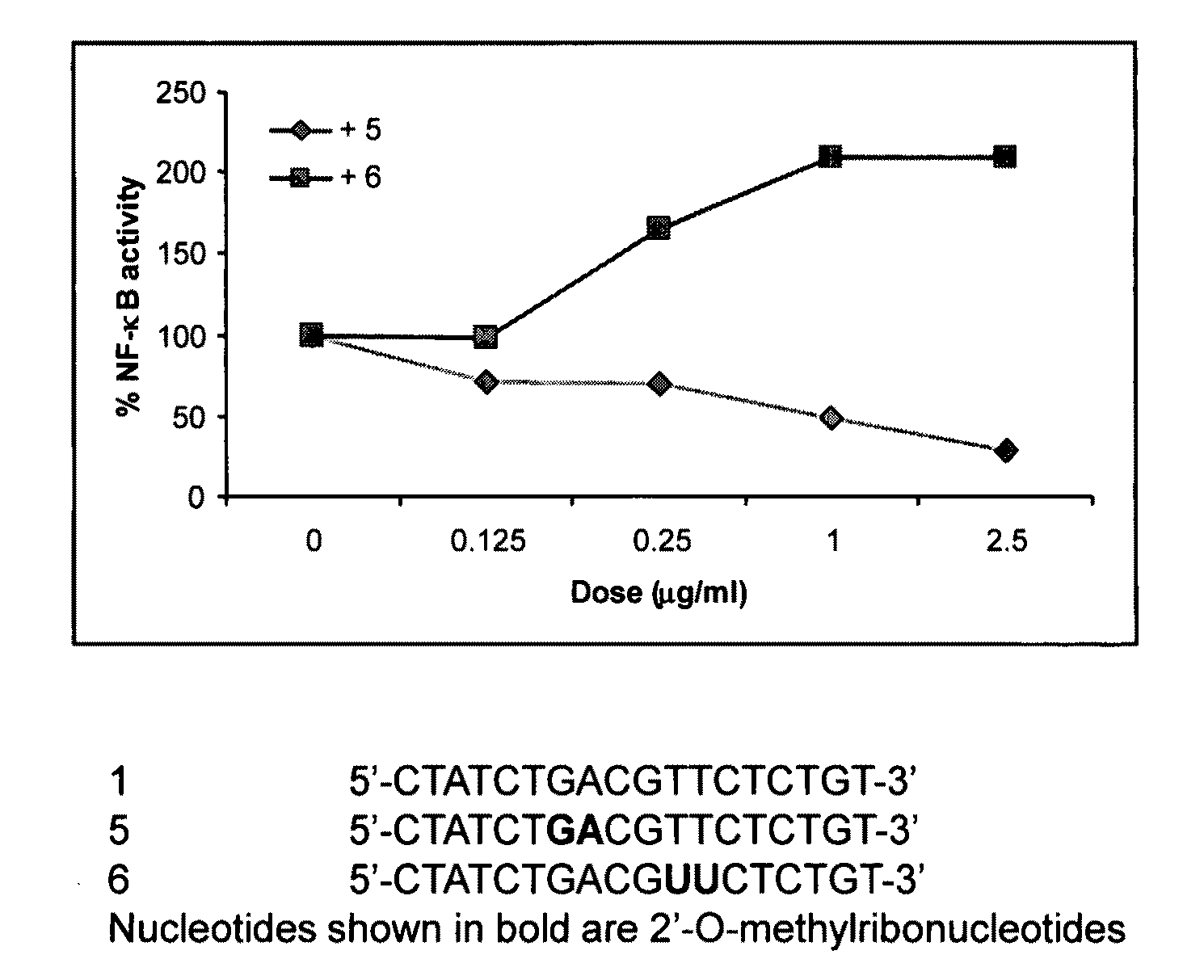
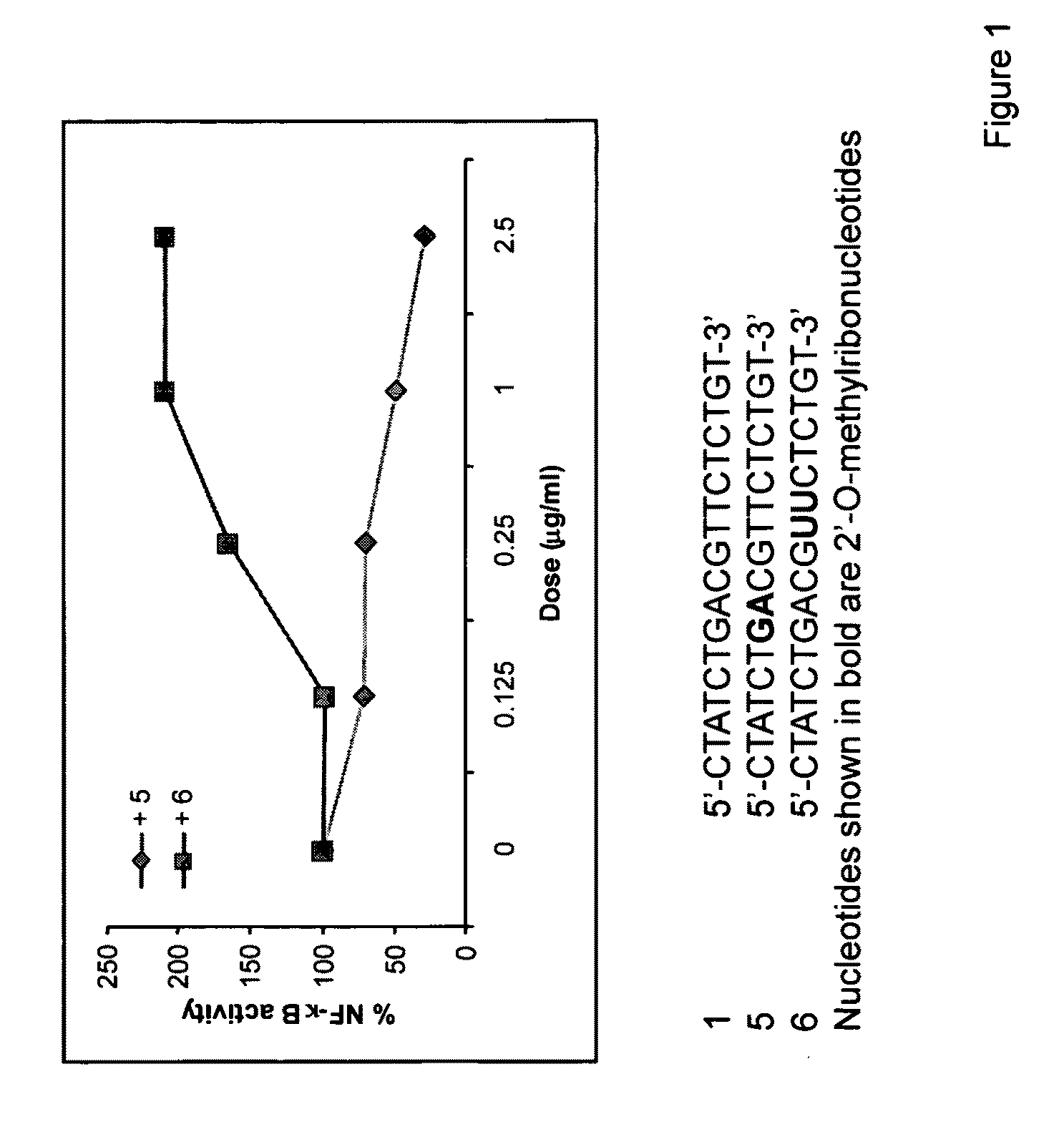
[0122]HEK293 cells stably expressing TLR9 (Invivogen) were transiently transfected with reporter gene, Seap, (Invivogen) for 6 hr. Cells were treated with 0.5 μg / ml 5′-CTATCTGACGTTCTCTGT-3′ (mouse CpG sequence; IMO / SEQ ID NO 1; 0 dose) alone and various concentrations of IRO 5 or 6 for 18 hr. TLR9-dependent reporter gene expression was determined according to the manufacturer's protocol (Invivogen) and the results are expressed as % activity of TLR9 stimulating oligonucleotide (100%). The results are shown in FIG. 1. These results demonstrate that IRO 5 inhibited TLR9 agonistic activity of IMO.
example 3
IRO Specifically Inhibit TLR9 Stimulation
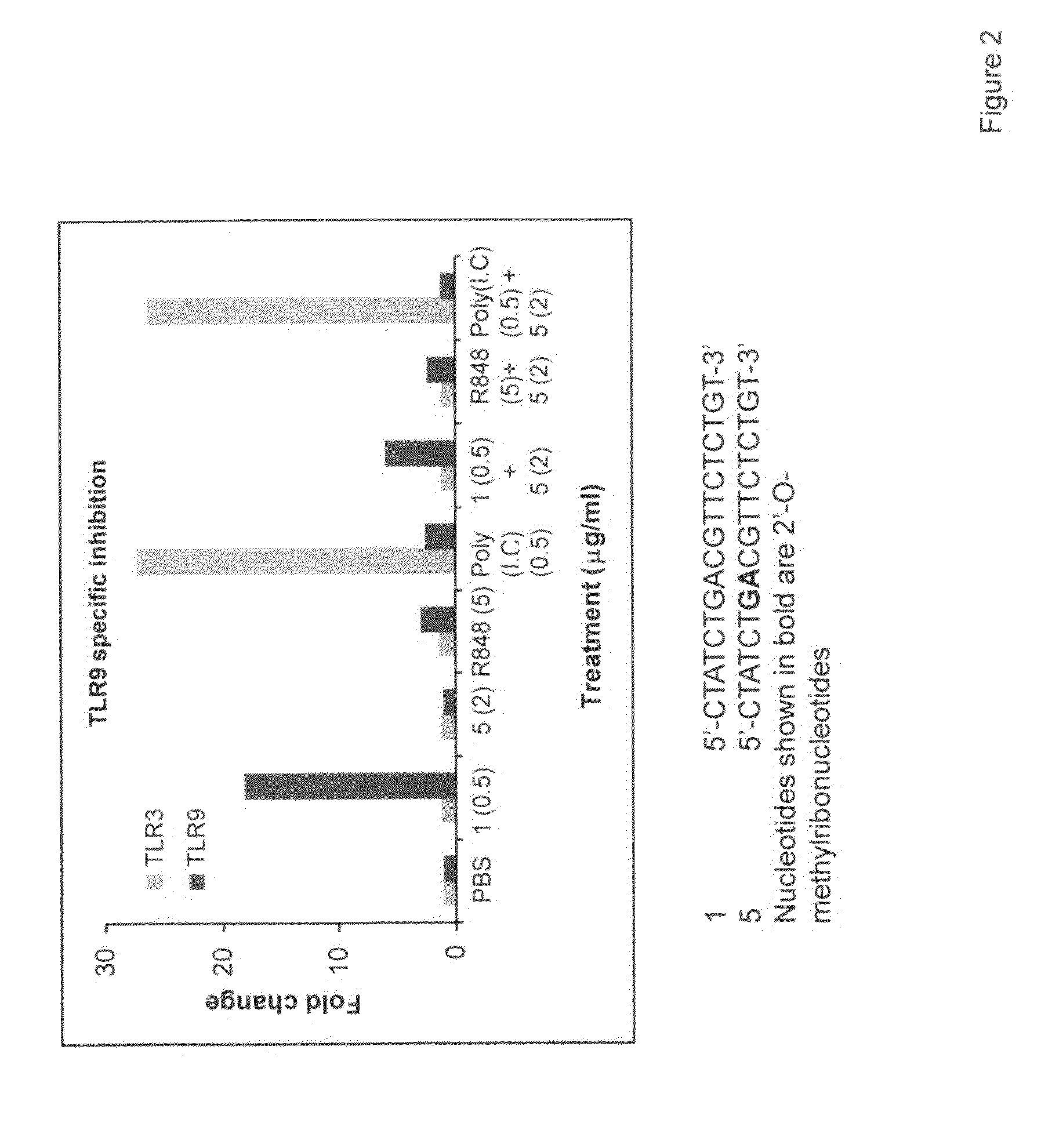
[0123]HEK293 cells stably expressing TLR9 or TLR3 (Invivogen) were transiently transfected with reporter gene, Seap, (Invivogen) for 6 hr. Cells were treated with 0.5 mg / ml IMO1 (0.5 μg / ml), IRO 5 (2.0 μg / ml), R848 (5.0 μg / ml), or poly (I).poly(C) (0.5 μg / ml) and combinations of IMO+IRO, R848+IRO, or poly(I).poly(C)+IRO for 18 hr. TLR9- or TLR3-dependent reporter gene expression was determined according to the manufacturer's protocol (Invivogen) and the results are expressed as fold change in NF-kB activity. The results are shown in FIG. 2. These results demonstrate that IRO 5 inhibits the activity of the TLR9 agonist but not agonist of TLR3, and more generally that IRO's can selectively inhibit TLR activation.
PUM
| Property | Measurement | Unit |
|---|---|---|
| Force | aaaaa | aaaaa |
| Structure | aaaaa | aaaaa |
Abstract
Description
Claims
Application Information
 Login to View More