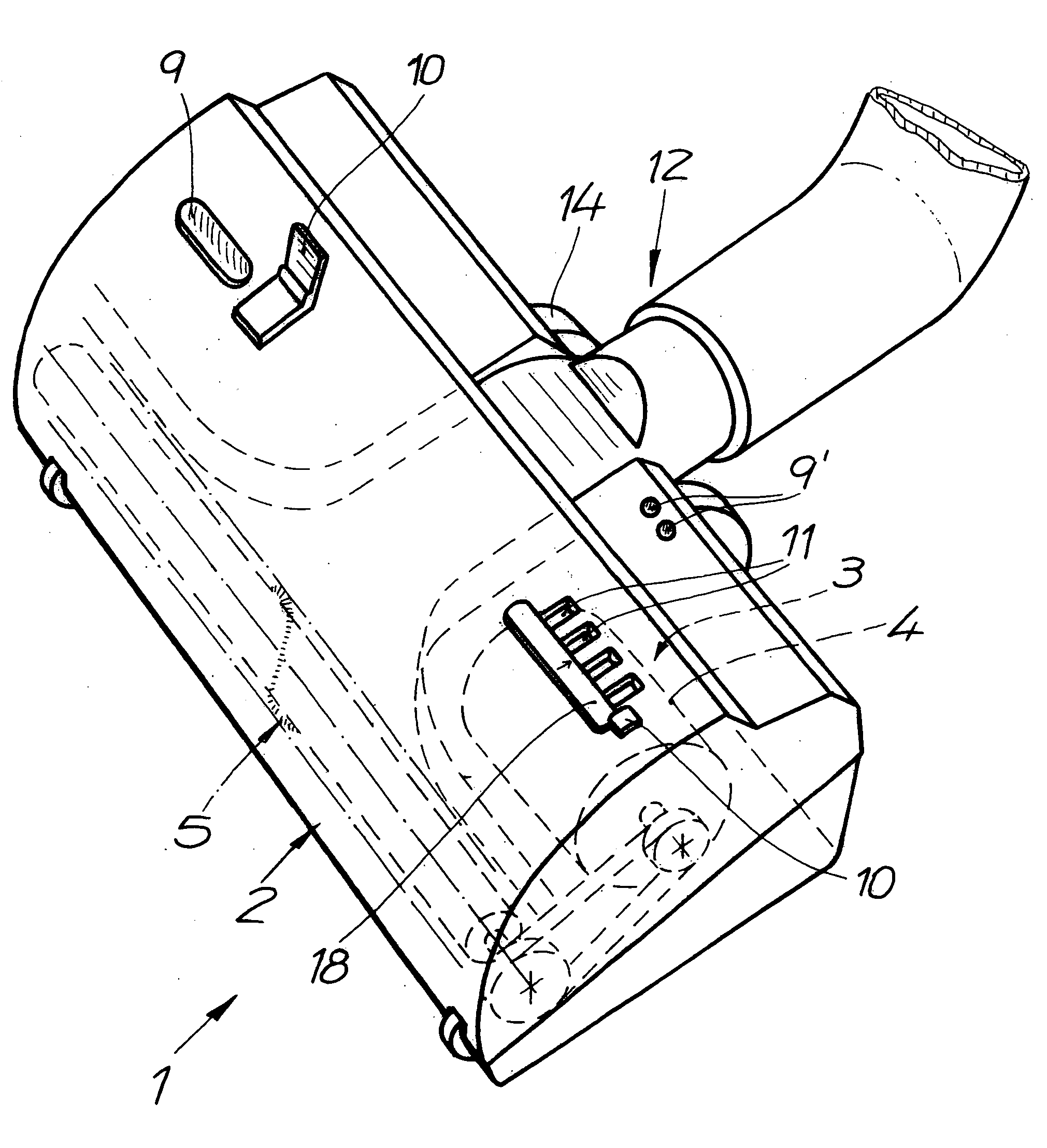
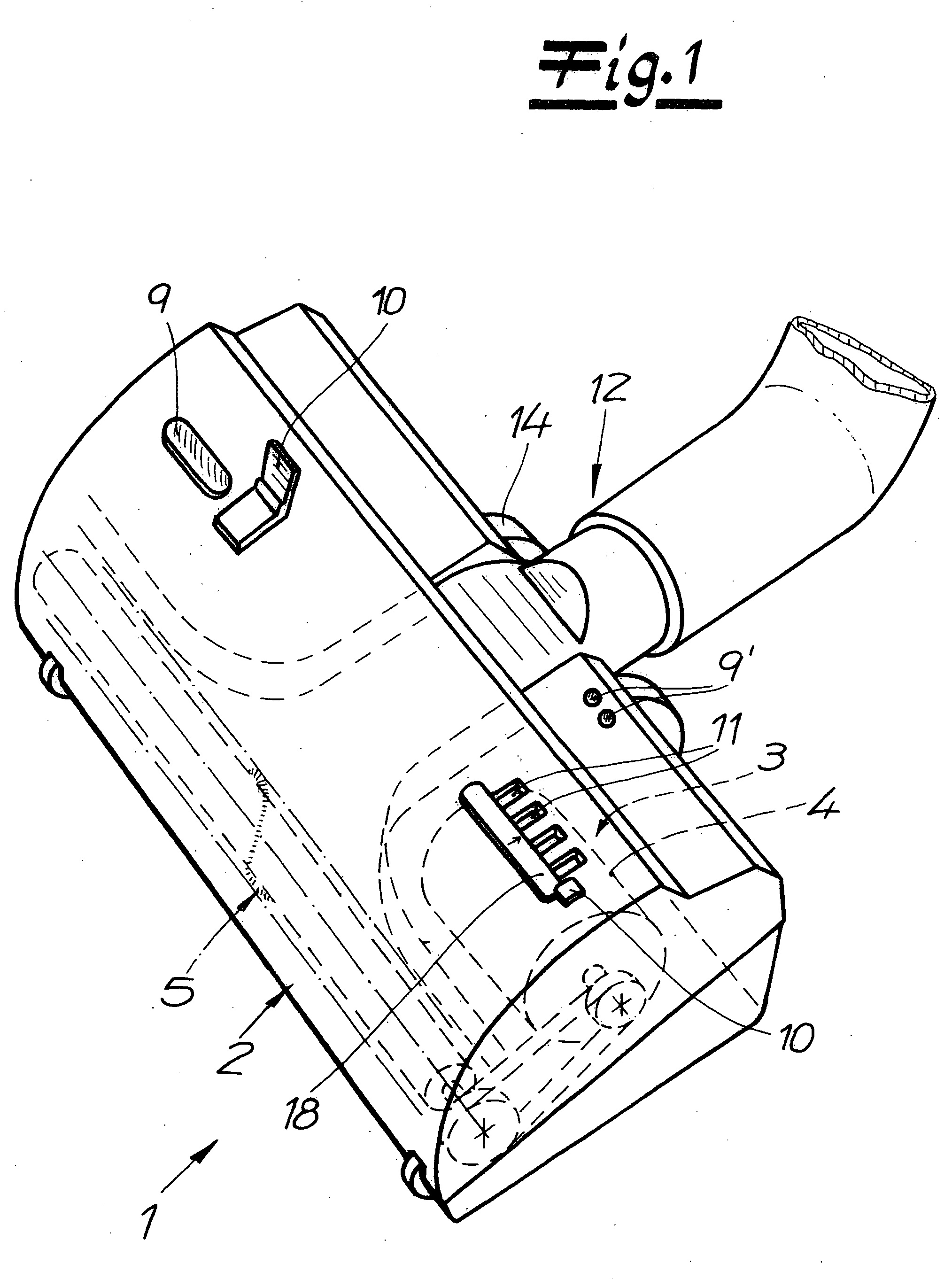
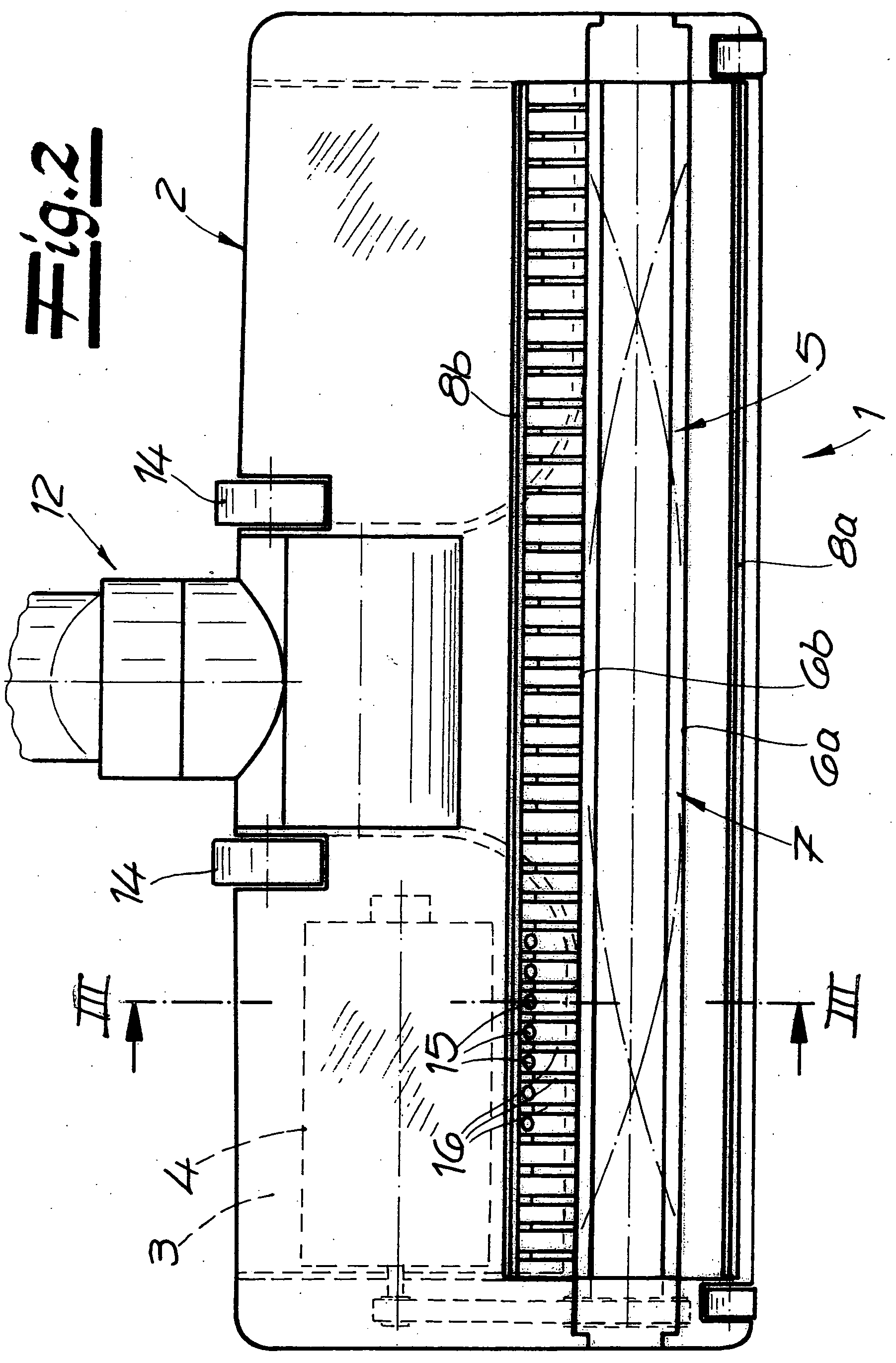
[0010]Proceeding from an electric vacuum head having the characteristics described above, this task is accomplished, according to the invention, in that the at least one air exit opening is disposed on the underside of the housing, in such a manner that the cooling air that exits from the air exit opening during operation of the electric vacuum head enters into the vacuum mouth by way of at least one of the vacuum mouth edges. Usually, approximately
ambient pressure prevails at the air entry openings of the motor chamber during vacuuming, and at least a slight partial vacuum occurs in the region of the underside of the housing into which the air exit opening opens. This causes air to be drawn in from the surroundings and passed over the motor to cool it, and to get into the vacuum mouth after it has left the air exit openings, together with the main air
stream drawn in on the underside of the housing. According to the invention, the required cooling air is passed over at least one of the vacuum mouth edges, and thereby contributes to the total amount of air for the vacuuming effect. A displacement of the air intake merely takes place, viewed in the flow direction, for the partial air
stream of the cooling air, in front of the vacuum mouth edges. In comparison with the known embodiments, in which the air exit opening is connected with a tilting joint, a suction channel, or a roller chamber, a comparatively slight partial vacuum prevails at the at least one air exit opening on the underside of the housing, and therefore correspondingly large flow cross-sections have to be provided. However, this is easily possible because of the large surface that is available at the underside of the housing.
[0014]By means of the configuration according to the invention, the channels, chambers, and joints along the vacuuming air stream, between the vacuum mouth and the vacuum connector, can be configured in a particularly sealed manner, without impairing the cooling, in order to minimize the occurrence of leakage air. For example, rigid and articulated connections between the parts of the electric vacuum head can be provided with seals or flexible connection hoses.
[0015]Since the cooling air contributes to the amount of air for the vacuuming effect, according to the invention, a particularly high level of vacuuming efficiency can be achieved even at a great demand for cooling air. Thus, the electric motor can easily be designed for a maximal
power consumption, under load, of more than 50 W, preferably more than 100 W, and particularly preferably more than 200 W.
[0016]In one embodiment of the invention, the at least one air exit opening is disposed in a depression between ribs that preferably run approximately perpendicular to the vacuum mouth edges. By means of the ribs that run approximately in the flow direction, and the set-back arrangement of the air exit opening, blockage of the air exit opening can be prevented even in the case of a high-
pile floor covering, and a sufficient air stream can be guaranteed.
[0017]Proceeding from the embodiment of an electric vacuum head that has been described above, further developments are possible. For example, cooling ribs and / or a fan wheel can be disposed on the electric motor, to support the cooling. The cross-section of the air entry opening and / or of the air exit openings can be configured to be adjustable, in order to allow
adaptation to a changing demand for cooling air. In this connection, adjustment of the cross-section can take place manually or with
temperature control, and the at least one air exit opening or the at least one air entry opening can be closed when the electric motor is shut off. It is also possible to variably increase or reduce the size of the flow cross-sections, as a function of different functional or power settings of the electric motor. In this connection, an electrically or mechanically driven
shutter can be provided for changing the cross-section. Furthermore, automatic
temperature control can also take place, by means of a temperature sensor or a
shutter controlled as a
bimetal shutter.



 Login to View More
  Login to View More