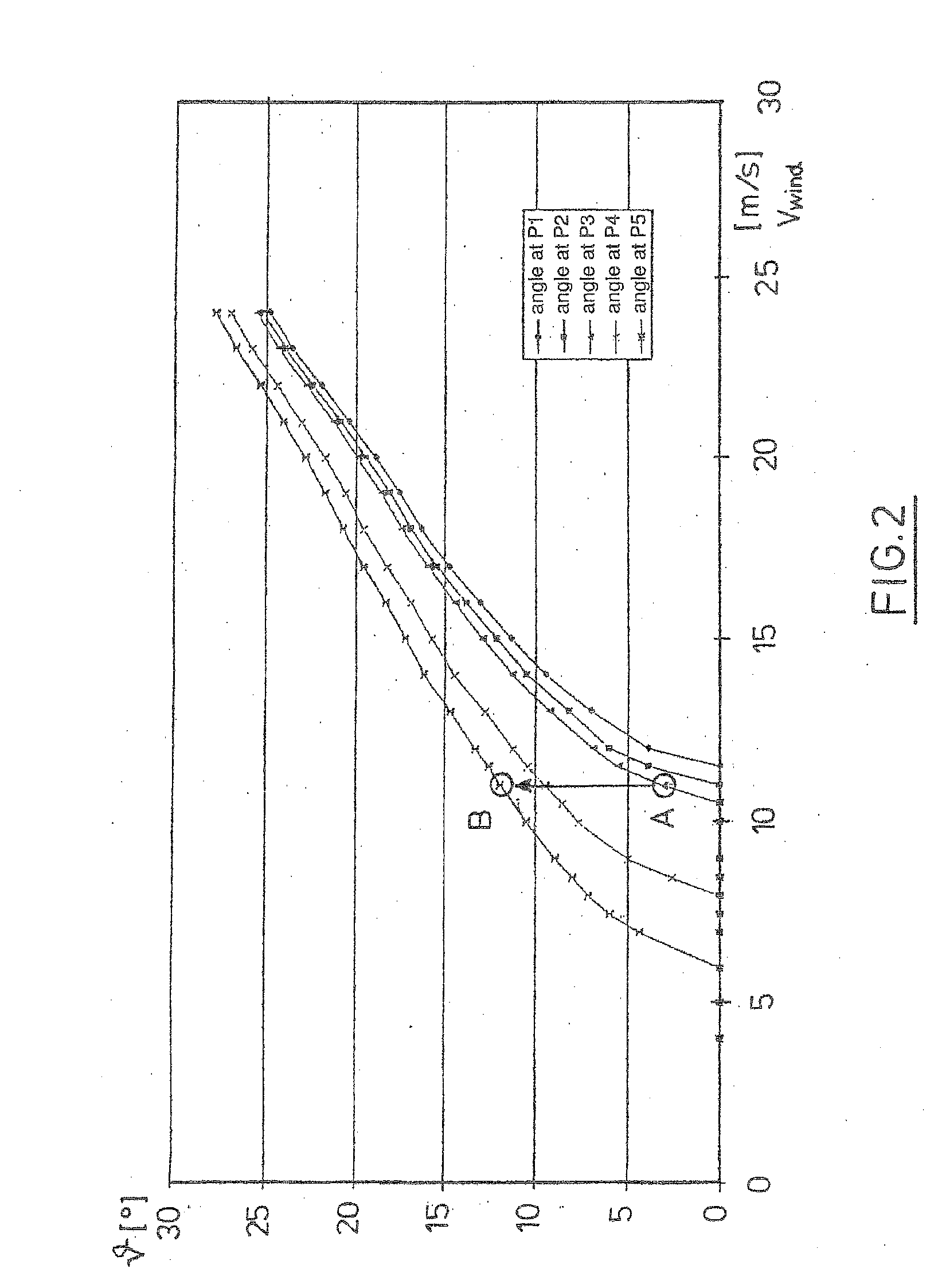
[0015]The invention relates to special operating states the controller of the plant is not designed for, and achieves a safety increase of the plant by acting on the pitch adjustment. In particular, according to the invention, it is possible to reduce load to a stable power value in a short period of time, for example less than a minute, especially less than half a minute, preferably not exceeding 10 seconds, in particular not exceeding 5 seconds or less than 5 seconds. The predetermined value of the reduced electrical quantity can be for example 60%, preferably 40%, more preferably 20% of the nominal value of the electrical quantity. Thenceforward until cancelled, the set point for the electrical quantity stays at the predetermined reduced value. The method of the invention and the plant control means of the invention, respectively, can be used advantageously also for a fast increase of the electrical quantity provided by the plant, when for example the pitch angle is reduced anticipatory in order to increase the received power of the plant quickly.
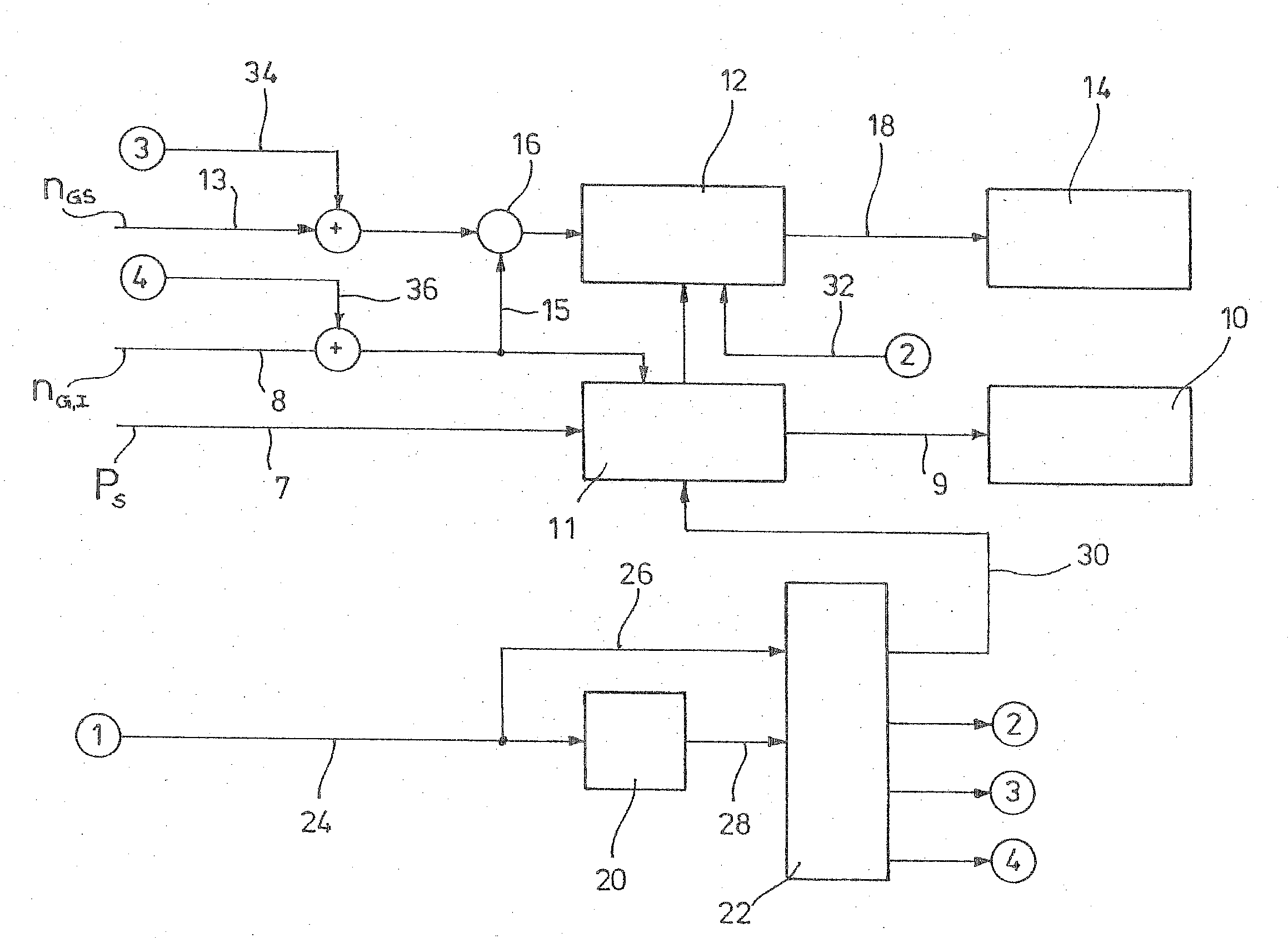
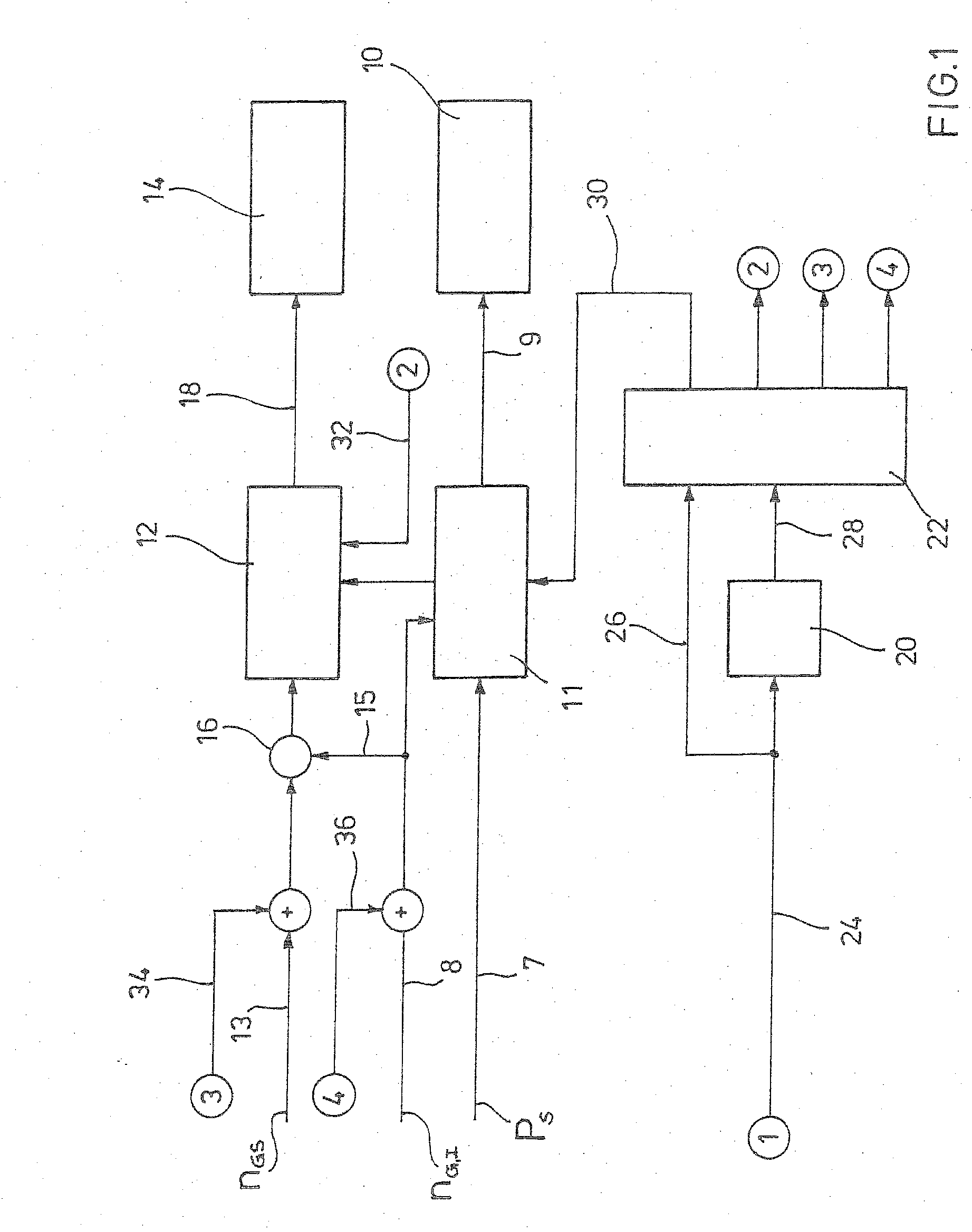
[0019]With regard to practice, it is especially feasible if the preset value is the preset generator torque or the preset generator power. According to a further especially feasible aspect, the electrical quantity can be the active power actually provided by the wind energy plant. According to another aspect, the adjustment of the new pitch angle can be performed by reducing by a defined offset a rotation speed set point supplied to the regulation means. The pitch controller establishes the difference between a rotation speed set point supplied to the pitch controller and a current rotation speed supplied to the pitch controller for example by a
measurement device. In so far as a deviation is detected, the pitch angle is changed by the controller. By subtracting an offset
signal from the rotation speed set point supplied to the controller, within the controller a large set point / current value difference can be generated very quickly, leading to a correspondingly fast regulation action by the controller. For the adjustment of the new pitch angle, a switching on of a disturbance variable is performed in an especially simple manner. According to an alternative or additional approach to the adjustment of the new pitch angle, a rotation speed set point supplied to the regulation means can be increased by a defined offset. Furthermore, a minimal and a maximal pitch angle are usually given to the regulation means, limiting the adjusting range of the controller. In this way, the controller can determine pitch angles only within the limits formed by the minimal and maximal angles. The maximum pitch angle usually is about 90° for all operating states, that is flag position of the rotor blade. The minimal pitch angle depends on the operating state of the plant. In
regular production mode, it is usually 0°. An alternative or additional option for adjusting the new pitch angle therefore is to increase the minimal pitch angle supplied to the regulation means by a defined offset. With this design as well, a regulation action can be initiated quickly and in an especially simple manner.
[0020]By adding a defined offset, that is a defined value, to an input variable of the regulation means, a fast influence on the regulation means is possible. Therein, the offset is defined such that the pitch angle desired in each case is adjusted quickly. For example, the offset values can be determined empirically and retained in characteristic diagrams. It is possible to add a defined offset to only one or to a plurality of input variables of the regulation means. The offset can be cancelled after a certain time and / or when going below a predetermined rotation speed of the generator or rotor. According to another aspect, the offset can be reduced over time to zero starting from an initial maximum value. In this aspect, the regulation means is therefore put down to its regular operating mode over time with the regular input variables for compensation of wind turbulences, by means of reducing the added offset over time to zero.
[0022]For determining a new, minimal pitch angle to be supplied to the regulation means, the current actual pitch angle can be increased by a respective pitch angle offset. A value A may be subtracted from the new minimal pitch angle determined in the described manner. The value A is time-variant and is increased, starting from zero, by means of a time-ramp or a function to a value equal to the pitch angle offset. In this way, the pitch angle offset is reduced over time, starting from an initial maximum value, to zero. The value A can be adjusted such that the rotation speed does not fall below the nominal rotation speed.



 Login to View More
  Login to View More