Methods and apparatus for optical transmission of digital signals

a digital signal and optical transmission technology, applied in the field of optical communication, can solve the problems of suppression of the amplitude of the signal (or fading) over particular, possible additional signal distortion sources of signals, and introduction of distortion in the transmitted optical signal, so as to reduce the reliance on inherent limitations, and improve the effect of optical power budg
US20090220239A1Active Publication Date: 2009-09-03MONASH UNIV

Patent Information

Authority / Receiving Office
US ยท United States
Patent Type
Applications(United States)
Current Assignee / Owner
MONASH UNIV
Publication Date
2009-09-03

Smart Images

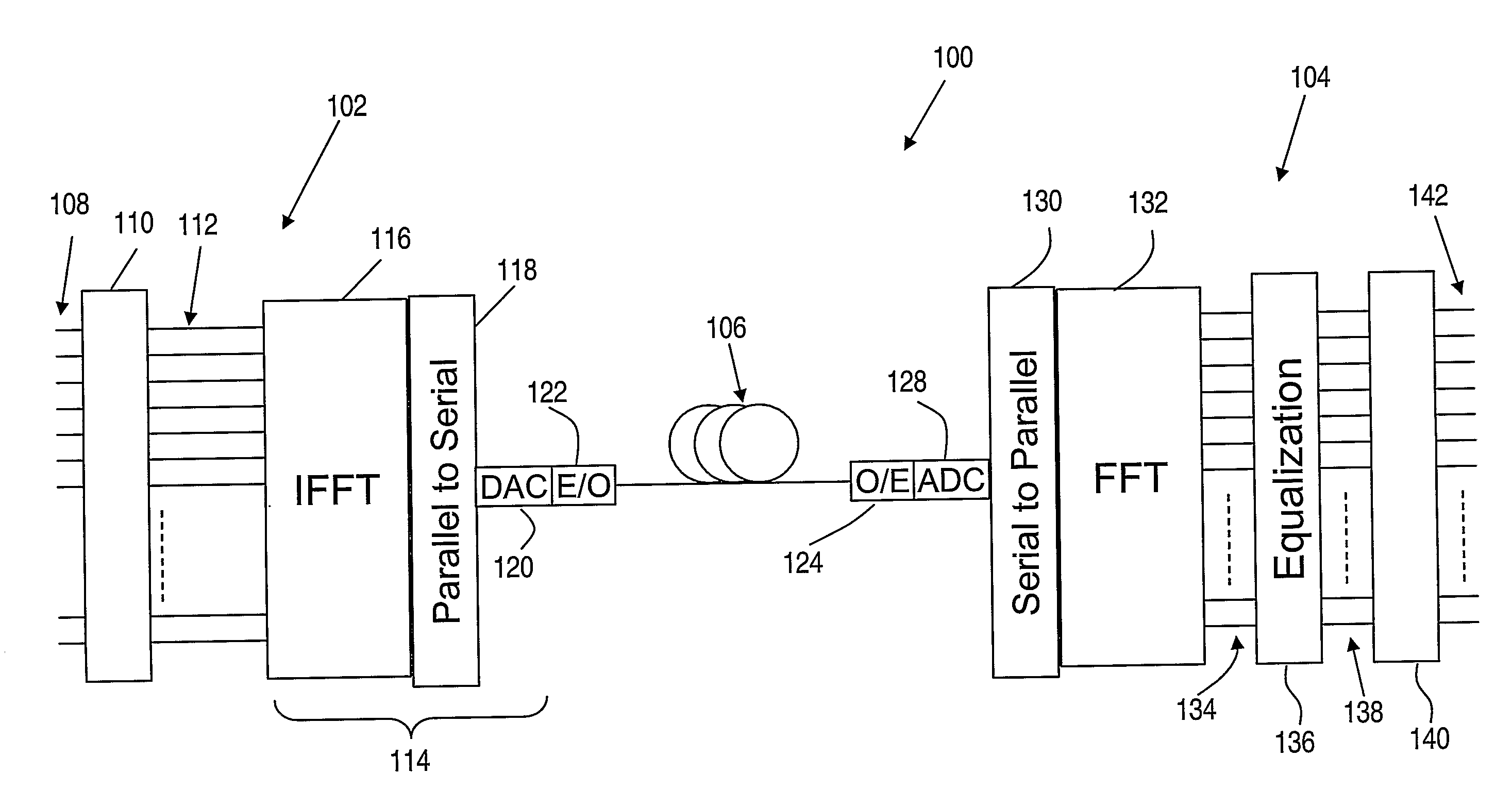
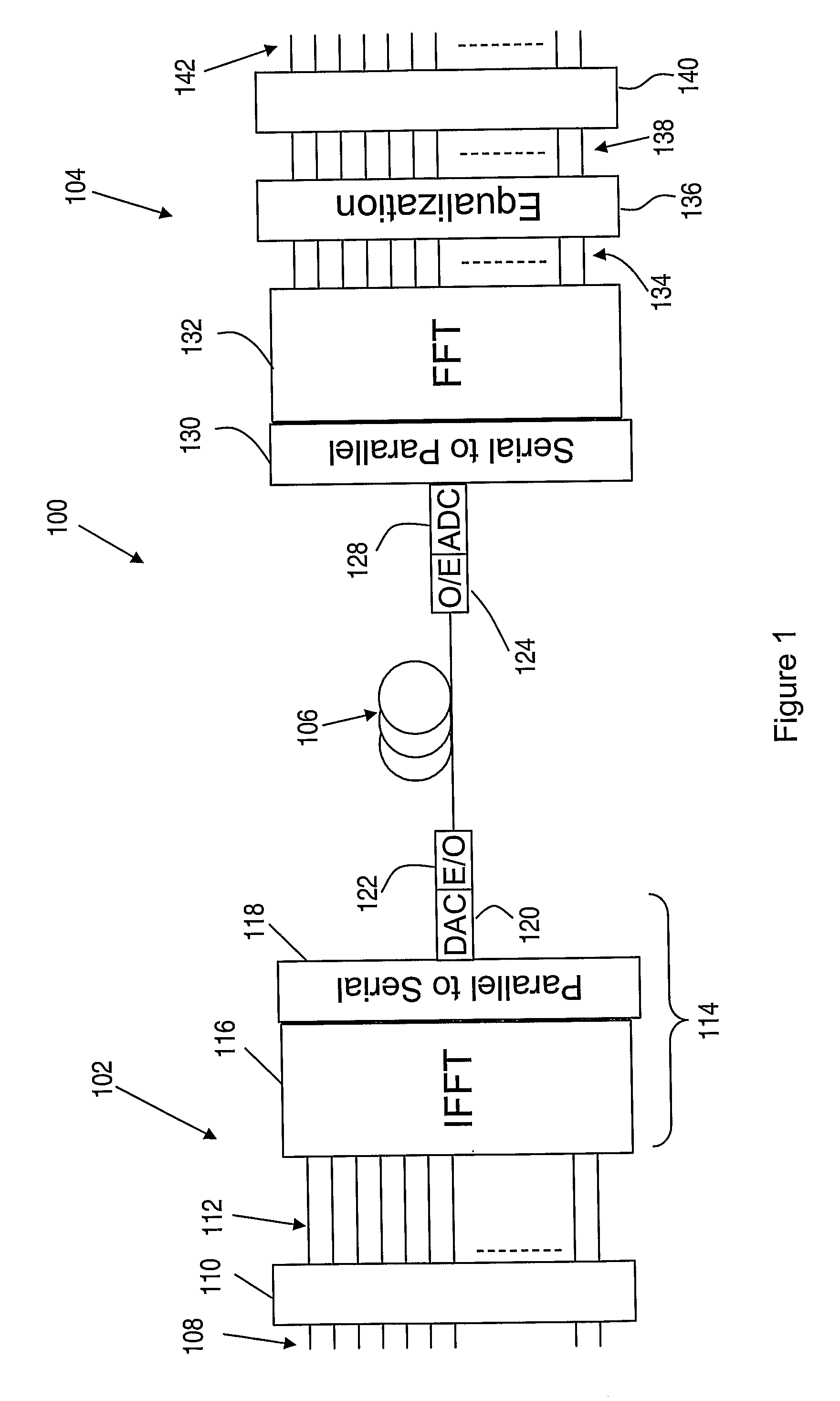
  • Figure 1
    Figure 1
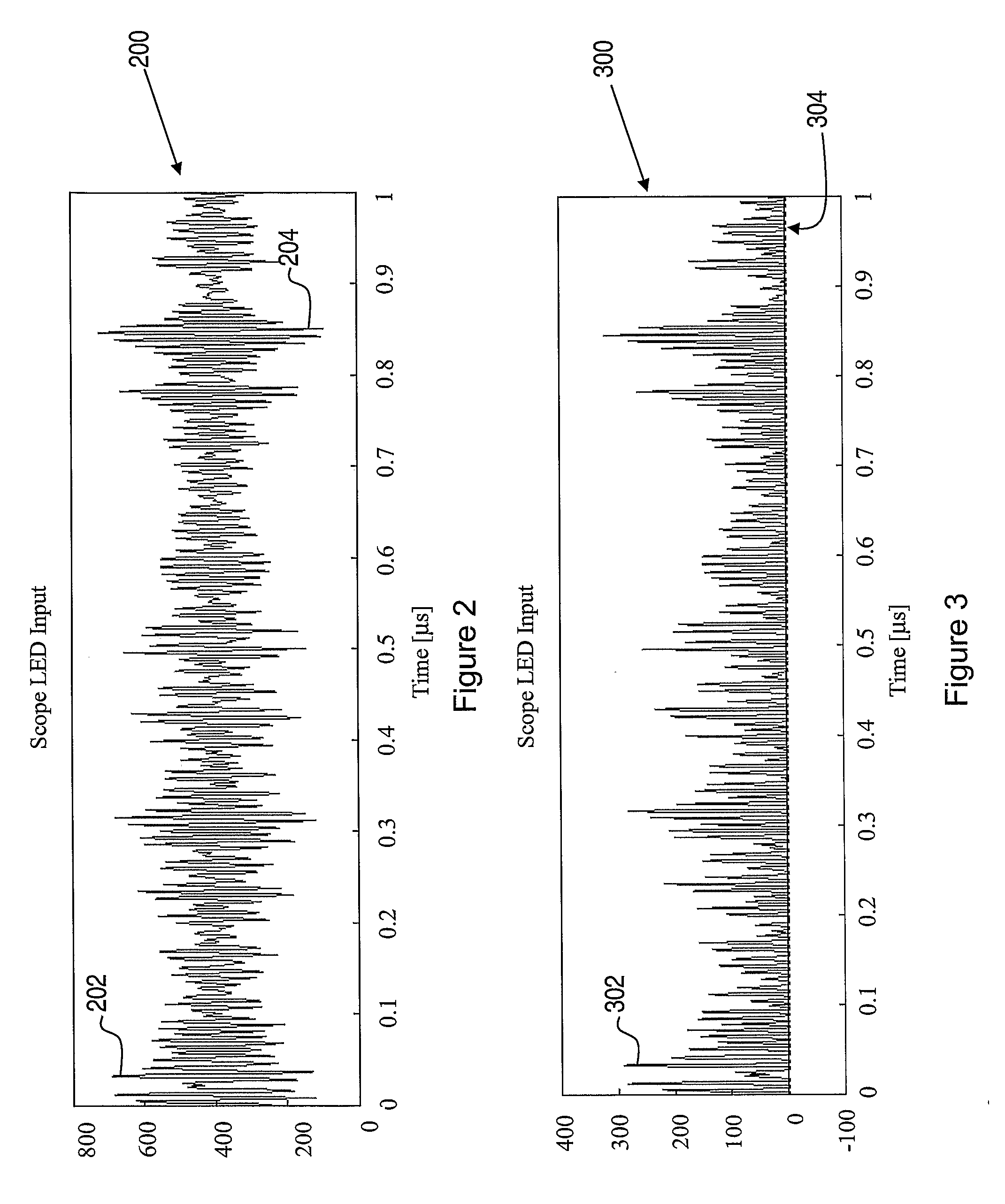
  • Figure 2
    Figure 2
  • Figure 3
    Figure 3
Patent Text Reader

Abstract

A method of communicating digital information over a dispersive optical channel includes encoding the digital information into a plurality of data blocks, each of which includes a number of bits of the information. A time-varying electrical signal is generated which corresponds with each of said data blocks. The time-varying electrical signal is applied to an optical transmitter (122) to generate an optical signal which includes an asymmetrically amplitude limited transmitted signal modulated onto an optical carrier. The optical signal is then transmitted over the dispersive optical channel (106). At a receiving apparatus (104) the optical signal is detected to produce an electrical signal which corresponds with the asymmetrically amplitude limited transmitted signal. A frequency domain equalisation of the electrical signal mitigates the effect of dispersion of the optical channel (106) on the transmitted optical signal, and the equalised signal is decoded to recover the encoded data blocks and the corresponding transmitted digital information. The method enables bipolar signals to be transmitted over a dispersive unipolar optical channel, and reduces or eliminates the need to apply a high optical bias level at the transmitter, thereby improving optical power efficiency and enabling output power levels to be maintained below applicable safe levels, while simultaneously enabling the effects of channel dispersion to be substantially mitigated.
Need to check novelty before this filing date? Find Prior Art

Description

FIELD OF THE INVENTION

[0001] The present invention relates generally to optical communications, and more particularly to methods and apparatus, for modulation and transmission of digital signals, which are particularly advantageous in communications systems that include dispersive optical paths.BACKGROUND OF THE INVENTION

[0002] Optical transmission, in which an information signal is modulated onto an optical carrier, is widely employed in modern communications systems. For example, long-haul transmission networks employ single-mode optical fibres for the transmission of digital information at very high bit rates, using one or more optical carriers, or wavelengths, over each fibre. Furthermore, optical transmission over shorter distances, and at lower bit rates, such as in customer access networks or local area data networks, are known which employ either single-mode or multi-mode optical fibres. Additionally, free space optical transmission paths may be used for line-of-sight communic...

Claims

the structure of the environmentally friendly knitted fabric provided by the present invention; figure 2 Flow chart of the yarn wrapping machine for environmentally friendly knitted fabrics and storage devices; image 3 Is the parameter map of the yarn covering machine
Login to View More