

Surface modified expanded polytetrafluoroethylene devices and methods of producing the same
a technology of expanded polytetrafluoroethylene and polytetrafluoroethylene, which is applied in the direction of laser details, prosthesis, textiles and papermaking, etc., can solve the problems of creating a series of distorted or gnarled nodes along the way, and achieve the effect of reducing the surface roughness and texture of the valley, and reducing the porosity and stiffness of the ridges
- Summary
- Abstract
- Description
- Claims
- Application Information
AI Technical Summary
Benefits of technology
Problems solved by technology
Method used
Image

Examples
Embodiment Construction
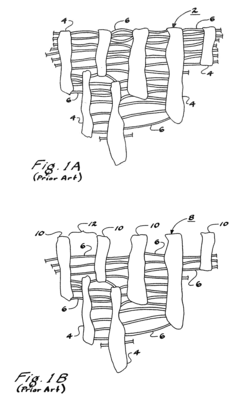
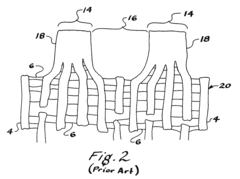
[0032]The present invention comprises a unique method for forming a unique material from an expanded polytetrafluoroethylene (PTFE) material. The present invention may be better understood through a review of previous PTFE surface treatment techniques, as are illustrated in FIGS. 1A through 3B and described below.
[0033]An expanded PTFE surface treatment process is taught in U.S. Pat. Nos. 5,462,781 and 5,437,900 to Zukowski. Zukowski employs a plasma surface treatment process, in which the surface fibrils are removed to a selected depth to leave freestanding nodal ridges. The modification process taught by Zukowski results in freestanding nodes on its surface that maintain their untreated, vertical orientation. FIGS. 1A and B depict cross-section views of an expanded PTFE material before and after, respectively, a Zukowski surface treatment. Shown in FIG. 1A is an expanded PTFE surface 2 prior to the plasma treatment having typical nodes 4 interconnected by fibrils 6. Shown in FIG. ...
PUM
| Property | Measurement | Unit |
|---|---|---|
| width | aaaaa | aaaaa |
| width | aaaaa | aaaaa |
| wavelength output | aaaaa | aaaaa |
Abstract
Description
Claims
Application Information
 Login to View More