
Wide band long slot array antenna using simple balun-less feed elements
a technology of balun-less feed elements and antennas, applied in slot antennas, antennas, basic electric elements, etc., can solve the problems of patch antennas, limited conventional long-slot antenna arrays, and inconvenient wide-bandwidth applications, and achieve the reduction of complexity of feed lines, weight and cost, and low thickness.
- Summary
- Abstract
- Description
- Claims
- Application Information
AI Technical Summary
Benefits of technology
Problems solved by technology
Method used
Image

Examples
Embodiment Construction
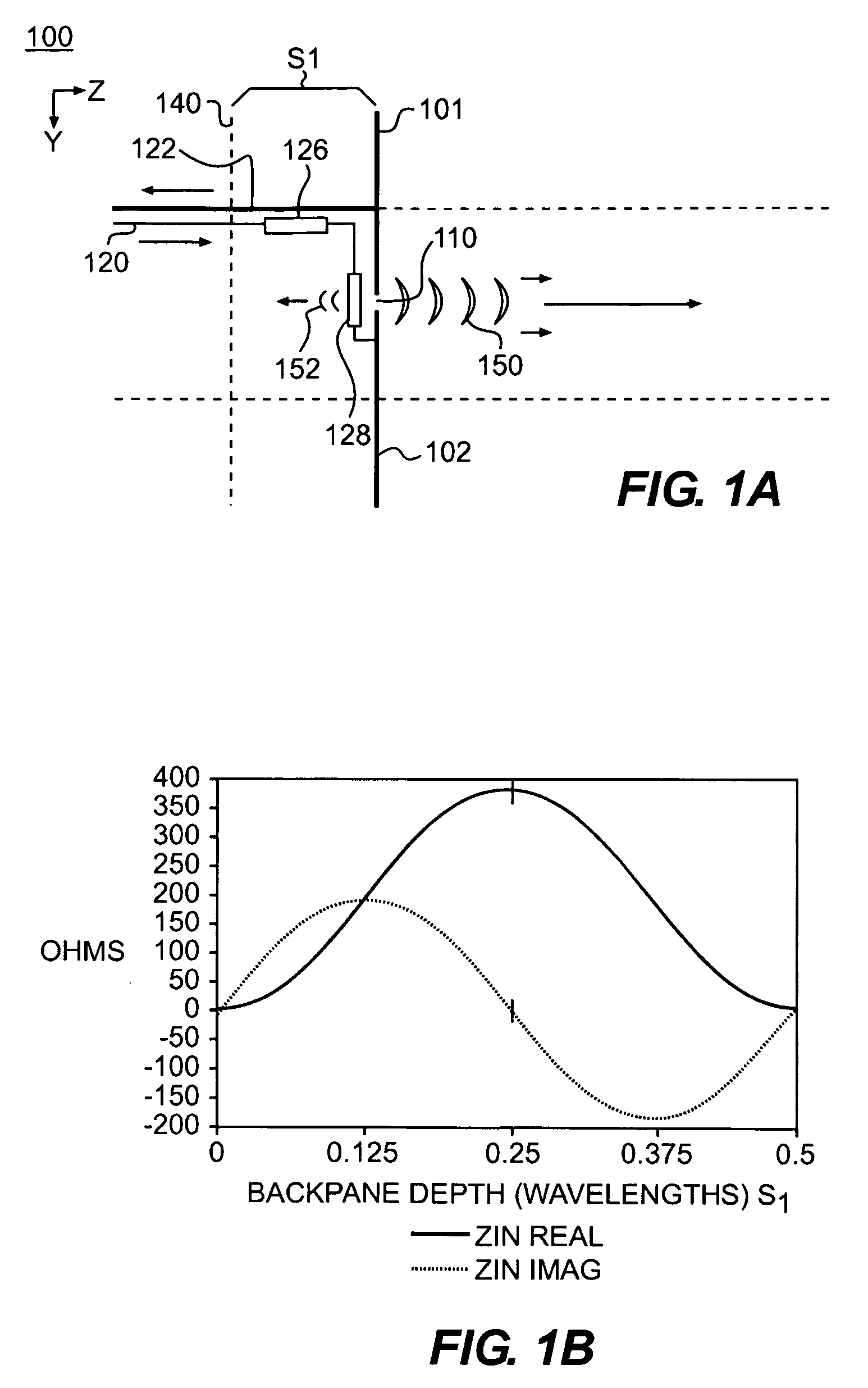
[0018]FIG. 1A shows, according to an embodiment, a unit cell radiation element 100 of a long-slot antenna array and the formation of a beam of radiation 150. In particular, conductors 101 and 102 are provided in an antenna plane. Conductors 101 and 102 can be, for example, conductive strips which are spaced apart from one another to form slot 110. In an embodiment, the conductive strips can be metal strips, such as copper. Feed line 120 carries electrical signals associated with radiation beam 150 (e.g., propagated in an active mode, and received in a passive mode) between a transceiver (not shown) and impedance transformer 126, respectively. Impedance transformer 126 matches the impedance between feed line 120 and the impedance of the environment in order to efficiently couple the electrical signal into radiation beam 150 (i.e., in the active mode) or from beam 150 (i.e., in the passive mode). Impedance transformer 126 is electrically connected to excitation probe 128, which spans ...
PUM
 Login to View More
 Abstract
Description
Claims
Application Information
 Login to View More