[0008]Exemplary embodiments of the present invention meet the above-described needs in the art by providing a technique for uniquely identifying a storage device so that a security policy can be enforced in a way that only allowed storage devices may be used in the corporation's computing devices. One aspect of exemplary embodiments of the present invention is to identify a storage device by utilizing a digital certificate.
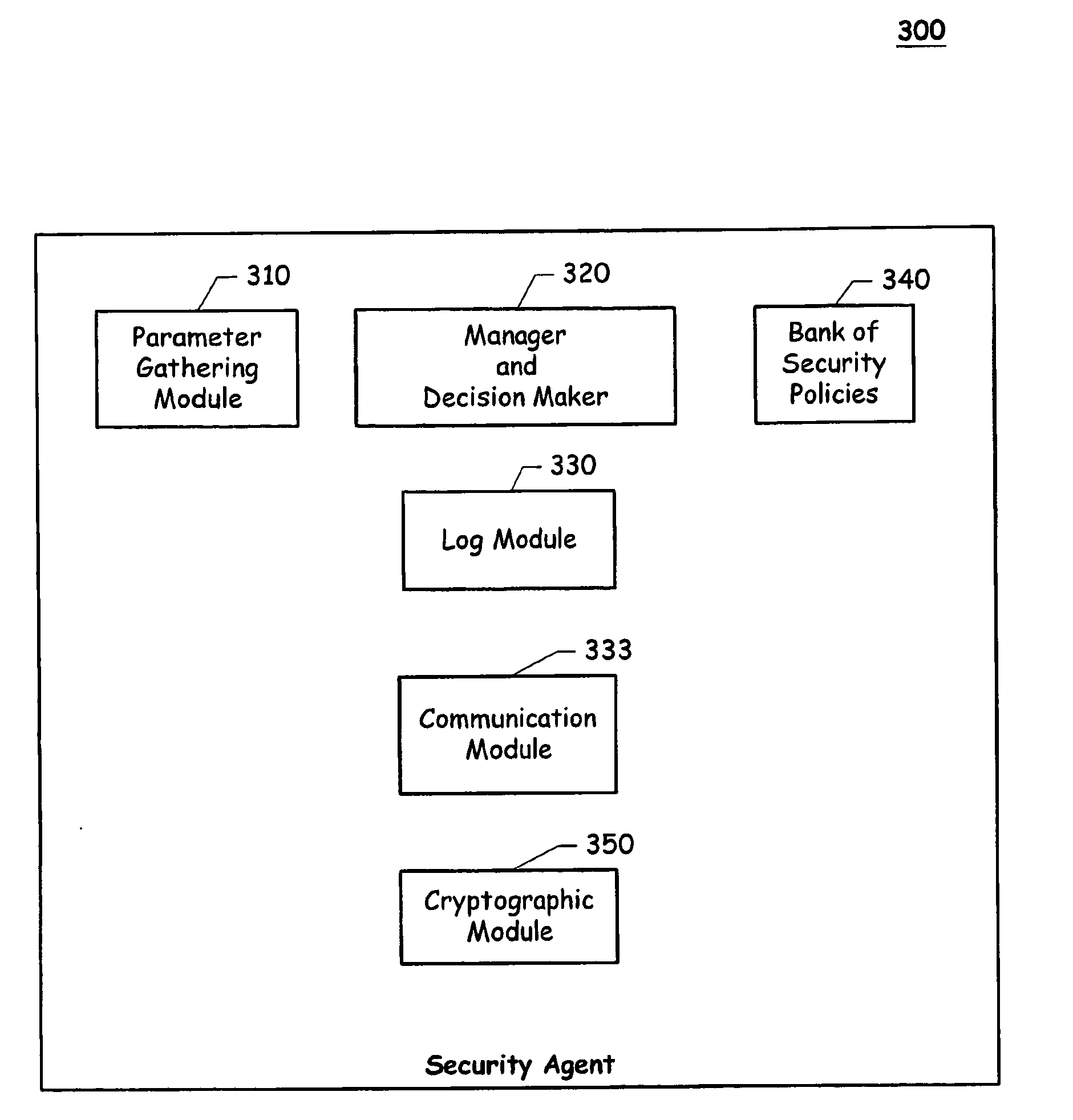
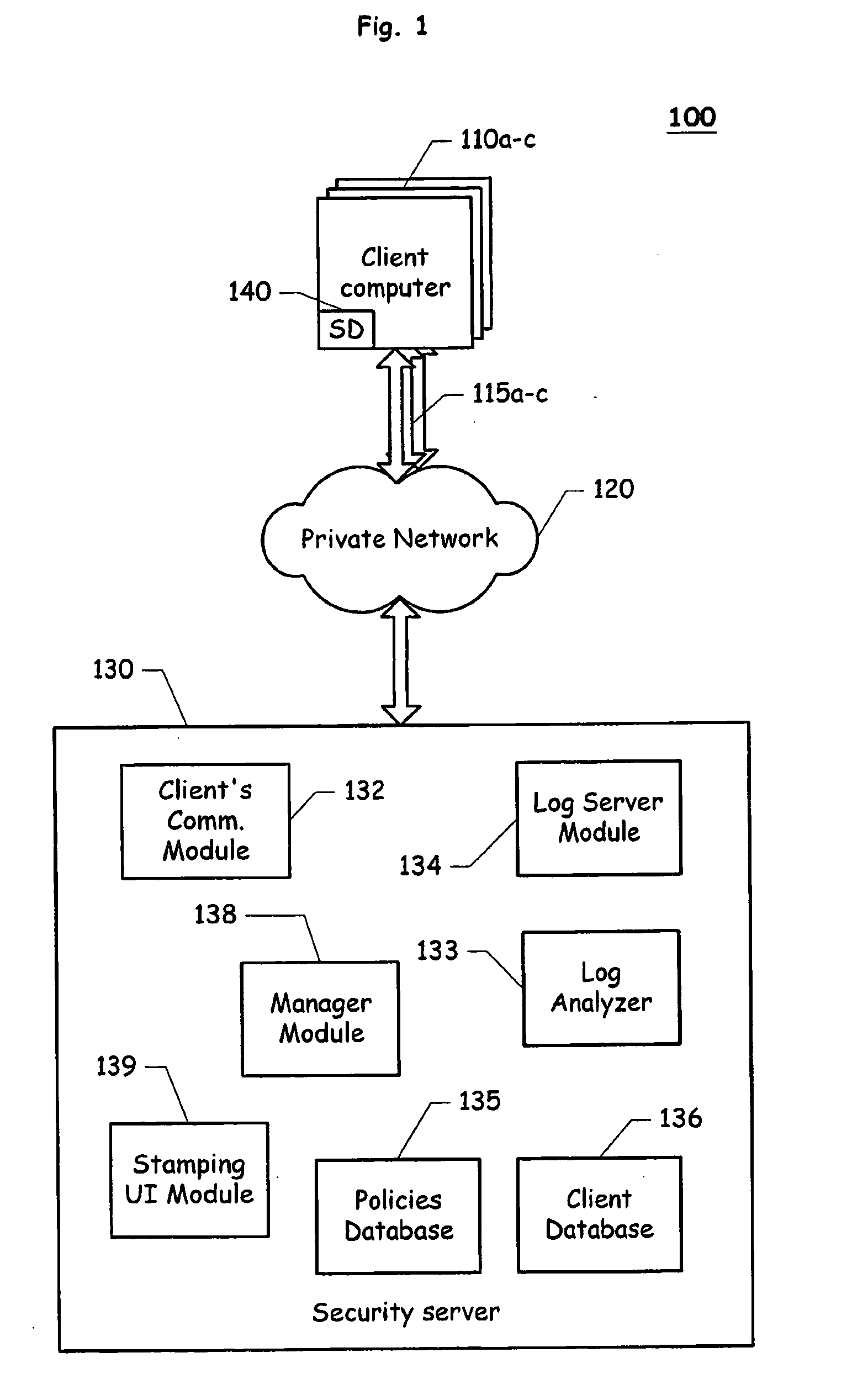
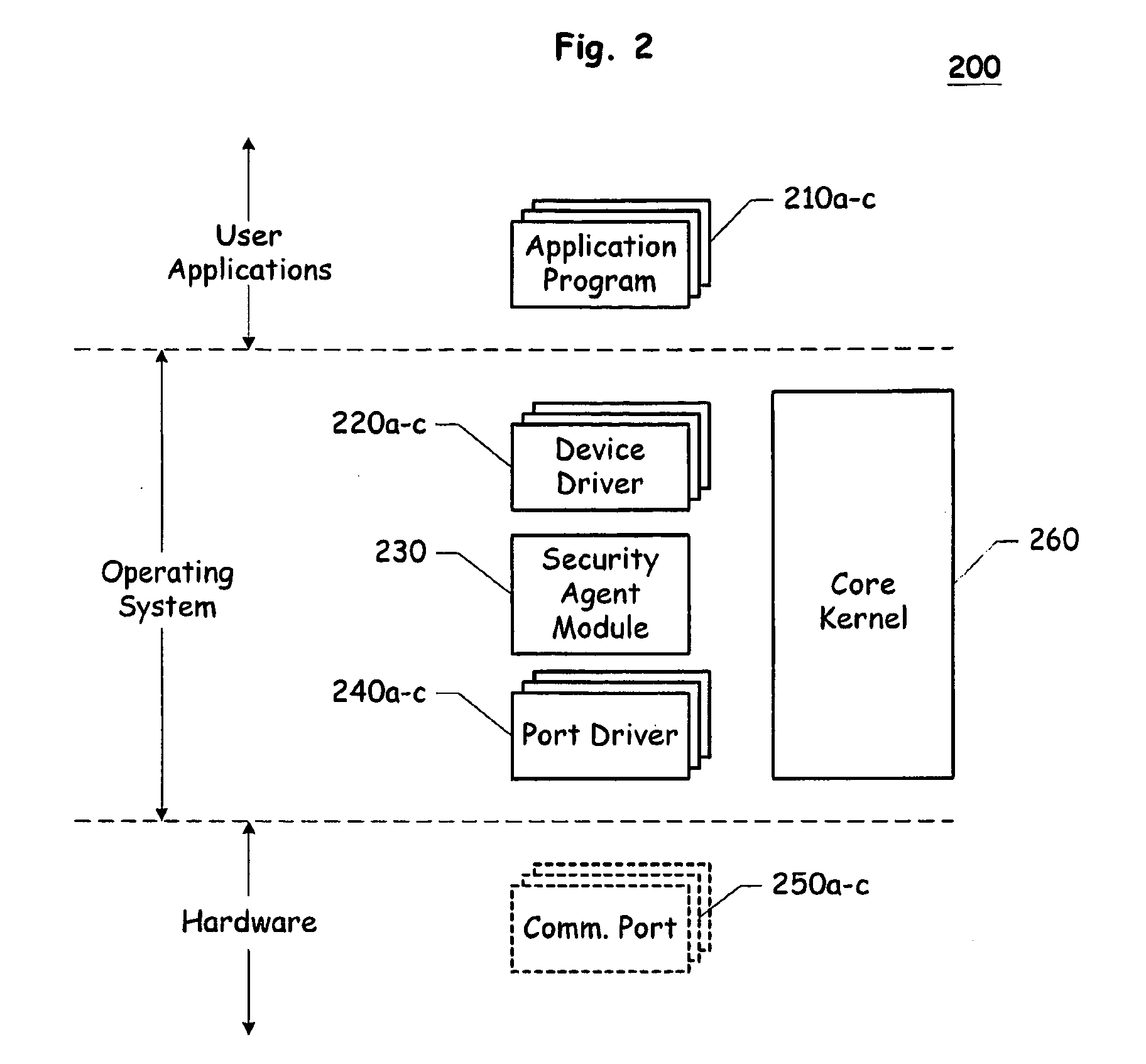
[0009]An exemplary embodiment of the present invention may include a Security Manager Module and a plurality of client agents operating on a private network or sub-network. The Security Manager Module (SMM) can reside on a security server in the private network and can manage or enforce a security policy. The SMM is typically controlled, configured and operated by a system administrator. A client agent, which may be a software module and / or a hardware device, is installed in each one of the computing devices to be connected to the private network. The existence of the client agent can be a mandatory condition for enabling the connection to the private network. In such an embodiment, the private network may not respond to, communicate with, or grant access to a computer that does not include a client agent.
[0010]The client agent operates to detect newly connected storage devices and if possible, to gather one or more parameters from the storage device. By cross-correlating this information with a stored policy controlled or enforced by the SMM, the client agent decides what should be done with the storage device. Exemplary parameters that may be gathered by the client agent include, but not limited to, the number of cylinders, the tracks per cylinder, a serial number if one exists, as well as other physical or configuration information about the storage device. In some embodiments, this information may be considered a digital certificate that is unique to a particular type of storage device and / or a particular storage device. An exemplary client agent, based on the policy and the unique digital certificate, may control the operations related to the storage device. For instance, the client agent may block access to the storage device; enable access to the storage device; disable all writing operations to the storage device, logging that this specific storage device was introduced to the client agent, etc.
[0011]Another aspect of exemplary embodiments of present invention is stamping module (SM). The SM is typically deployed within a security server implementing an exemplary embodiment of the present invention. The SM is basically a user interface module that is used by an administrator. In operation, the SM detects a storage device that has been connected to the administrator's computer or the security server and, if possible, gathers one or more parameters from the storage device. In addition, the SM may query the administrator for a security ascription (such as, but not limited to a department name) for the device. The SM then “stamps” the device by writing or storing within the storage device, a digital certificate signing the security ascription (classification), device parameters and more security parameters.
[0012]Another aspect of exemplary embodiments of the present invention is the creation and utilization of the digital certificate. In one embodiment of this aspect of the present invention, the digital certificate can be created in a Central Signing Module (CSM) that is dedicated to a particular device or device type. A unique private key (PrK) that is associated with the security server and known only to the security server is utilized by the security server during the creation of a digital certificate. The PrK remains only in one security server; however in practice, it might be beneficial to back it up in a media that exists outside the network but remains secure. The PrK may be generated randomly during the installation of the security server or may be generated by another source and simply provided to the security server. The PrK is used by the security server during the creation of a digital certificate for each one of the external devices.
[0013]Moreover, exemplary embodiments of the present invention may include a Log Module (LM) that is integral to the client agent and a Log Server Module (LS), which is an integral part of the security server. The LS may be used to store, and manage the logs that are collected and stored. The central location may include a Log Analyzer (LA), which analyzes each one of the logs to find suspicious activities. The log feature implements or ensures the security of the “stamp” by coordinating between all the client agents. Thus, the log feature ensures that every “stamp” is used only by one unique device.


 Login to View More
  Login to View More