Method for spraying the exterior surfaces of blow molded plastic beverage bottles with a treatment to minimize, restrict, or inhibit bottle jams during the use of an air transport system in a bottle plant

a technology for beverage bottles and exterior surfaces, applied in transportation and packaging, other domestic articles, packaging types, etc., can solve problems such as reduced filling speed, container operation variations, and inconvenience, and achieve the effect of preventing contamination by the medium of treatment, reducing disturbances, and significantly reducing disturbances

a technology for beverage bottles and exterior surfaces, applied in transportation and packaging, other domestic articles, packaging types, etc., can solve problems such as reduced filling speed, container operation variations, and inconvenience, and achieve the effect of preventing contamination by the medium of treatment, reducing disturbances, and significantly reducing disturbances

US20100095639A1Inactive Publication Date: 2010-04-22KHS GMBH

Image

Smart Image Click on the blue labels to locate them in the text.
Viewing Examples
Smart Image
  • Method for spraying the exterior surfaces of blow molded plastic beverage bottles with a treatment to minimize, restrict, or inhibit bottle jams during the use of an air transport system in a bottle plant
  • Method for spraying the exterior surfaces of blow molded plastic beverage bottles with a treatment to minimize, restrict, or inhibit bottle jams during the use of an air transport system in a bottle plant
  • Method for spraying the exterior surfaces of blow molded plastic beverage bottles with a treatment to minimize, restrict, or inhibit bottle jams during the use of an air transport system in a bottle plant

Examples

Experimental program
Comparison scheme
Effect test

Embodiment Construction

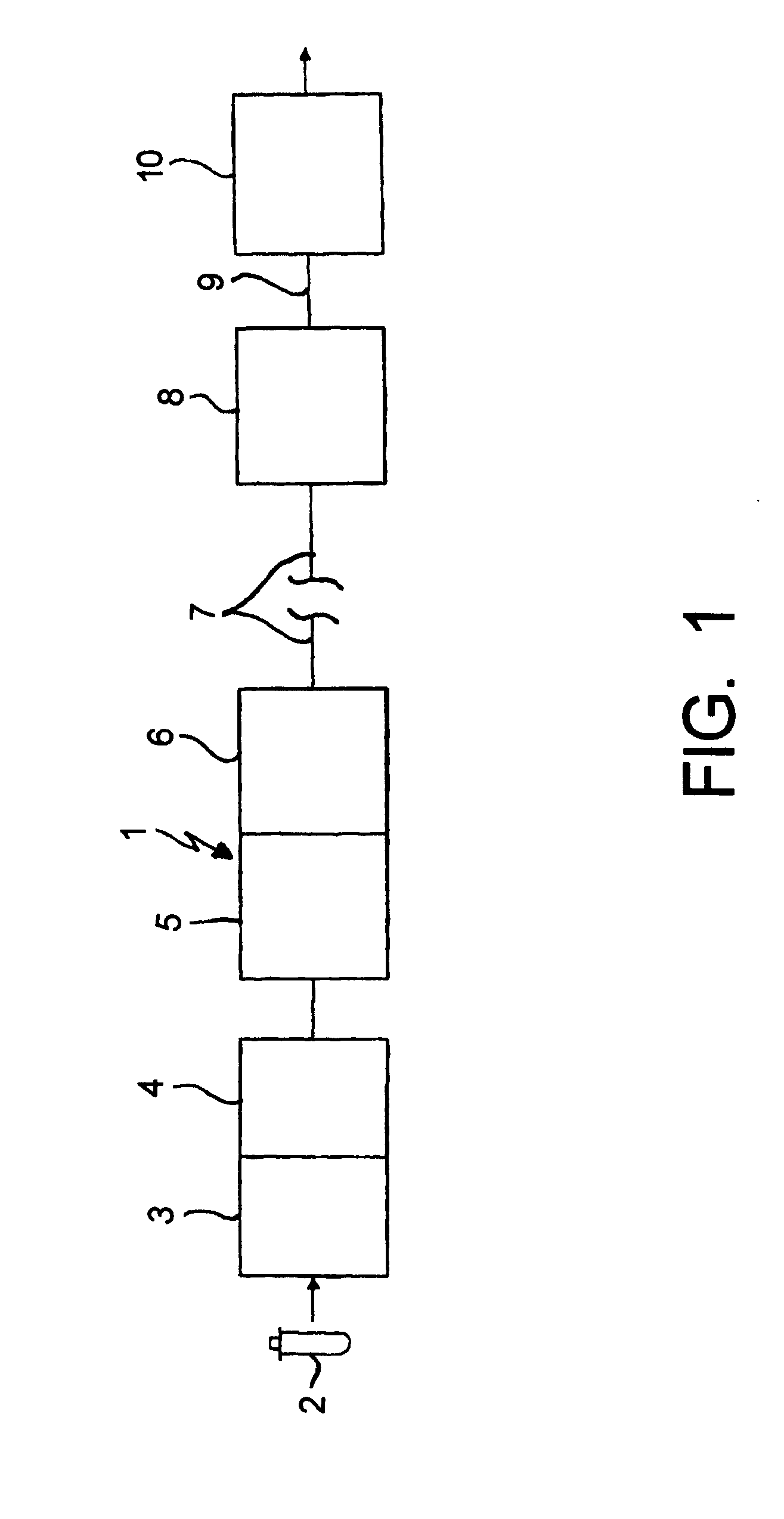
[0028]A schematic representation shows FIG. 1 as a general processing, or treatment arrangement 1 in accordance with one aspect of the present application. Completed pre-form structures, or pre-forms 2 are brought at the input-side into the arrangement. The preforms 2 first proceed through a heating station 3, in which the pre-forms 2 are preheated to a controlled temperature. Thereupon the pre-forms 2 are passed to a blow-molding station 4, in which the pre-forms 2 are brought to the desired container form. For example, the desired container form could be a bottle for beverages, or drinks. The desired form is brought about by blowing to expand the pre-forms 2 in blow molds.

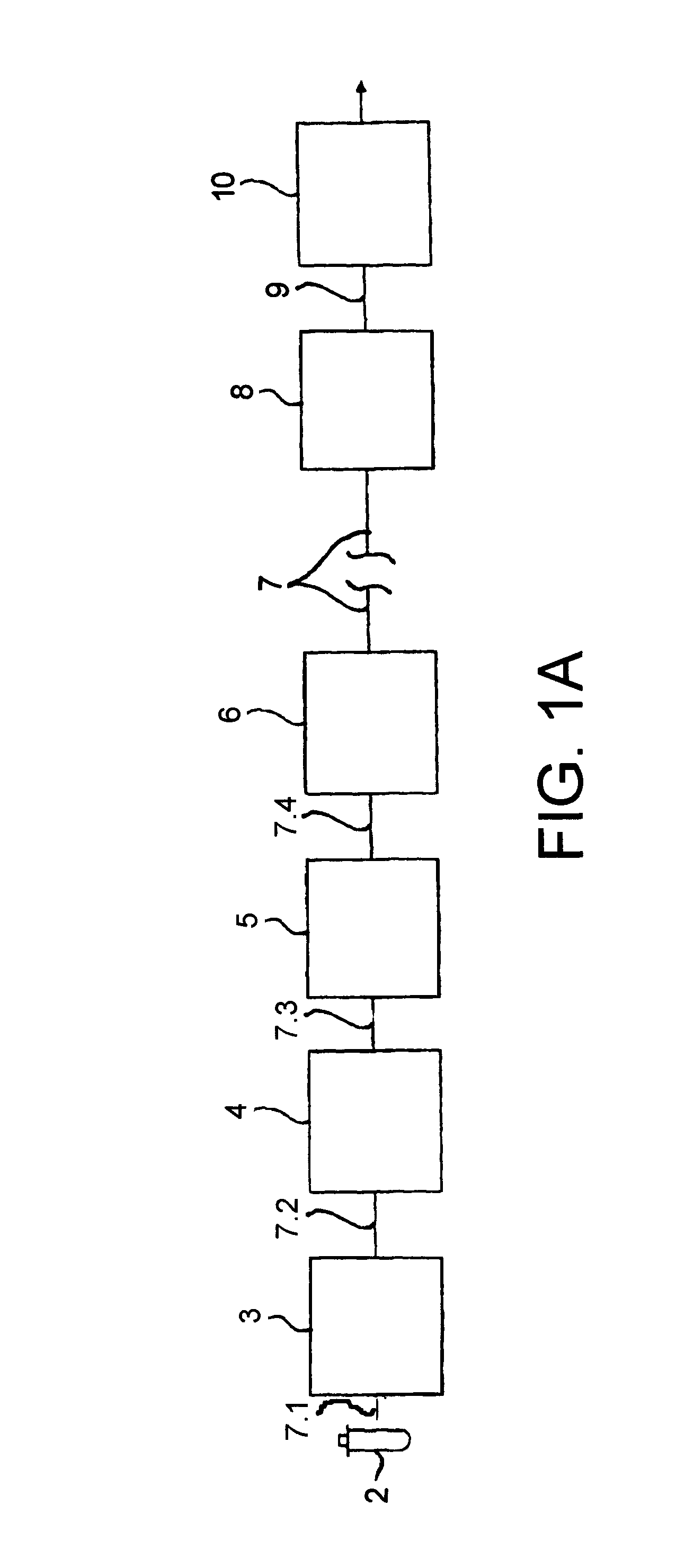
[0029]FIG. 1A depicts one possible embodiment in which the pre-forms 2 could enter the heating arrangement 3 by means of either a rotary or linear conveyer 7.1. The pre-forms 2 are heated to a temperature desirable for blow-molding. The pre-forms 2 could then be passed from the heating station 3 to the blow-moldi...

the structure of the environmentally friendly knitted fabric provided by the present invention; figure 2 Flow chart of the yarn wrapping machine for environmentally friendly knitted fabrics and storage devices; image 3 Is the parameter map of the yarn covering machine
Login to View More

PUM

PropertyMeasurementUnit
frictionaaaaaaaaaa
friction-aaaaaaaaaa
surface frictionaaaaaaaaaa
Login to View More

Abstract

A method for spraying the exterior surfaces of blow molded plastic beverage bottles with a treatment to minimize, restrict, or inhibit bottle jams during the use of an air transport system. The abstract of the disclosure is submitted herewith as required by 37 C.F.R. §1.72(b). As stated in 37 C.F.R. §1.72(b): A brief abstract of the technical disclosure in the specification must commence on a separate sheet, preferably following the claims, under the heading “Abstract of the Disclosure.” The purpose of the abstract is to enable the Patent and Trademark Office and the public generally to determine quickly from a cursory inspection the nature and gist of the technical disclosure. The abstract shall not be used for interpreting the scope of the claims. Therefore, any statements made relating to the abstract are not intended to limit the claims in any manner and should not be interpreted as limiting the claims in any manner.

Description

CONTINUING APPLICATION DATA[0001]This application is a Continuation-In-Part application of International Patent Application No. PCT / EP2007 / 008931, filed on Oct. 15, 2007 which claims priority from Federal Republic of Germany Patent Application No. 10 2006 049 134.3, filed on Oct. 18, 2006 and Federal Republic of Germany Patent Application No. 20 2006 015 912.6 Oct. 18, 2006. International Patent Application No. PCT / EP2007 / 008931 was pending as of the filing date of this application. The United States was an elected state in International Patent Application No. PCT / EP2007 / 008931.BACKGROUND[0002]1. Technical Field[0003]The present application relates to a procedure and a device for the treatment of containers made from plastic material.[0004]2. Background Information[0005]Background information is for informational purposes only and does not necessarily admit that subsequently mentioned information and publications are prior art.[0006]Plastic containers are used, for instance, as pack...

Claims

the structure of the environmentally friendly knitted fabric provided by the present invention; figure 2 Flow chart of the yarn wrapping machine for environmentally friendly knitted fabrics and storage devices; image 3 Is the parameter map of the yarn covering machine
Login to View More

Application Information

Patent Timeline
22 Apr 2010
Publication
US20100095639A1
IPC
B65B65/06; B65B3/02; B65B7/28; B05D3/02
CPC
B05D5/08; B05D5/083; B65D23/0807; B29C49/06; B29L2031/7158; B05D7/02; B29C49/42; B29C49/42388
Inventors
HOHENHORST, MICHAEL; BACKHAUS, MARTIN