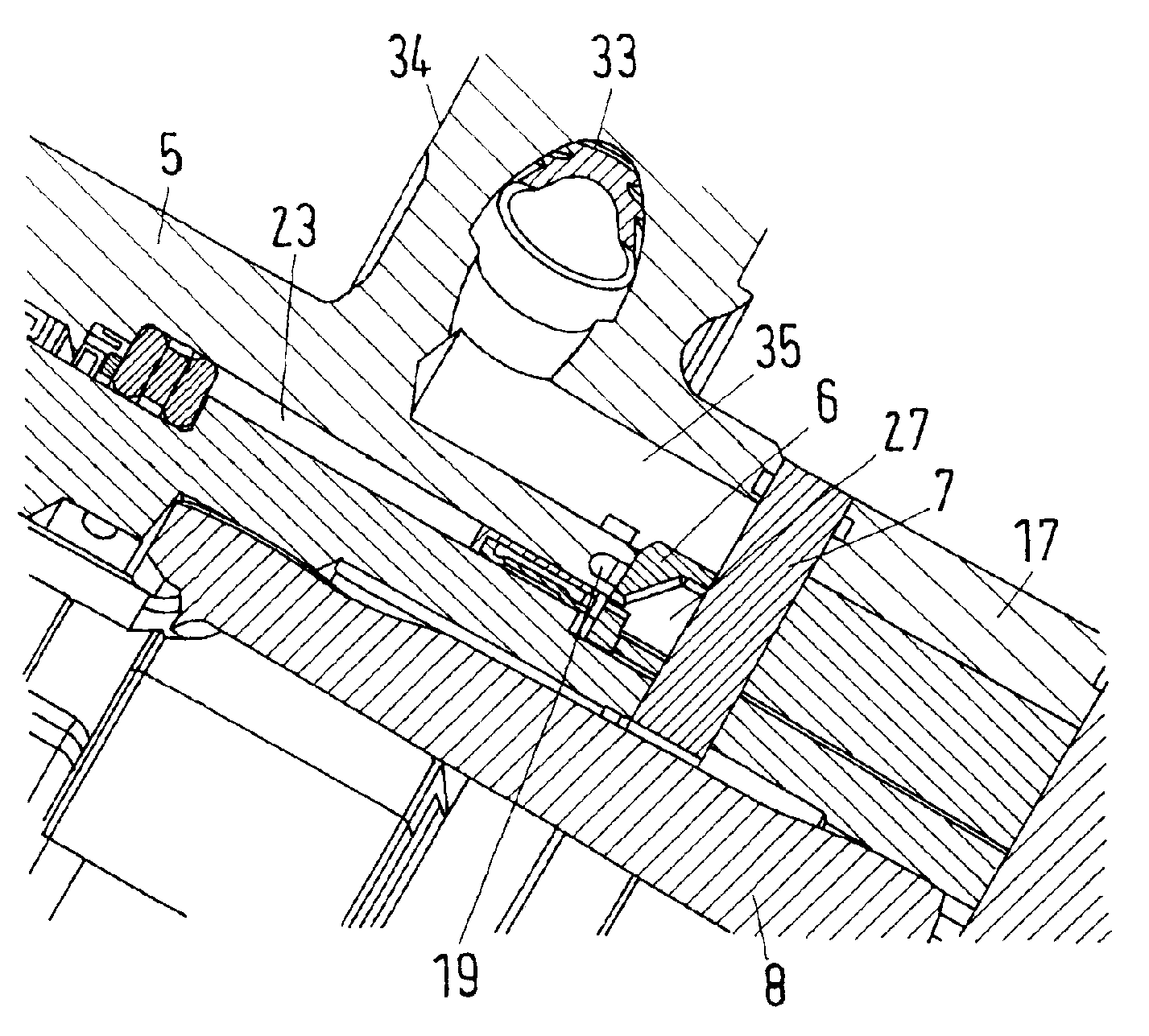
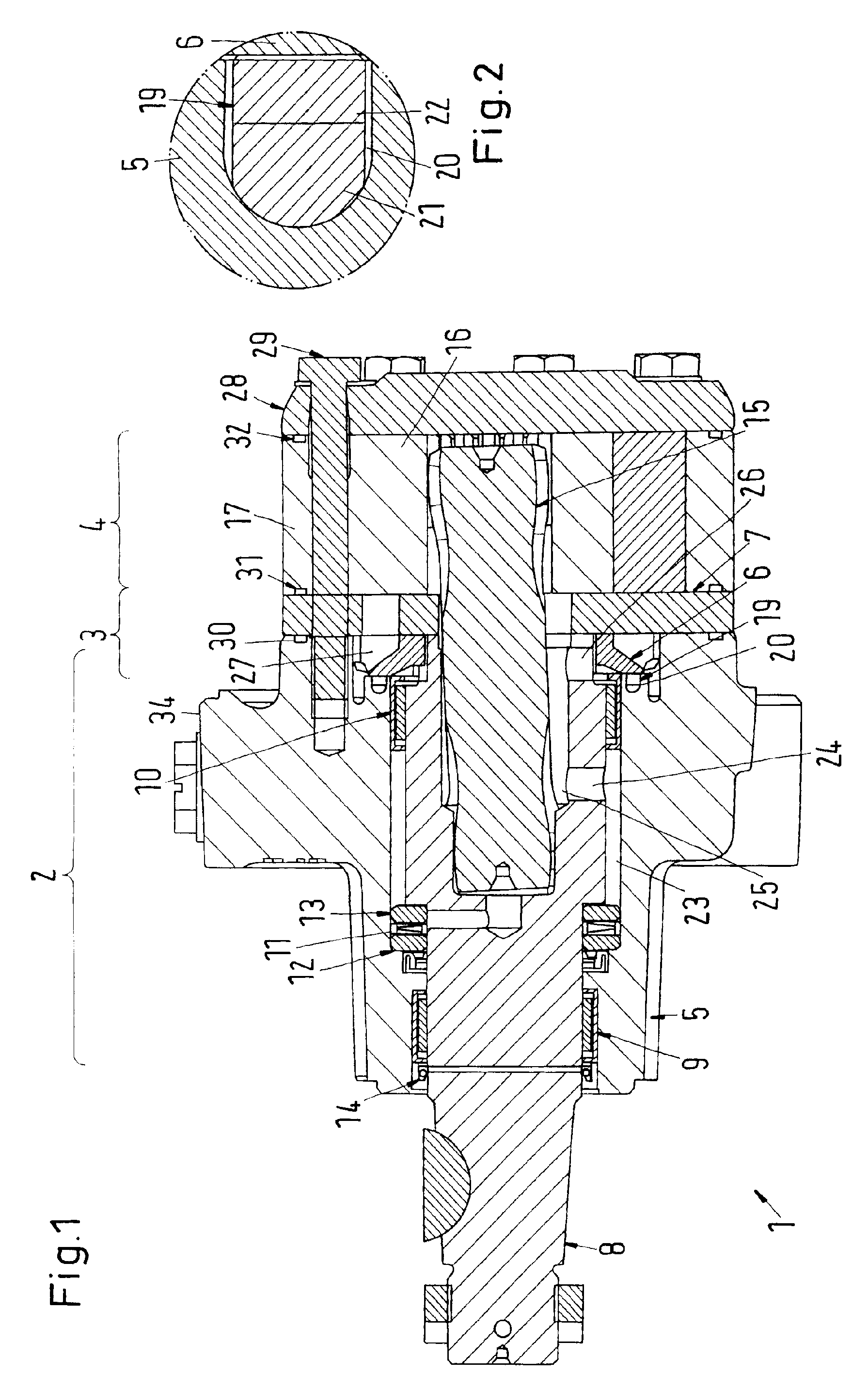
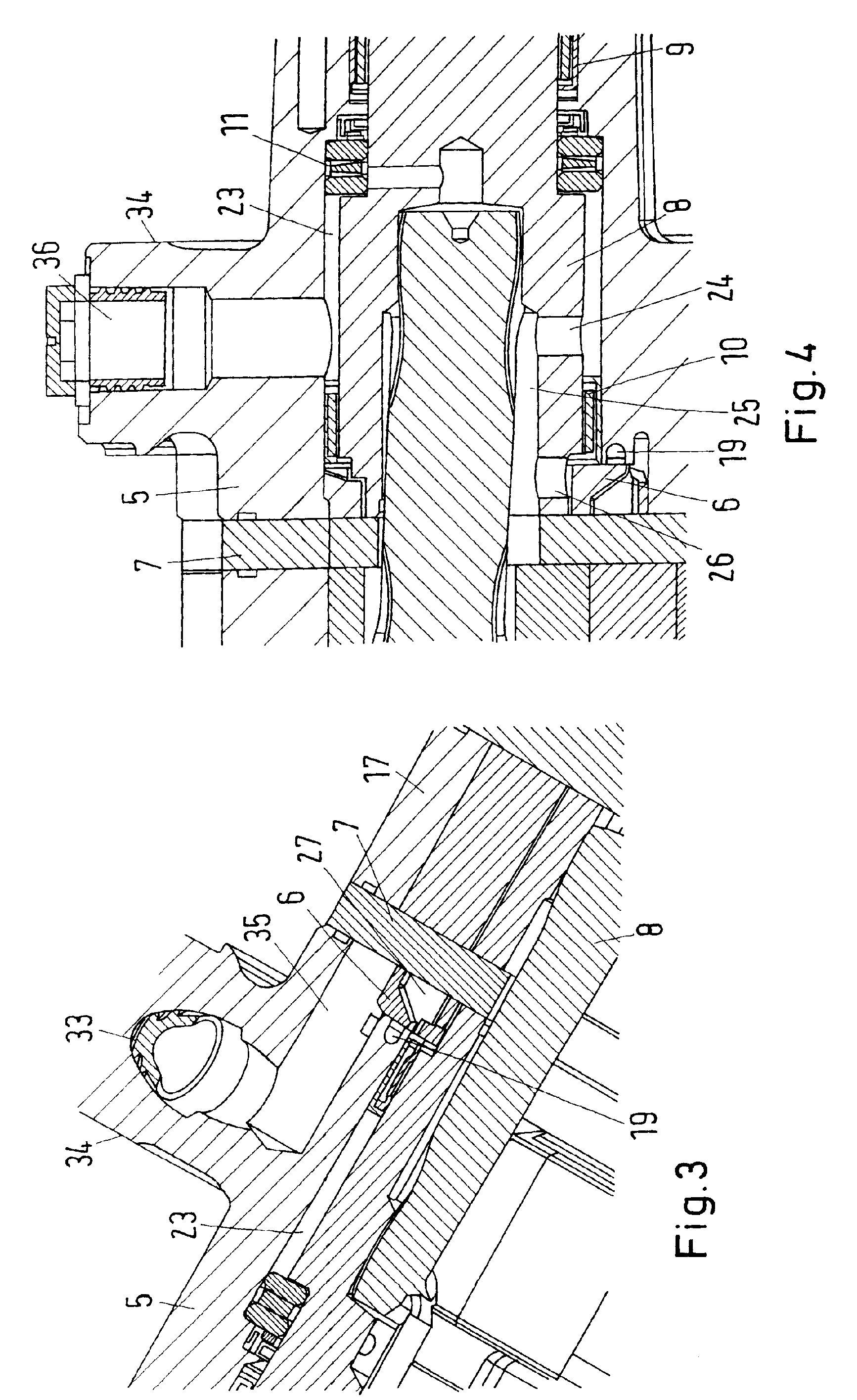
[0011]Preferably, the sealing is arranged in an annular groove, the position of the sealing in the radial direction being clearance-subjected. This clearance-subjected position is achieved in that the groove has a large width than the sealing. The groove can be made either in the housing or in the rotary slide valve. In order to ensure an axial prestress of the sealing, the depth of the groove should be smaller than the thickness of the sealing. The groove ensures a safe positioning of the sealing. The clearance-subjected position causes that the sealing can be acted upon by the pressure of the working medium. This pressure causes a
radial deformation of the sealing and thus an increased pressure against the rotary slide valve, which is then pressed more firmly against the valve plate. When the
working pressure is increasing, the rotary slide valve will be pressed against the valve plate with an increasing force, so that a tight connection between the rotary slide valve and the valve plate remains ensured.
[0012]Advantageously, the sealing has two areas, the housing-side area being made to be elastic and the area facing the valve plate comprising a friction-reducing material. Thus, the areas lie next to one another in the axial direction. The housing-side area can, for example, be made of a
rubber material. The other area may, for example, comprise Teflon, PTFE or the like, to keep the wear and the friction between the sealing and the rotary slide valve small. The required tightness is ensured by the housing-side area. Further, this area can be deformed by the pressurised
hydraulic fluid and transfer this deformation in the form of an increased pressure force to the rotary slide valve. At the same time, it provides a static prestressing, which is particularly favourable when starting the machine. The sealing can be made in one piece. However, it is also possible to make it of several pieces, for example of two pieces, one part being the first area and one part being the second area.
[0013]Preferably, the sealing is unrotatably held in the housing. Thus, in relation to the housing the sealing performs no relative movement. The sealing can therefore be held relatively firmly in the housing. It is sufficient that only the surface of the sealing, which is in contact with the rotary slide valve, is provided with a low-frictional and
wear resistant material. Thus, it is possible to make a relatively large area of the sealing elastic, which is advantageous for the desired function and tightness.
[0015]Preferably, in the groove the sealing separates an area that is connected to the inlet connection from an area that is connected to the outlet connection. Depending on the rotation direction of the machine either one side or the other of the sealing will be acted upon by the increased pressure of the working medium. The working medium with low pressure is on the other side. Thus, depending on the rotation direction, the sealing is acted upon by pressure either radially inwards or radially outwards, the clearance-subjected position of the sealing in the groove ensuring that a relatively large surface of the sealing can be acted upon by pressure. This causes that a relatively
large deformation of the sealing or a relatively large force transfer via the sealing to the rotary slide valve is possible, so that the rotary slide valve is reliably pressed against the valve plate. The
radial deformation and the displacement of the sealing also increase the surface of the rotary slide valve that can be acted upon by the pressure of the working medium. This presses the rotary slide valve against the valve plate with an increased force.
[0016]Preferably, the
drive shaft has a channel, a working medium being transportable to the rotary slide valve through the channel. The space required in the housing for the supply and
discharge of the
hydraulic fluid is reduced in that this channel is arranged in the
drive shaft. The space required for the hydraulic machine can be further reduced.
[0017]It is particularly preferred that the channel connects an outer annular chamber that is formed between the housing and the
drive shaft to an inner annular chamber that is formed between the drive shaft and an articulated shaft. As the articulated shaft performs an orbiting movement, an annular chamber is provided between the articulated shaft and the drive shaft. The outer annular chamber between the housing and the drive shaft thus permits a manufacturing with relatively large tolerances, as an outer
diameter of the drive shaft does not have to be exactly adapted to an inner
diameter of the housing. This makes the design of the hydraulic machine very cost effective.


 Login to View More
  Login to View More