Low noise cooling device

US20100243217A1Active Publication Date: 2010-09-30SIGNIFY HLDG BV

Image

Smart Image Click on the blue labels to locate them in the text.
Viewing Examples
Smart Image
  • Low noise cooling device
  • Low noise cooling device
  • Low noise cooling device

Examples

Experimental program
Comparison scheme
Effect test

Embodiment Construction

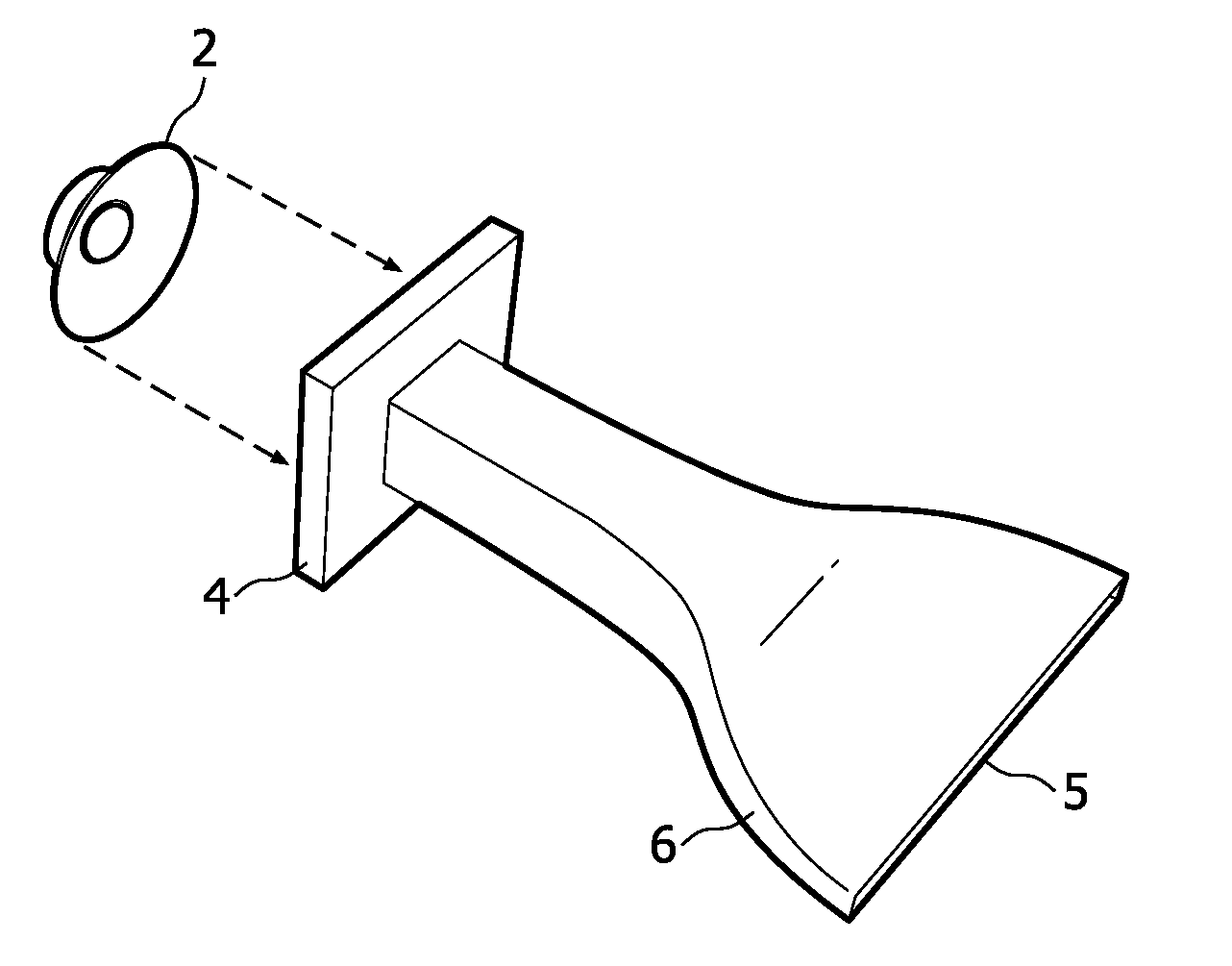
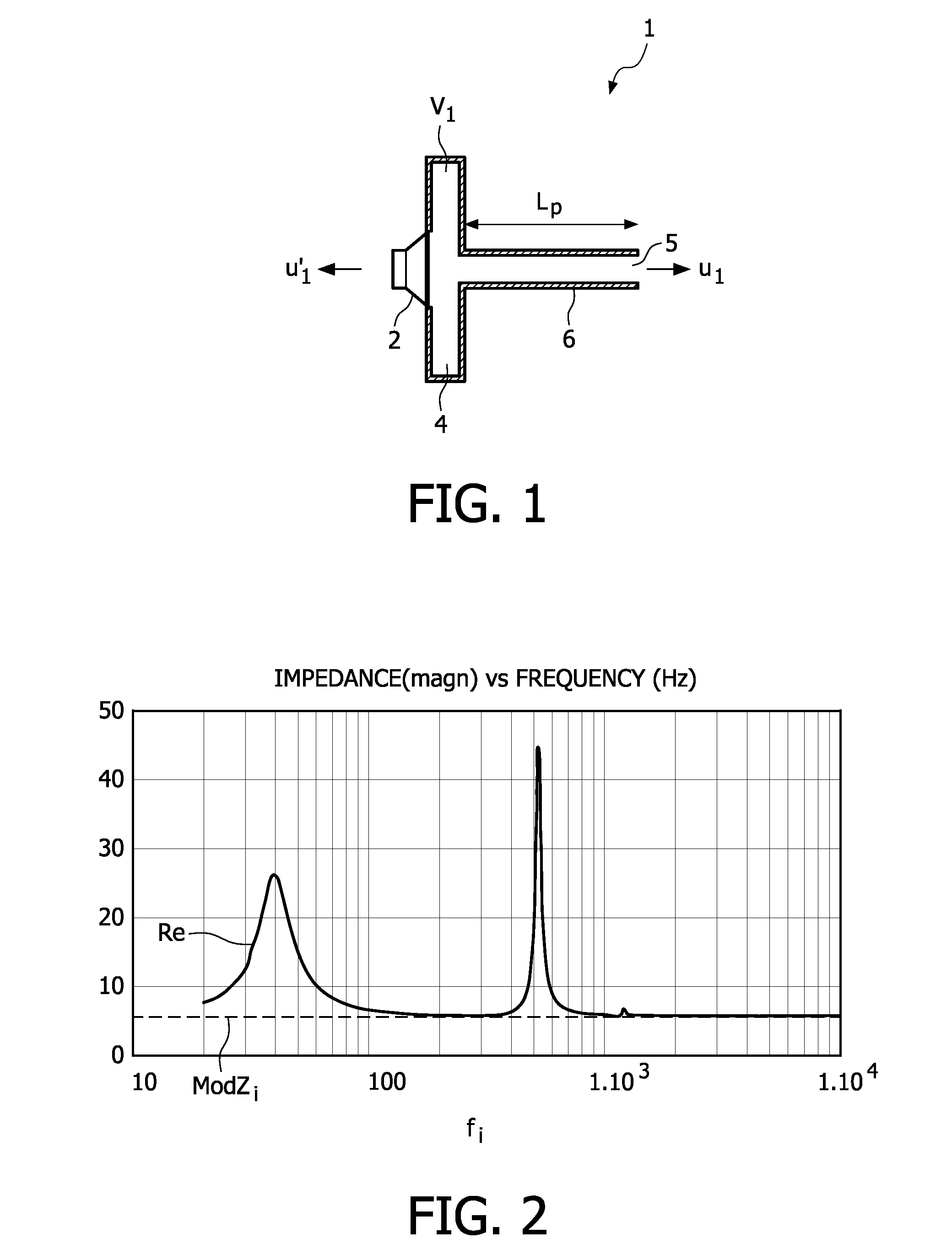
[0031]The cooling device 1 in FIG. 1 comprises a transducer 2 having a membrane adapted to generate pressure waves at a working frequency (fw). The transducer 2 is here illustrated as a loudspeaker, but is not limited thereto. On the contrary any transducer capable of generating a pressure wave could be used. A cavity 4 is arranged in front of the transducer 2, thereby enclosing a first side of the transducer membrane. The fluid in the cavity 4 is here air. The cavity 4 is in communication with the environment outside the cavity through an opening 5. Furthermore, the opening is in communication with the rear of the transducer (i.e. the side of the membrane facing away from the cavity). The opening 5 is connected to the cavity 4 via a channel 6, having a uniform shape and size throughout its extension, here in the form of a cylindrical tube 6. However, the channel may be in a variety of shapes. For example, the channel may have a rectangular cross-section. Also, the cross-section may...

the structure of the environmentally friendly knitted fabric provided by the present invention; figure 2 Flow chart of the yarn wrapping machine for environmentally friendly knitted fabrics and storage devices; image 3 Is the parameter map of the yarn covering machine
Login to View More

PUM

No PUM Login to View More

Abstract

A cooling device (1) using pulsating fluid for cooling of an object, comprising: a transducer (2) having a membrane adapted to generate pressure waves at a working frequency (fw), and a cavity (4) enclosing a first side of the membrane. The cavity (4) has at least one opening (5) adapted to emit a pulsating net output fluid flow towards the object, wherein the opening (5) is in communication with a second side of the membrane. The cavity (4) is sufficiently small to prevent fluid in the cavity (4) from acting as a spring in a resonating mass-spring system in the working range. This is advantageous as a volume velocity (u1) at the opening is essentially equal to a volume velocity (u1′) at the second side of the membrane, apart from a minus sign. Thus, at the working frequency the pulsating net output fluid can be largely cancelled due to the counter phase with the pressure waves on the second side of the membrane resulting in a close to zero far-field volume velocity. Thus a low sound level is achieved, at a low cost, without requiring mechanical symmetry.

Description

TECHNICAL FIELD[0001]The present invention relates to a cooling device using pulsating fluid for cooling of an object, comprising: a transducer having a membrane adapted to generate pressure waves at a working frequency (fw), and a cavity enclosing a first side of the membrane, the cavity having at least one opening adapted to emit a pulsating net output fluid flow towards the object, wherein the opening is in communication with a second side of the membrane.[0002]The present invention further relates to an electronic device and an illumination device comprising such a cooling device.BACKGROUND OF THE INVENTION[0003]The need for cooling has increased in various applications due to higher heat flux densities resulting from newly developed electronic devices, being, for example, more compact and / or higher power than traditional devices. Examples of such improved devices include, for example, higher power semiconductor light-sources, such as lasers or light-emitting diodes, RF power de...

Claims

the structure of the environmentally friendly knitted fabric provided by the present invention; figure 2 Flow chart of the yarn wrapping machine for environmentally friendly knitted fabrics and storage devices; image 3 Is the parameter map of the yarn covering machine
Login to View More

Application Information

Patent Timeline
30 Sep 2010
Publication
US20100243217A1
IPC
F28F23/00
CPC
F04F7/00; F04D33/00; F04D23/006; F04D35/00; H05K7/20
Inventors
AARTS, RONALDUS MARIA; LASANCE, CLEMENS JOHANNES MARIA