Novel 4,5-dihydroisoxazoles with estrogenic activity
Inactive Publication Date: 2010-10-21
PULKKINEN JUHA +4
View PDF0 Cites 3 Cited by
Summary
Abstract
Description
Claims
Application Information
AI Technical Summary
This helps you quickly interpret patents by identifying the three key elements:
Problems solved by technology
Method used
Benefits of technology
Problems solved by technology
However, the above mentioned publications do not suggest any pharmaceutical use for the disclosed compounds.
Method used
the structure of the environmentally friendly knitted fabric provided by the present invention; figure 2 Flow chart of the yarn wrapping machine for environmentally friendly knitted fabrics and storage devices; image 3 Is the parameter map of the yarn covering machine
View more
Image
Smart Image Click on the blue labels to locate them in the text.
Viewing Examples
Smart Image
Click on the blue label to locate the original text in one second.
Reading with bidirectional positioning of images and text.
[0084]Method A: 2-Nitrobenzaldehyde oxime (2.14 g, 0.0129 mol) is dissolved into 100 ml of chloroform. Allylbenzene (2.31 g, 0.0194 mol) and pyridine (0.31 g, 0.0039 mol) are then added and the solution is cooled to 0° C. After that, 5% NaOCl solution (58 ml, 0.039 mol) is added dropwise to the vigorously stirred reaction mixture keeping the temperature of the solution at 0-5° C. for 1.5 h. Then the mixture is allowed to warm to the room temperature. The organic layer is separated and the water phase extracted with dichloromethane. The combined organic phase is then washed with 2 M HCl, saturated NaHCO3 and water, dried with MgSO4 and evaporated to dryness. The residue is purified by column cromatography using dichloromethane as an eluent.
[0240]Method B: To a solution of 5-Benzyl-3-(2-methoxyphenyl)-4,5-dihydroisoxazole (compound 6, 2 mmol, synthesized using the general method described in Example 1) in 2 ml of dichloromethane was added 2.2 ml of 1M BBr3 in dichloromethane (2.2 mmol, for compounds having two or three aromatic methoxyl groups, 4.2 mmol and 6.2 mmol was used, respectively) and the solution was stirred under argon at room temperature overnight. The organic layer was evaporated to give the oily product, which was purified by column chromatography using dichloromethane as an eluent.
the structure of the environmentally friendly knitted fabric provided by the present invention; figure 2 Flow chart of the yarn wrapping machine for environmentally friendly knitted fabrics and storage devices; image 3 Is the parameter map of the yarn covering machine
Login to View More
PUM
Login to View More
Abstract
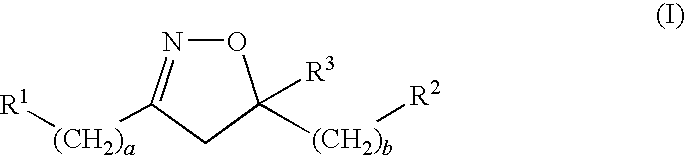
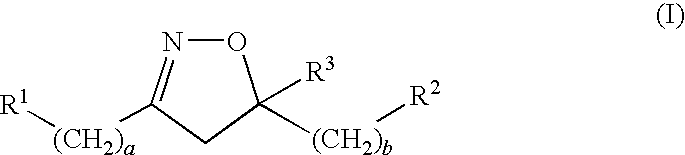
This invention relates to novel 4,5-dihydroisoxazoles of formula (I), to their use as estrogenreceptor modulators, and to methods of their preparation.
Description
FIELD OF THE INVENTION[0001]This invention relates to certain 4,5-dihydroisoxazoles, to their use as estrogenreceptor modulators, and to methods of their preparation.BACKGROUND OF THE INVENTION[0002]The nuclear hormonereceptor superfamily is a very important target for drug development. Members of this group include estrogen, androgen, progesterone, and glucocorticoid receptors, the activity of which can be controlled by ligand binding, as well as constitutive androstane and pregnane X receptors which have an essential role in drugmetabolism. Nuclear hormone receptors regulate expression of their target genes, which control the essential metabolic reactions and differentiation processes of cells. Thus, nuclear receptor disorders are of great clinical importance.[0003]Naturally occurring and synthetic estrogens have been widely utilized in the treatment of variety of disorders including cardiovascular disease, menopausal symptoms, dysmenorrhea, acne, prostatic cancer, hirsutism, o...
Claims
the structure of the environmentally friendly knitted fabric provided by the present invention; figure 2 Flow chart of the yarn wrapping machine for environmentally friendly knitted fabrics and storage devices; image 3 Is the parameter map of the yarn covering machine
Login to View More
Application Information
Patent Timeline
Application Date:The date an application was filed.
Publication Date:The date a patent or application was officially published.
First Publication Date:The earliest publication date of a patent with the same application number.
Issue Date:Publication date of the patent grant document.
PCT Entry Date:The Entry date of PCT National Phase.
Estimated Expiry Date:The statutory expiry date of a patent right according to the Patent Law, and it is the longest term of protection that the patent right can achieve without the termination of the patent right due to other reasons(Term extension factor has been taken into account ).
Invalid Date:Actual expiry date is based on effective date or publication date of legal transaction data of invalid patent.


 Login to View More
  Login to View More