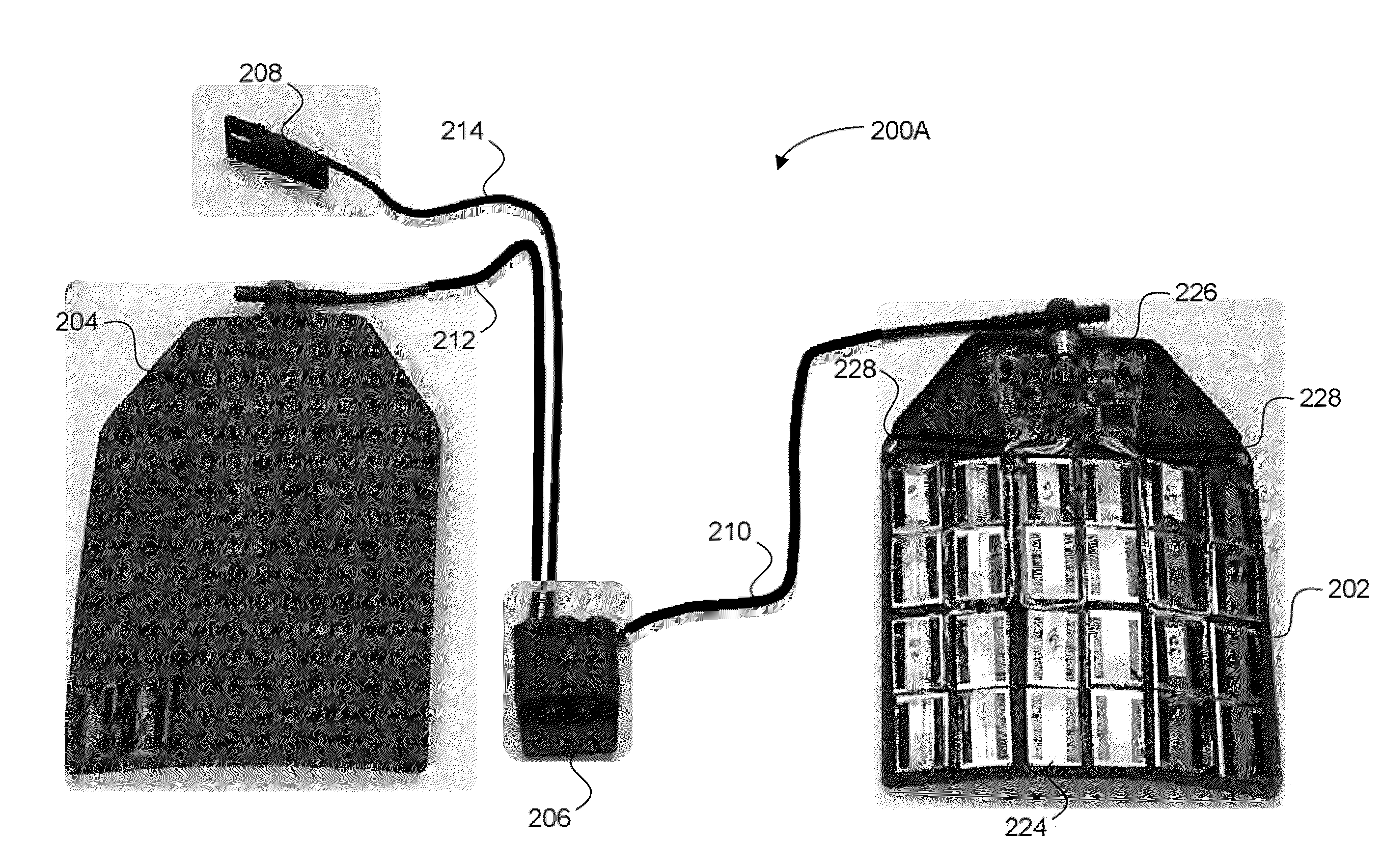
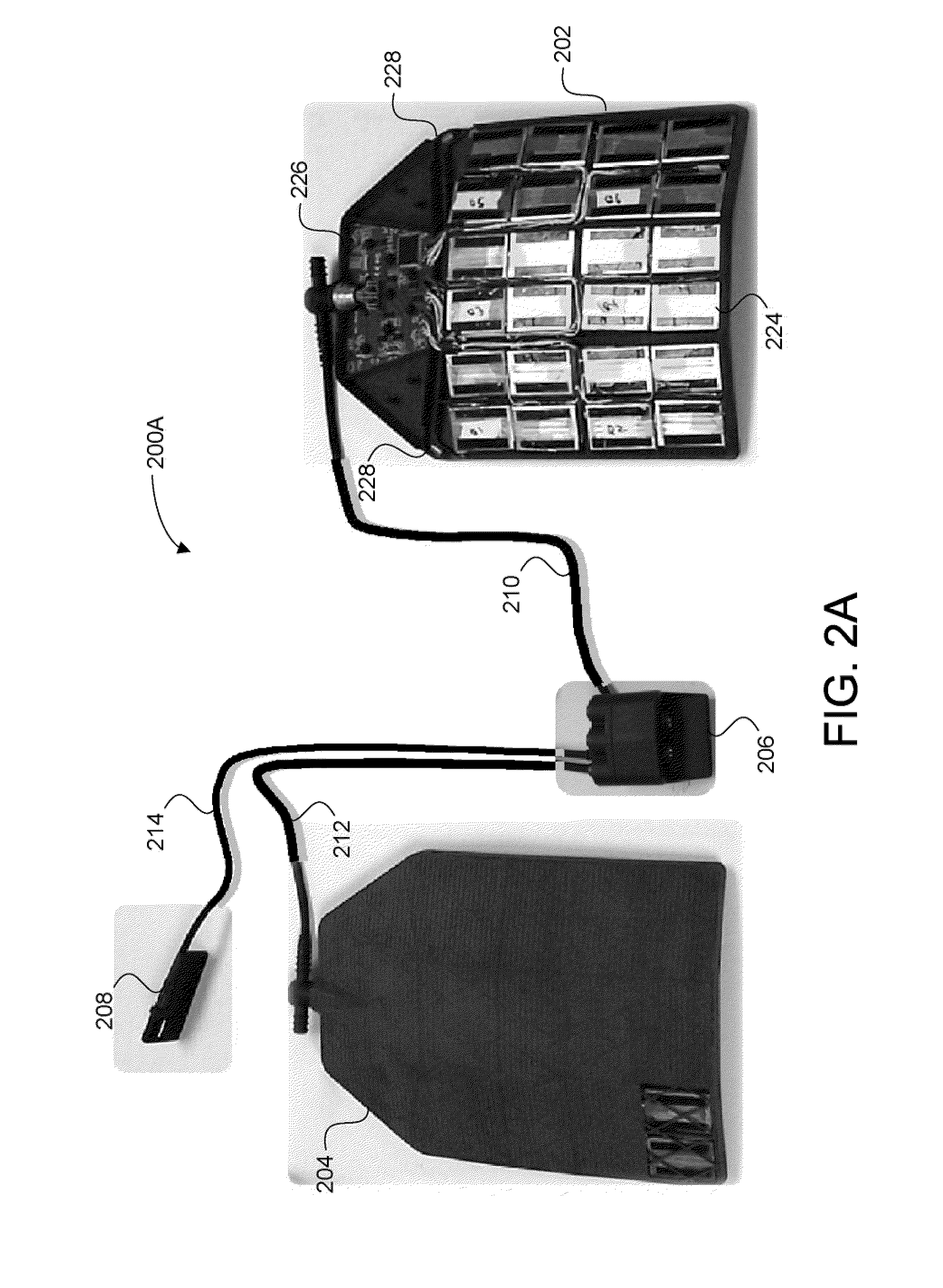
[0006]The armored plate may provide ballistic protection to a user of an armored garment that incorporates the armored plate. When positioned proximally and face-to-face, the power plate may enhance the protectiveness of the armored plate. For example, a ballistic
projectile that first strikes the power plate may be decelerated, shattered, or deflected to some degree (e.g., twist), thereby reducing energy transmitted to the armored plate.
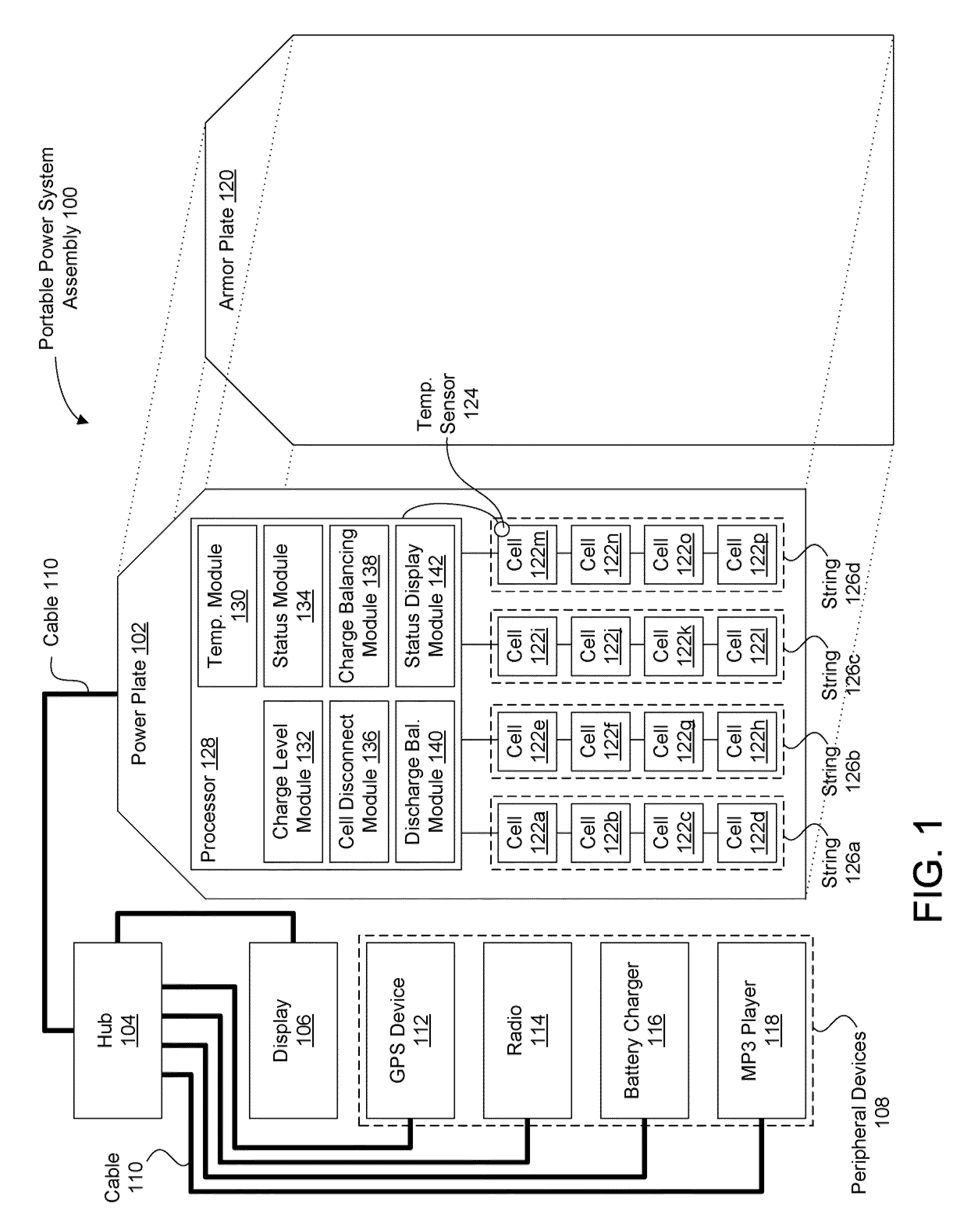
[0010]The strings may include any configuration such as a
linear array of cells or a
rectangular array of cells. The cells that are respectively included in each of the strings may be connected in series, in parallel, or in another configuration. The strings may be connected in series, in parallel, or in another configuration. Additionally, the strings may be isolated from each other so that they are not interconnected. By segregating the strings, performance of the power plate may be maintained, even when one or more of the strings become disabled, such as in the event of
ballistic impact on one of the strings. Furthermore, wires and / or cables routed to the cells may be segregated so as to minimize wire and / or cable failure in the event of
ballistic impact on a wire or cable.
[0017]The
cell disconnect module may be configured to disconnect one or more of the cells having a fault associated therewith, such as that determined through execution of the status module. By disconnecting a
cell having a fault, performance of the
portable power system assembly may be maintained. For example,
catastrophic failure of a
cell such as an explosion or cell ignition may be prevented. Furthermore, leakage of damaged cells may be halted or minimized. Additionally, by disconnecting a cell having a fault, the remaining cells may be prevented from becoming faulty or otherwise damaged.
[0019]Controlling the charge
power level during charging of the cells may extend lifetime and maintain proper performance of the cells, as well as prevent overheating. Controlling charge
power level of each cell may minimize or greatly reduce charging times. For example, controlling the charge
power level may prevent against overcharging where a cell's capacity is exceeded,
overvoltage where the
cell voltage exceeds an upper design limit, and / or
overcurrent where the current delivered to the cell exceeds an upper design limit. To illustrate controlling a charge power level, if one cell is at 80% capacity and the remaining cells are each at 98% capacity, the charge balancing module will prevent excessive current from being provided to the one cell during charging while the capacity of the one cell is brought up to match that of the remaining cells.
[0021]Controlling the
discharge power level during discharging of the cells may extend lifetime and maintain proper performance of the cells, as well as prevent safety risks. For example, controlling the
discharge power level may prevent against deep discharging where a cell is completely drained or rapid discharges due to shorted circuitry. To illustrate controlling a
discharge power level, if the power plate is utilized to provide electrical power to a lamp that is left on for an extended period of time, the discharge balancing module may prevent the cells from becoming completely drained.
[0023]Another aspect of the invention relates to an armored garment that incorporates an electrical power source. The armored garment may include an armor plate situated in the garment to provide ballistic protection to the front of the
upper abdomen of a wearer of the garment. The armored garment may further include a sleeve disposed on the garment outside of the armor plate. The sleeve may be configured to secure an electrical power source to the garment having a
footprint that corresponds to a
footprint of the armor plate. The sleeve may have an opening through which the electrical power source is insertable and removable to the sleeve. The opening may be formed on a side of the sleeve opposite the head of a wearer of the garment while the garment is being worn by the user. The armored garment may further include a pouch configured to at least partially enclose the electrical power source within the sleeve. The electrical power source may enhance ballistic protection of the armored garment.


 Login to View More
  Login to View More