This helps you quickly interpret patents by identifying the three key elements:
Problems solved by technology
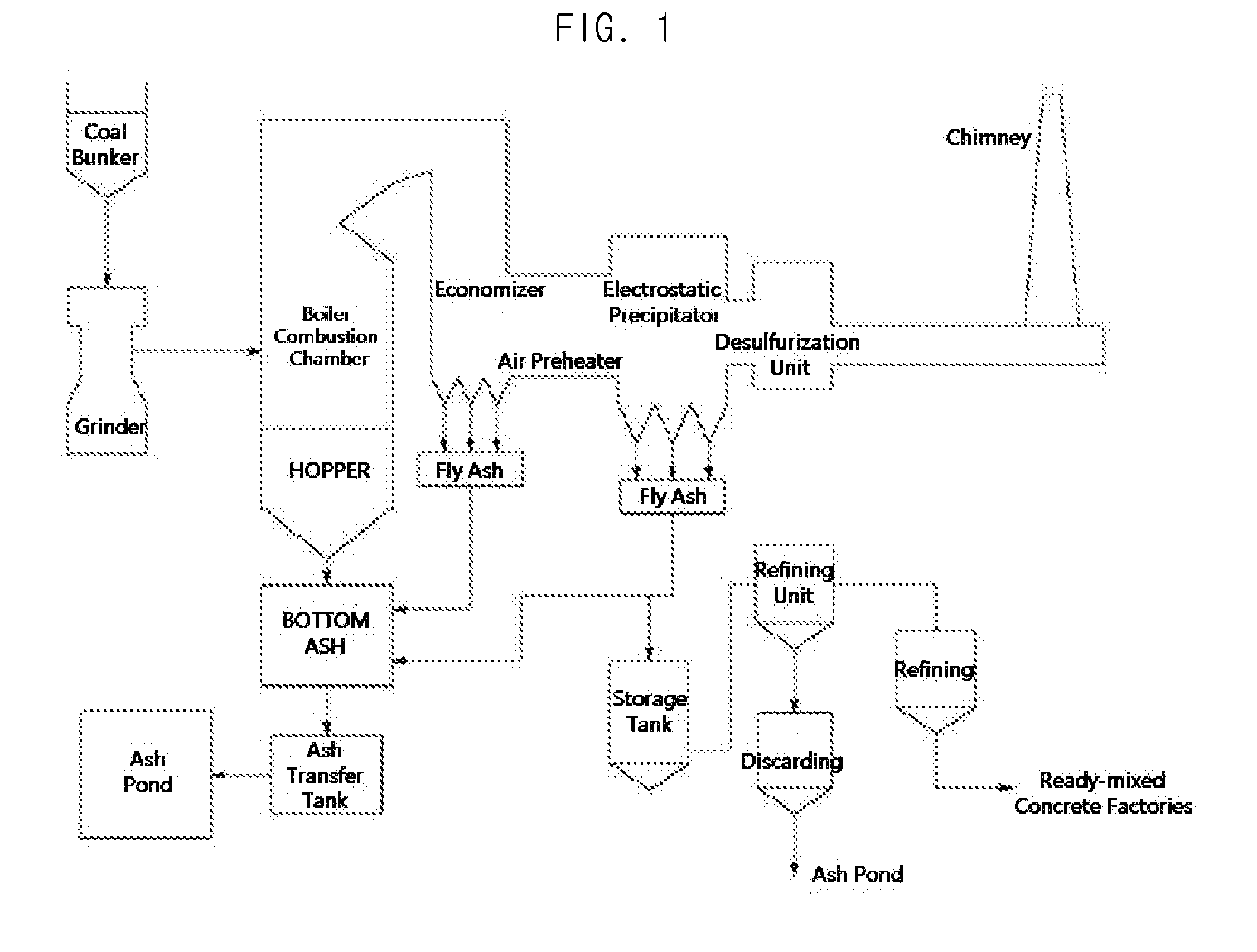
Method used
Benefits of technology
Benefits of technology
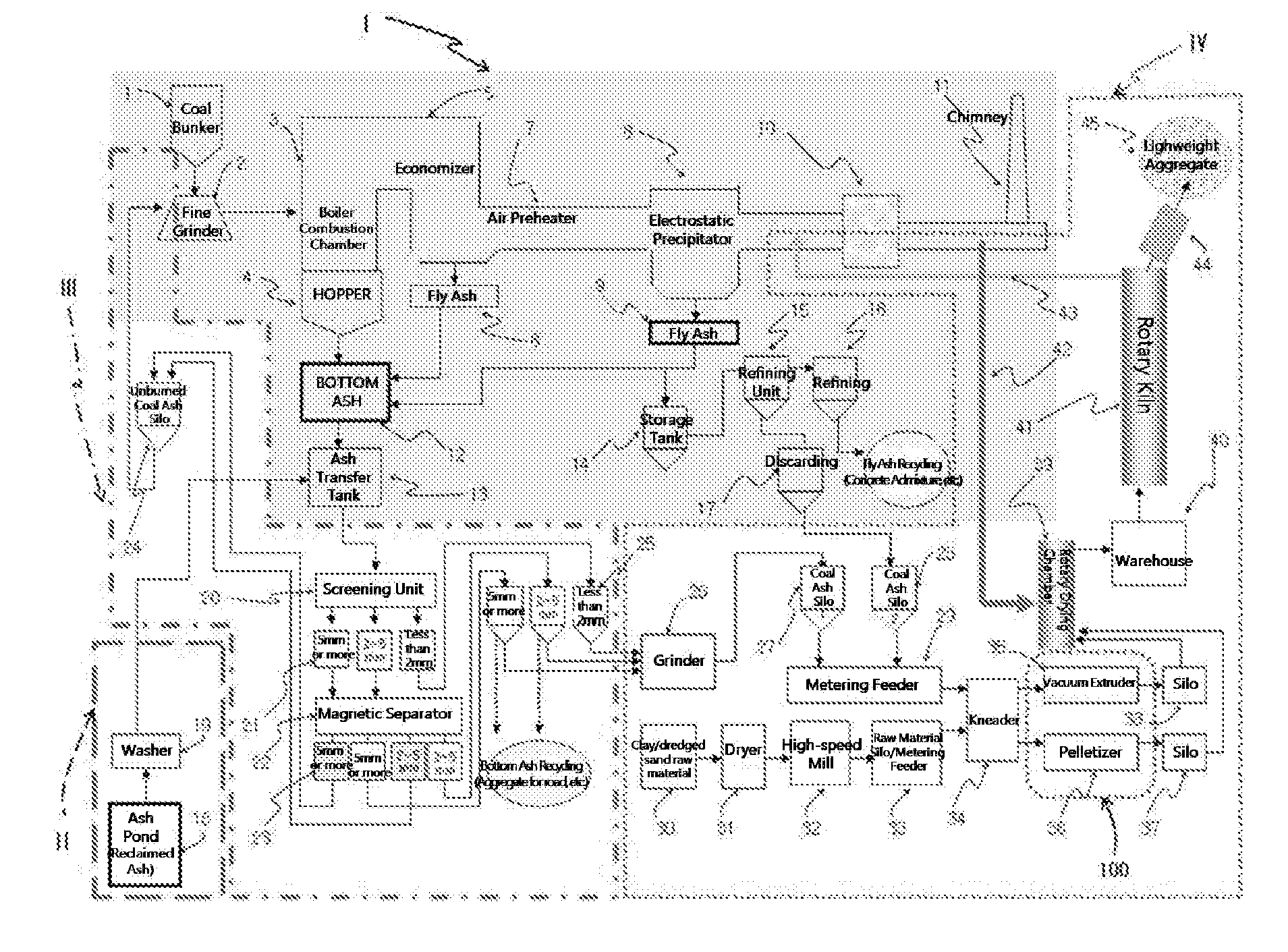
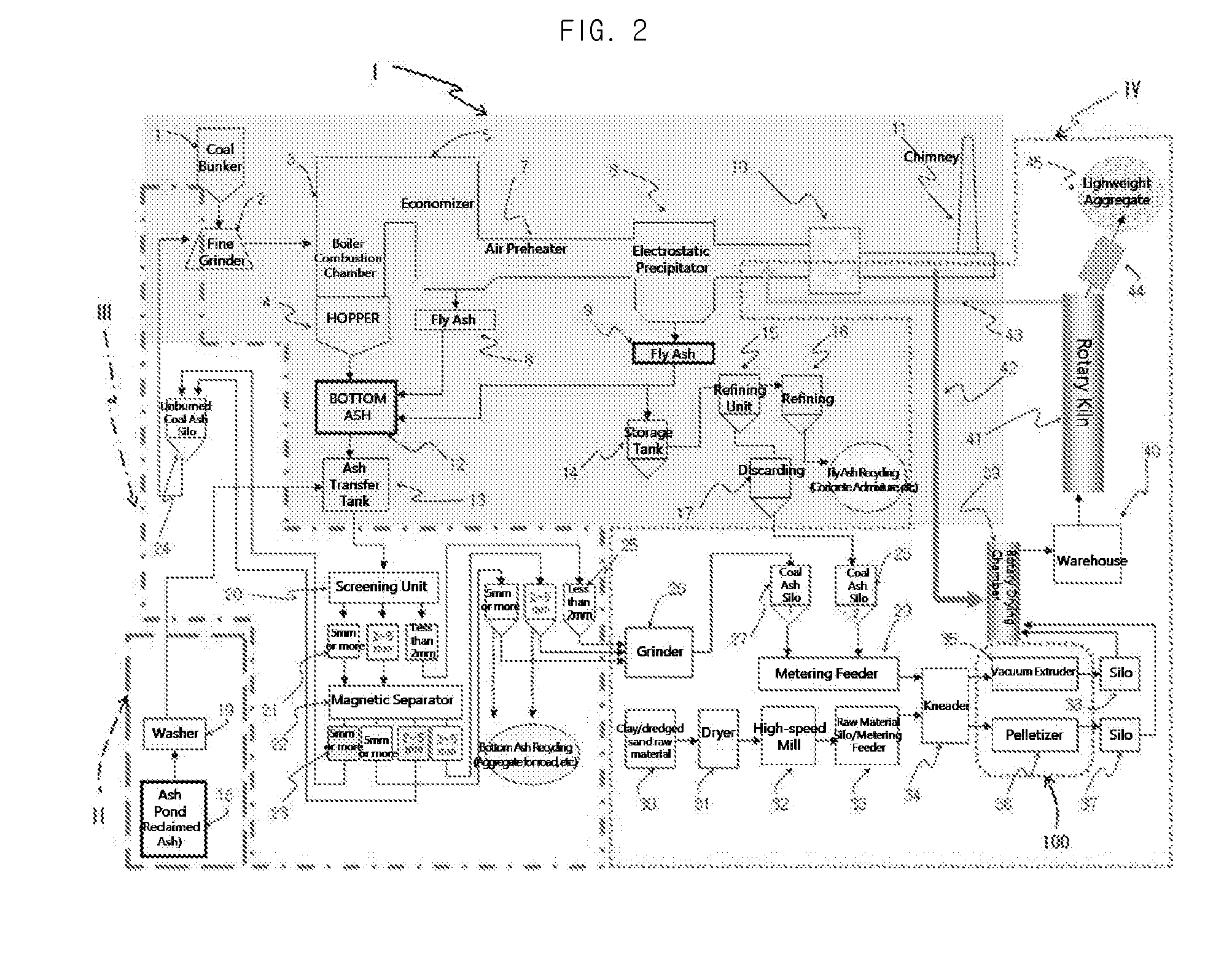
[0013]It is an object of the present invention to provide an apparatus and method for recycling coal ash, which allow each type of coal ash, which is generated in a thermoelectric power plant, to be completely recycled for specific uses, unlike the prior art in which each type of coal ash is partially recycled.
Problems solved by technology
Because the bottom ash has non-uniform particle size and distribution and inferior quality, it is completely is landfilled in breakwaters built into the sea.
Because of this disadvantage, in order for the reclaimed ash to be used in concrete aggregates and the like, the reclaimed ash stored in an ash pond is screened according to particle size and subjected to a washing process and the like.
Even if the reclaimed ash is recycled in this manner, there is a problem in that coal ash remaining after the screening process should be disposed of.
Also, the use of only a portion of reclaimed ash from an additional process for recycling the reclaimed ash causes an increase in the production cost of aggregates and is undesirable in terms of the efficiency of resource recycling.
In Korea, about 1,100 thousand tons of coal ash was generated in the year 2002, and the reclamation of coal ash has problems in that it is difficult to ensure and maintain a landfill, residents neighboring the landfill suffer inconvenience due to fugitive dust, and the reclaimed coal ash flows out in the rainy season to contaminate the surrounding environment.
However, there is a problem in that the coal ash generated should be disposed of after the reburning process.
However, when reclaimed coal ash or bottom ash is recycled as a concrete aggregate substitute as described above, the reclaimed coal ash and the bottom ash have various water contents depending on particle size when used as a concrete aggregate and makes it difficult to ensure the slump and strength of concrete manufactured therefrom, because they contain unrefined fly ash at various ratios and have a very non-uniform particle size distribution, and the strength of the bottom ash differs depending on particle size and shape.
Thus, it is significantly difficult to practically use reclaimed coal ash in concrete.
Also, in order to manufacture concrete from reclaimed ash or bottom ash in a stable manner, it is necessary to carry out a process of separating the reclaimed ash or the bottom ash into coarse aggregate and fine aggregate after a washing process, but these additional processes such as the particle size separation process can increase the production cost of the aggregate and are undesirable in terms of the efficiency of resource recycling.
For these reasons, the use of reclaimed coal ash has not provided satisfactory results in economic and technical terms.
Method used
the structure of the environmentally friendly knitted fabric provided by the present invention; figure 2 Flow chart of the yarn wrapping machine for environmentally friendly knitted fabrics and storage devices; image 3 Is the parameter map of the yarn covering machine
View more
Image
Smart Image Click on the blue labels to locate them in the text.
Viewing Examples
Smart Image
Click on the blue label to locate the original text in one second.
Reading with bidirectional positioning of images and text.
Smart Image
Examples
Experimental program
Comparison scheme
Effect test
example 1
Measurement of Chemical Substances and Leaching of Hazardous Substances of Raw Materials
[0044]The chemical components of red clay (Asan Industrial Co., Ltd., Hongsung, Choongchungnam-do, Korea), dredged sand (Young-Heung thermal power plant, Korea) and reclaimed ash (Young-Heung thermal power plant, Korea) required for manufacturing aggregate were measured according to the chemical analysis and testing methods of KS L 4007 (chemical analysis method of clay). Also, the leaching of hazardous substances contained therein was measured using an ICP-AES instrument (JOVINYVON 138 ultima2c, Holland).
[0045]As a result, as shown in Table 1 below, the reclaimed ash contained a significantly large amount of unburned carbon, suggesting that it can be recycled as electricity generating fuel. The dredged sand showed chemical components similar to those of red clay, suggesting that it can serve to increase the formability and plastic strength of a raw material mixed therewith, and thus can be used ...
example 2
Separation of Reclaimed Ash According to Particle Size and Measurement Ignition Loss
[0046]The reclaimed ash of Example 1 was washed and then separated according to particle size using a screen. The separated reclaimed ash was burned in an electric furnace under conditions of heating rate of 3.8° C. / min, peak temperature of 1150° C. and maintenance time of 1 hour, and the ignition loss of the burned reclaimed ash was measured to determine the content of unburned components in the reclaimed ash according to the particle size.
[0047]As a result, as shown in FIG. 2, the reclaimed ash having a particle size of 5 mm or more showed the highest ignition loss of 24.6%, and the reclaimed ash having a particle size of 1.2-2 mm and the reclaimed ash having a particle size of 2-5 mm showed the second and third higher ignition losses. The reclaimed ash having a particle size smaller than 1.2 mm or less showed an insignificant level of ignition level.
[0048]The reclaimed ash separated according to particle size in Example 2 was subjected to magnetic separation using a magnetic separator (International Process System Co, USA; employing a permanent magnetic such as Photo 3-10), made of a rare earthmetalalloy (Nd—Fe—B) and having a magnetic flux density of 10,000 gauss. To measure the ignition loss of the reclaimed ash subjected to magnetic separation, the reclaimed ash was burned in an electric furnace under conditions of heating rate of 3.8° C. / min, peak temperature of 1150° C. and maintenance time of 1 hour.
[0049]As a result, as shown in Table 3 below, the coal ash of No. 1 subjected to magnetic separation showed a black color, because it contained carbon as its main component. The coal ash of No. 2, not subjected to magnetic separation, was close to gray and showed a porous particle structure.
[0050]Also, as shown in Table 4 below, the coal ash of No. 1 contai...
the structure of the environmentally friendly knitted fabric provided by the present invention; figure 2 Flow chart of the yarn wrapping machine for environmentally friendly knitted fabrics and storage devices; image 3 Is the parameter map of the yarn covering machine
Login to View More
PUM
Property
Measurement
Unit
Length
aaaaa
aaaaa
Particle size
aaaaa
aaaaa
Fraction
aaaaa
aaaaa
Login to View More
Abstract
The present invention relates to an apparatus and method for recycling coal ash, and more particularly to an apparatus and method for recycling coal ash, in which the apparatus for recycling coal ash comprises an unburned coal ash recovery unit and a lightweight aggregate manufacturing unit and is provided in an existing thermoelectric power plant and in which coal ash which is generated in the thermoelectric power plant is completely recycled for specific purposes using the coal ash recycling apparatus. According to the invention, the surrounding environment can be prevented from being contaminated during the transportation of waste to a recycling factory and transportation expenses can be reduced. Moreover, coal ash is completely recycled for specific uses, such that unburned carbon contained in the coal ash can be used. Also, coal ash can be recycled even as concrete admixtures having strict standards. In addition, the present invention can prevent environmental contamination caused by the landfilling of waste and recycle waste, thereby reducing the loss of land and the waste of resources.
Description
TECHNICAL FIELD[0001]The present invention relates to an apparatus and method for recycling coal ash, and more particularly to an apparatus and method for recycling coal ash, in which the apparatus for recycling coal ash comprises an unburned coal ash recovery unit and a lightweight aggregate manufacturing unit and is provided in an existing thermoelectric power plant and in which coal ash which is generated in the thermoelectric power plant is completely recycled for specific purposes using the coal ash recycling apparatus.BACKGROUND ART[0002]As shown in FIG. 1, in a thermoelectric power plant that generates electricity using coal, electricity is generally generated by pulverizing coal to a specific size in order to promote the burning of coal, that is, preparing pulverized coal, and feeding the pulverized coal into a boiler in which the coal is burned, and at the same time, producing high-temperature and high-pressure steam and feeding the produced steam into a steam turbine.[0003...
Claims
the structure of the environmentally friendly knitted fabric provided by the present invention; figure 2 Flow chart of the yarn wrapping machine for environmentally friendly knitted fabrics and storage devices; image 3 Is the parameter map of the yarn covering machine
Login to View More
Application Information
Patent Timeline
Application Date:The date an application was filed.
Publication Date:The date a patent or application was officially published.
First Publication Date:The earliest publication date of a patent with the same application number.
Issue Date:Publication date of the patent grant document.
PCT Entry Date:The Entry date of PCT National Phase.
Estimated Expiry Date:The statutory expiry date of a patent right according to the Patent Law, and it is the longest term of protection that the patent right can achieve without the termination of the patent right due to other reasons(Term extension factor has been taken into account ).
Invalid Date:Actual expiry date is based on effective date or publication date of legal transaction data of invalid patent.



 Login to View More