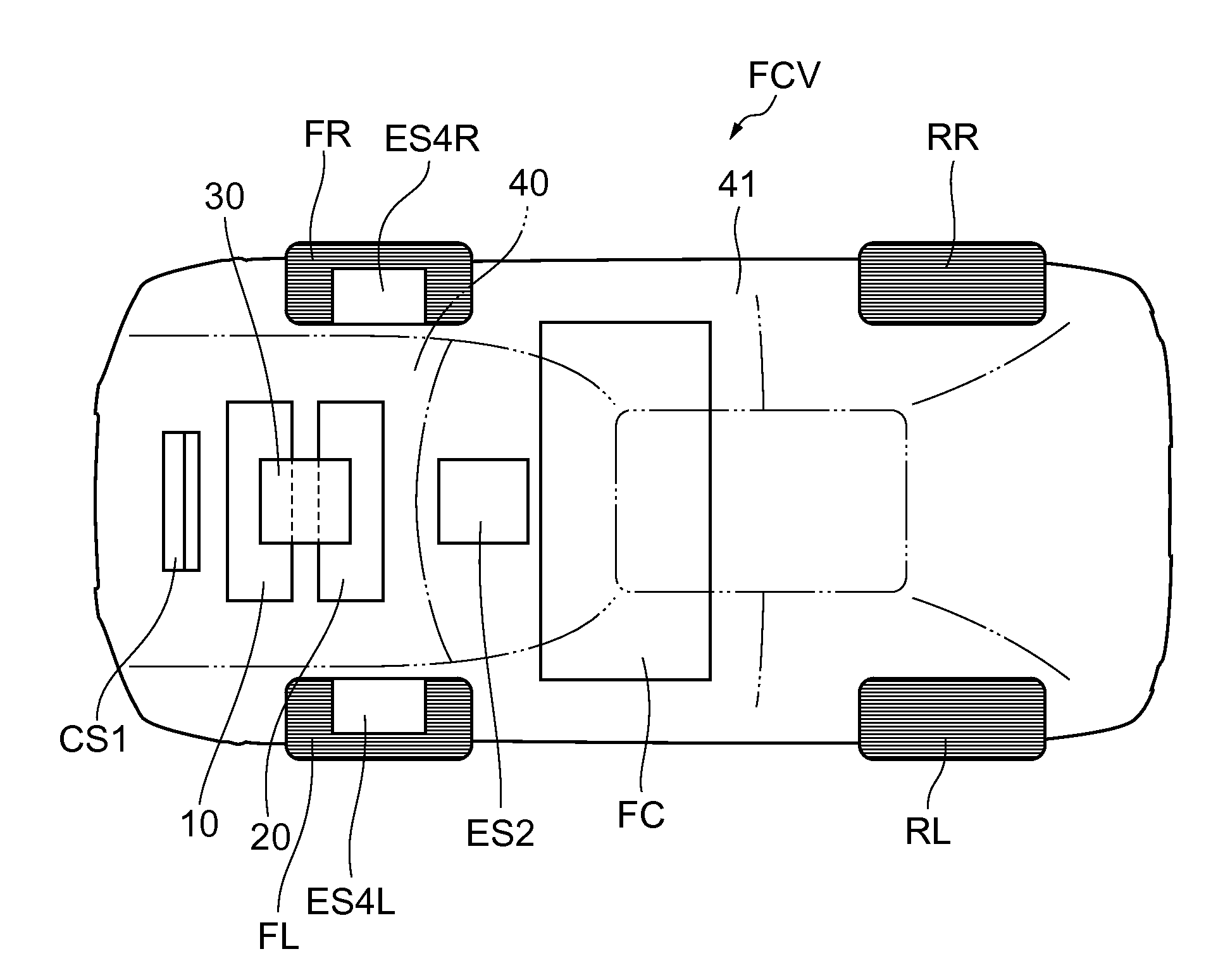
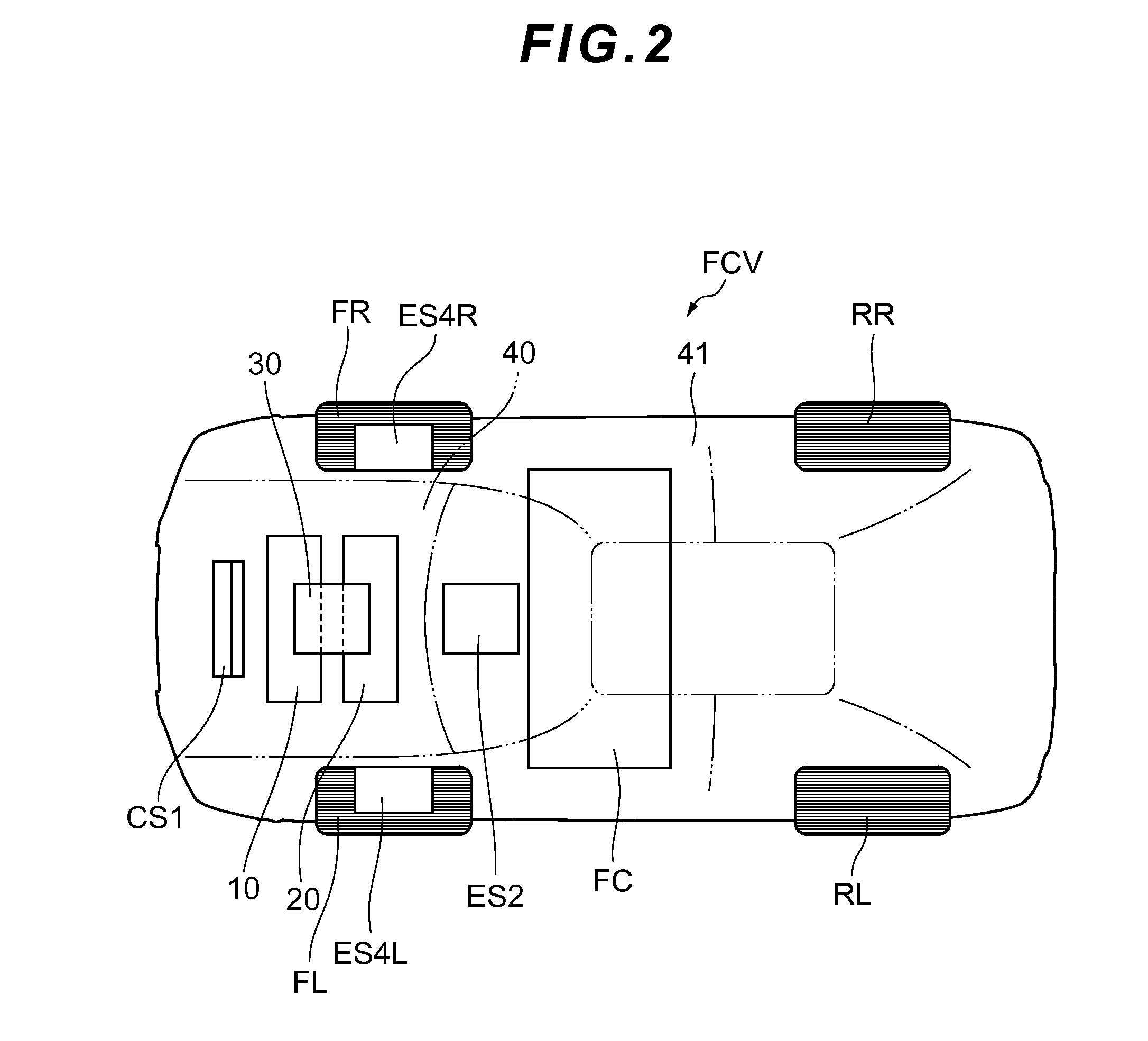
[0008]In the present invention, the first tank and the second tank, which constitute the gas storage section, are arranged in the front area of the fuel cell vehicle, whereby it becomes unnecessary to arrange the first tank and the second tank below the passenger room, making it possible to contribute to an increase in the space in the passenger room. Besides, because
weight distribution can be performed in such a manner as to position heavy loads near the front area, it is possible to keep driving performance good when the front wheels are used as driving wheels. Furthermore, in the present invention, attention is paid to the characteristics of the first and second tanks constituting the gas storage section. The inside of the first and second tanks which store a reaction gas or a
raw material gas obtains a
high pressure, and hence the tanks are fabricated robust in such a manner as to be able to withstand the
high pressure and in order to prevent breakage by the impact from the outside. In the present invention, by using the strength of the first tank and the second tank, it is ensured that even when mutual interference occurs, this mutual interference does not lead to breakage. Specifically, tanks constituting the gas storage section are divided into at least two parts, a first tank and a second tank, and the tanks are arranged so that the positions of the tanks are out of alignment in a vertical direction. Because the first tank and the second tank are arranged in an off-set manner like this, even when the fuel cell vehicle collides and an impact is applied, with the result that the first tank and the second tank come close to each other and interfere with each other, it is possible to absorb the impact while changing the relative positional relation by increasing the amount of offset in a vertical position.
[0009]In the fuel cell vehicle of the present invention, it is also preferred that the second tank be arranged in a position lower than the first tank. When an impact by a collision as described above is applied, the forward first tank moves backward and the backward second tank moves forward, resulting in a condition in which the first tank and the second tank interfere with each other. Because in this preferable aspect the second tank is arranged in a position lower than the first tank, it is possible to adopt a configuration which is such that in the case where the tanks come close to each other and interfere with each other, the backward second tank moves backward while being pushed further below by the first tank. And it becomes possible to adopt a configuration which is such that the impetus of the backward movement of the forward first tank is greatly reduced by the interference with the second tank. Therefore, it becomes possible to control the direction in which the first tank and the second tank move backward during a collision and hence it is possible to positively avoid a situation in which the first tank and the second tank hit passengers and other equipment.
[0010]In the fuel cell vehicle of the present invention, it is also preferred that the first tank and the second tank be fixed to a cross member extending in the width direction of the fuel cell vehicle, and that the cross member have a brittle portion between a part which fixes the above-described first tank and a part which fixes the above-described second tank. When an impact by a collision as described above is applied, the forward first tank moves backward and the backward second tank moves forward, and hence external forces are applied to the cross member which fixes the first tank and the second tank, with the result that breakage occurs from the brittle portion. For this reason, by adjusting the shape of the cross member and the position and the mode of the brittle portion, it becomes easy to control the behavior of the first tank and the second tank during a collision. Furthermore, it becomes possible to regulate the behavior of the first tank and the second tank after a collision by using the cross member and, therefore, it is possible to reduce the amount of movement of the first tank and the second tank after a collision.
[0013]According to the present invention, it is possible to provide a fuel cell vehicle which enables compatibility to be ensured between an increase in the tank capacity of the fuel cell vehicle and an increase in the space in a passenger room and a
trunk, and is capable of absorbing the impact of a collision even if the collision occurs.



 Login to View More
  Login to View More