Check patentability & draft patents in minutes with Patsnap Eureka AI!

Method and Apparatus For Mechanical Energy Harvesting Using Planar Microfluidic Device

a microfluidic device and mechanical energy technology, applied in the field of electrical energy harvesting, can solve the problems of increasing power demands that traditional electrochemical batteries are unable to meet, affecting the advancement of electronics, and not greatly increasing their energy density, so as to achieve the effect of increasing the amount of energy produced for a given surface area

Inactive Publication Date: 2012-07-19
KRUPENKIN THOMAS NIKITA +1
View PDF6 Cites 26 Cited by
  • Summary
  • Abstract
  • Description
  • Claims
  • Application Information

AI Technical Summary

Benefits of technology

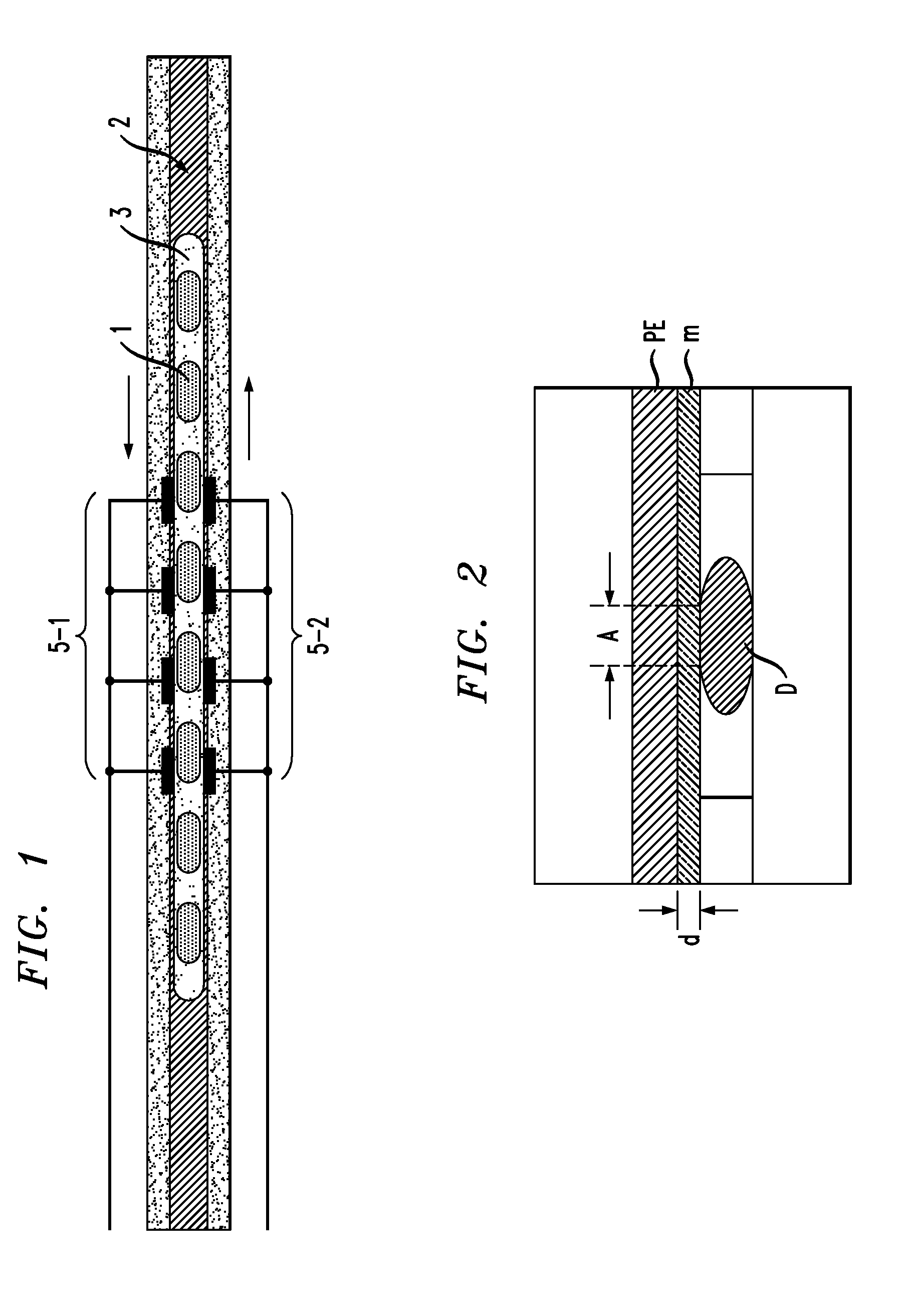
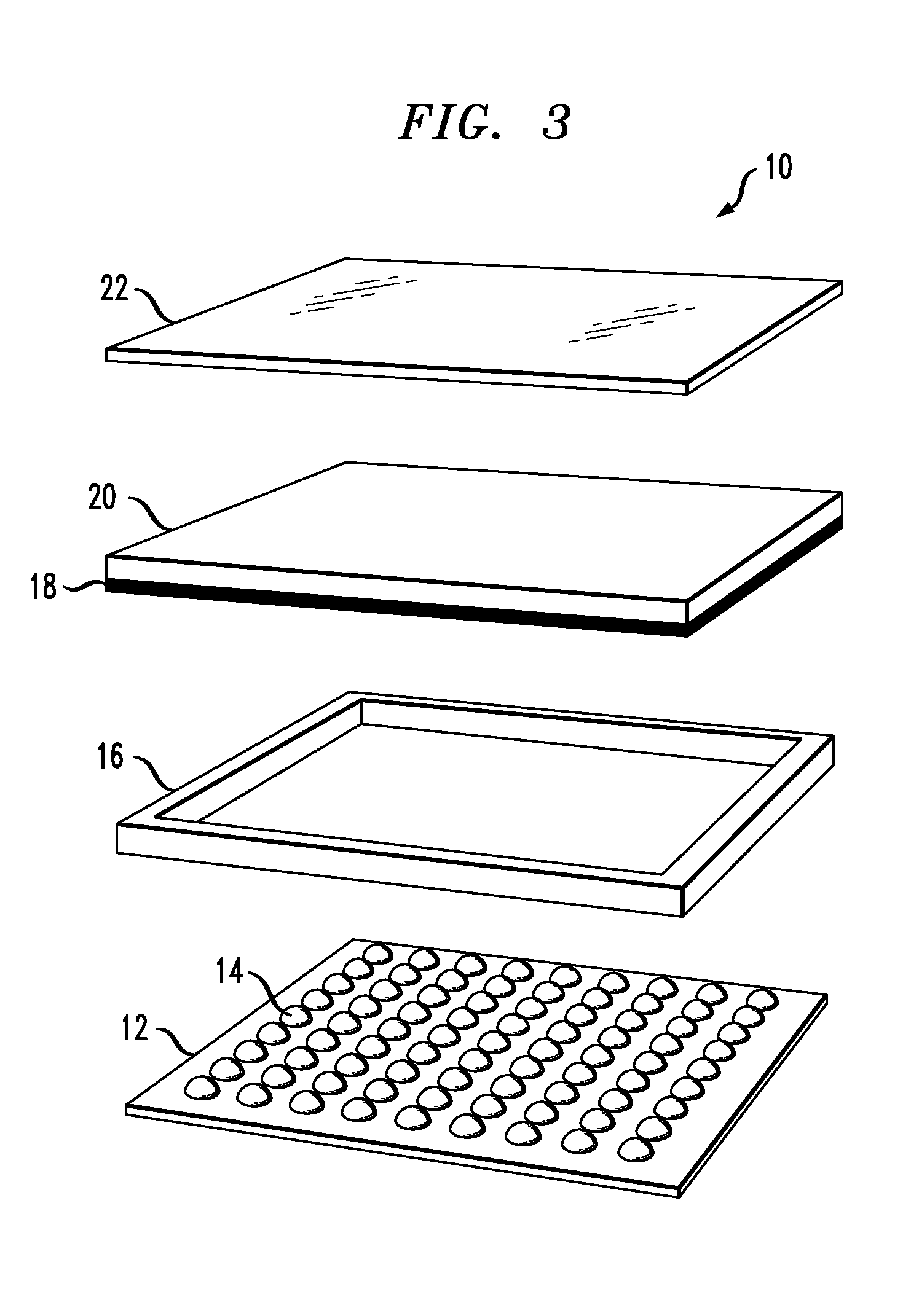
[0009]In accordance with an exemplary embodiment of the present invention, an array of conductive liquid droplets is disposed on a base substrate and separated from a dielectric-covered electrode by an elastic spacer, forming a capacitive array structure. The elastic spacer is periodically compressed in response to external vibrations, which in turn causes the droplets to be periodically squeezed between the electrode and base substrate. The droplet compression increases the contact area between the droplets and the electrode, creating periodic changes in the amount of electrical charge accumulated between the electrodes, resulting in electrical energy production in the form of a current flowing between the electrodes.
[0011]In an alternative embodiment, multiple arrays of droplets may be stacked upon each other (with the associated elastic spacer and conductor), increasing the amount of energy that is produced for a given surface area (i.e., “footprint”).

Problems solved by technology

Although the battery quality has substantially improved over the last two decades, their energy density has not greatly increased.
At present, factors such as cost, weight. limited service time and waste disposal problems (intrinsic to batteries) are impeding the advance in many areas of electronics.
The problem is particularly acute in the portable electronics market, where rapidly growing performance and sophistication of mobile electronic devices has led to ever-increasing power demands that traditional electrochemical batteries are unable to meet.
High power harvesting of mechanical energy is a long-recognized concept, yet it has not been able to be commercialized, due at least in part to the lack of a viable energy harvesting technology.
Existing methods of mechanical-to-electrical energy conversion such as electromagnetic, piezoelectric, or electrostatic do not allow for effective direct coupling to most of the high power environmental mechanical energy sources.
Bulky and expensive mechanical or hydraulic transducers are required to convert a broad range of aperiodic forces and displacements typically encountered in nature into a form accessible for conversion using these methods.
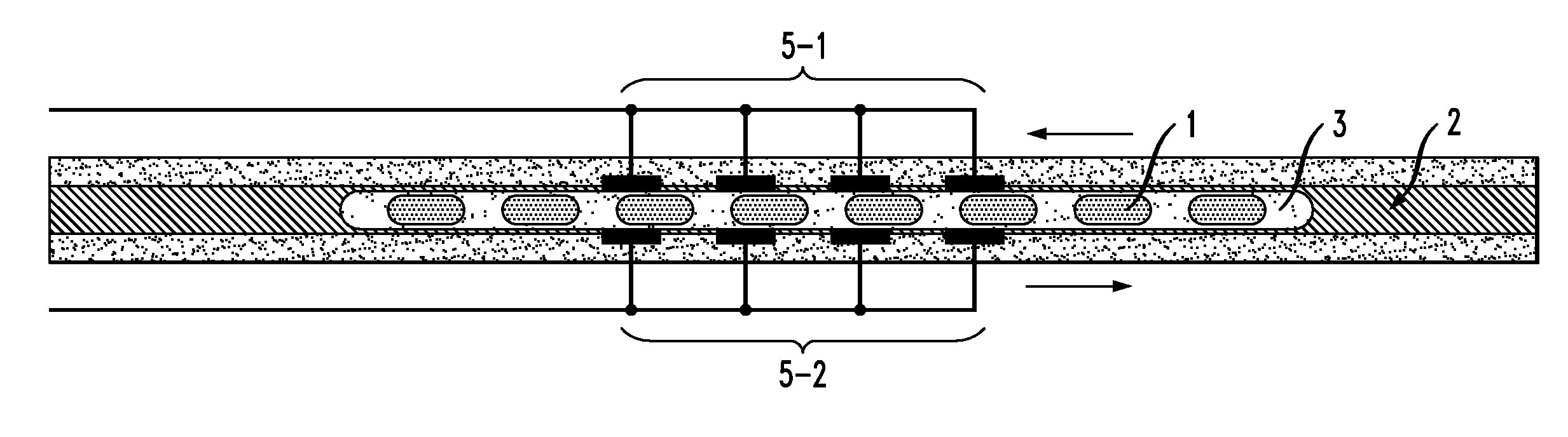
While the microfluidic-based energy harvester as shown in FIG. 1 exhibits a significant improvement over the state of the art, this actuation method is not well-suited for applications where the energy is being harvested from mechanical vibrations, since the displacement amplitude of a vibration is often too small to initiate motion of droplets along a channel.

Method used

the structure of the environmentally friendly knitted fabric provided by the present invention; figure 2 Flow chart of the yarn wrapping machine for environmentally friendly knitted fabrics and storage devices; image 3 Is the parameter map of the yarn covering machine
View more

Image

Smart Image Click on the blue labels to locate them in the text.
Viewing Examples
Smart Image
  • Method and Apparatus For Mechanical Energy Harvesting Using Planar Microfluidic Device
  • Method and Apparatus For Mechanical Energy Harvesting Using Planar Microfluidic Device
  • Method and Apparatus For Mechanical Energy Harvesting Using Planar Microfluidic Device

Examples

Experimental program
Comparison scheme
Effect test

Embodiment Construction

[0023]Before describing the details of the present invention, it is useful to provide an understanding of the underlying principles of electric energy harvesting from the basic microfluidic structure. Microfluidics is a branch of micro-fabrication which is concerned with developing means of handling small volumes of liquids. An aspect of the present invention is to utilize fluidic structures consisting of a large number of microscopic volumes of liquids (e.g., volumes from picoliters to microliters) as a working element in a mechanical-to-electrical energy conversion system. The large number of these microscopic elements (on the order of hundreds or even thousands) yields a realistic amount of electrical energy that can be generated from a relatively small volume of mechanical motion.

[0024]Indeed, the maximum electrical energy output that can be produced by an energy harvesting system of the present invention is directly proportional to the variation of the electrostatic field energ...

the structure of the environmentally friendly knitted fabric provided by the present invention; figure 2 Flow chart of the yarn wrapping machine for environmentally friendly knitted fabrics and storage devices; image 3 Is the parameter map of the yarn covering machine
Login to View More

PUM

No PUM Login to View More

Abstract

An apparatus comprising a mechanical-to-electrical energy converting device utilizes an array of microfluidic droplets in association with a planar electrode and separated by a dielectric layer to form a capacitive structure. An elastic spacer is also disposed between the planar electrode and array of droplets, such that as the spacer is compressed, the contact area of the droplets and the dielectric is increased—increasing the total capacitance value. Periodic changes in the force applied to the elastic spacer (such as associated with vibrational motion) creates a periodic change in the capacitance value, generating an electrical current flow between the planar electrode and array of conductive droplets.

Description

CROSS-REFERENCE TO RELATED APPLICATIONS[0001]This application claims the benefit of U.S. Provisional Application No. 61 / 433,992, filed Jan. 19, 2011 and herein incorporated by reference.TECHNICAL FIELD[0002]The present invention relates to the harvesting of electrical energy from mechanical, vibrational movement and, more particularly, to the utilization of a plurality of microfluidic elements to convert vibrational energy into useful electrical energy.BACKGROUND OF THE INVENTION[0003]Currently, the majority of autonomous and mobile electronic systems are powered by electrochemical batteries. Although the battery quality has substantially improved over the last two decades, their energy density has not greatly increased. At present, factors such as cost, weight. limited service time and waste disposal problems (intrinsic to batteries) are impeding the advance in many areas of electronics. The problem is particularly acute in the portable electronics market, where rapidly growing per...

Claims

the structure of the environmentally friendly knitted fabric provided by the present invention; figure 2 Flow chart of the yarn wrapping machine for environmentally friendly knitted fabrics and storage devices; image 3 Is the parameter map of the yarn covering machine
Login to View More

Application Information

Patent Timeline
no application Login to View More
Patent Type & Authority Applications(United States)
IPC IPC(8): H01L41/113H10N30/30
CPCH01G5/012H02N1/08H01G5/16
Inventor KRUPENKIN, THOMAS NIKITATAYLOR, JOSEPH ASHLEY
Owner KRUPENKIN THOMAS NIKITA
Features
  • R&D
  • Intellectual Property
  • Life Sciences
  • Materials
  • Tech Scout
Why Patsnap Eureka
  • Unparalleled Data Quality
  • Higher Quality Content
  • 60% Fewer Hallucinations
Social media
Patsnap Eureka Blog
Learn More