Check patentability & draft patents in minutes with Patsnap Eureka AI!

Low-cost redeployable protective shelter

a protective shelter and low-cost technology, applied in the field of protective shelters, can solve the problems of unsuitable locations for underground shelter installation, unportable underground shelters, and increased construction costs of underground shelters, and achieve the effects of low structural weight, high wind resistance, and low construction cos

Active Publication Date: 2012-12-27
M&K LEGACY LLC
View PDF8 Cites 0 Cited by
  • Summary
  • Abstract
  • Description
  • Claims
  • Application Information

AI Technical Summary

Benefits of technology

"The patent describes a protective shelter that can be easily installed and is resistant to wind and tornadoes. The shelter is made of a cylindrical wall member and a domed member that can be attached to an underlying substrate, such as soil or concrete. The shelter is small and light enough to be portable but massive enough to not be blown away or structurally compromised in high winds. The shelter is made from pressure vessels, such as decommissioned liquid propane tanks, and has a relatively low wind resistance. The technical effects of this invention include an affordable, portable, and safe protective shelter that can be easily installed and resistant to wind and tornadoes."

Problems solved by technology

Construction costs of underground shelters are greater than those for above-ground shelters.
Also, underground shelters are not portable.
Moreover, some locations are unsuitable for installation of underground shelters because of a high underground water table, which could flood the underground shelter and pose a danger to any inhabitants of the shelter.
However, such buildings are expensive and certainly not portable.
Houses with wood frame construction are vulnerable to tornadoes due to their high wind resistance and low structural weight.
Mobile homes are particularly susceptible to tornado and tropical cyclone destruction because of their high wind resistance, low structural strength, and light weight.
However, curved surfaces are typically not as easy to work with or manufacture as are planar surfaces.

Method used

the structure of the environmentally friendly knitted fabric provided by the present invention; figure 2 Flow chart of the yarn wrapping machine for environmentally friendly knitted fabrics and storage devices; image 3 Is the parameter map of the yarn covering machine
View more

Image

Smart Image Click on the blue labels to locate them in the text.
Viewing Examples
Smart Image
  • Low-cost redeployable protective shelter
  • Low-cost redeployable protective shelter
  • Low-cost redeployable protective shelter

Examples

Experimental program
Comparison scheme
Effect test

Embodiment Construction

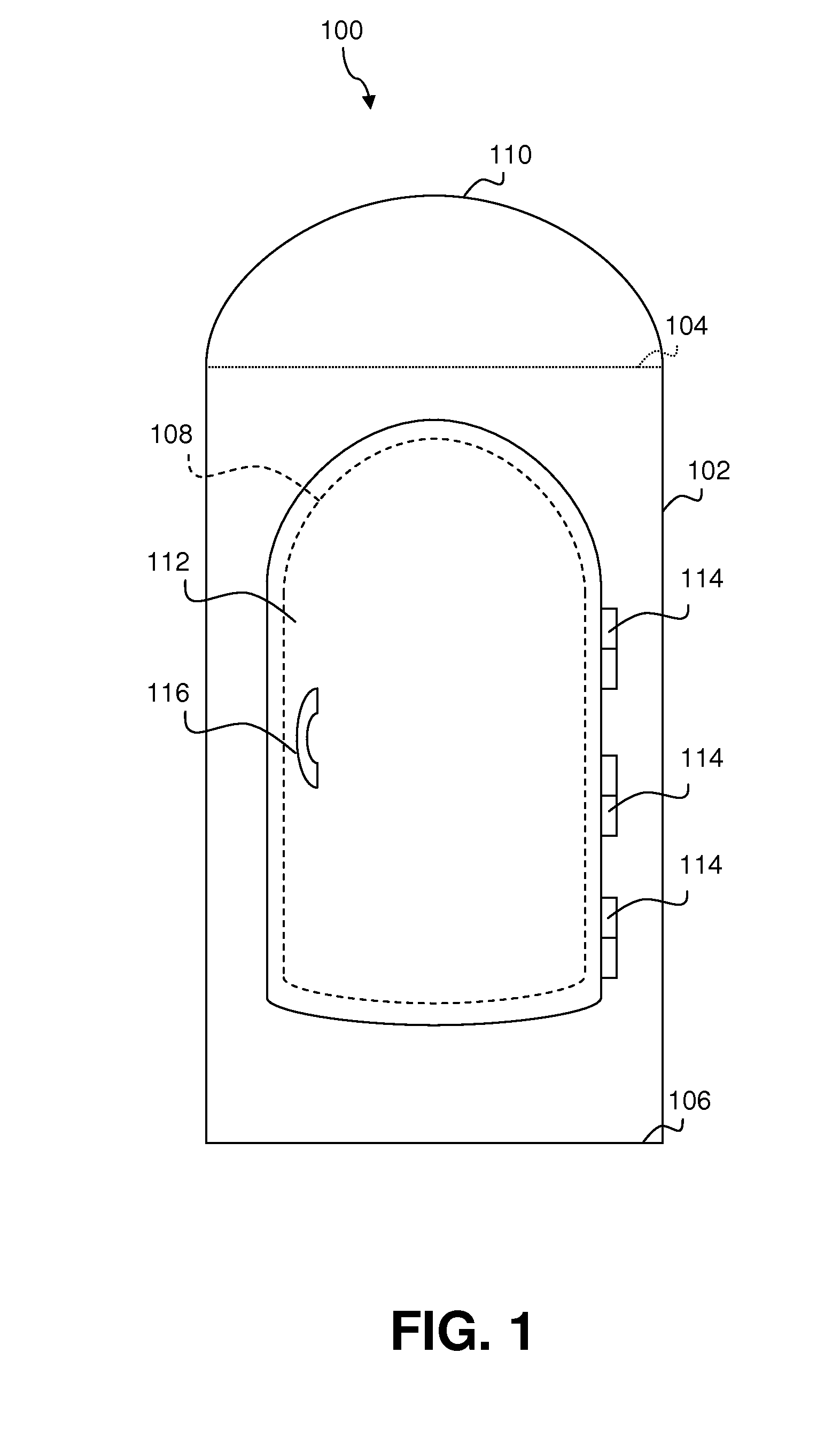
[0021]With reference now to the figures, and in particular with reference to FIG. 1, there is depicted an exemplary embodiment of a protective shelter 100. As shown, protective shelter 100 includes a substantially cylindrical wall member 102 defining a shelter interior (shown subsequently as 204 in FIGS. 2 and 304 in FIGS. 3A and 3B). Wall member 102 includes a first end (illustrated as dotted line 104), a second end 106, and an opening (its perimeter is represented as dashed line 108) formed there through. A domed member 110 is coupled to first end 104 of wall member 102. A door 112 is coupled via hinges 114 to wall member 102. Door 112 is openable to permit ingress and egress into and out of shelter interior through opening 108 and closeable to cover opening 108 (as shown in FIG. 1). A handle 116 is attached to exterior of door 112 to facilitate opening of door 112 from the exterior of protective shelter 100. Each dimension of door 112 exceeds a corresponding dimension of the unde...

the structure of the environmentally friendly knitted fabric provided by the present invention; figure 2 Flow chart of the yarn wrapping machine for environmentally friendly knitted fabrics and storage devices; image 3 Is the parameter map of the yarn covering machine
Login to View More

PUM

No PUM Login to View More

Abstract

A protective shelter is presented. The protective shelter includes a substantially cylindrical wall member defining a shelter interior. The wall member has a first end and a second end and an opening formed there through. A domed member is coupled to the first end of the wall member. A door coupled to the wall member. The door is openable to permit ingress and egress into and out of the shelter interior through the opening and being closeable to cover the opening. At least one anchor point is coupled to the wall member adjacent to the second end, such that the protective shelter can be anchored to an underlying substrate.

Description

PRIOR APPLICATION DATA[0001]The present application is a continuation of U.S. patent application Ser. No. 12 / 696,810, filed on Jan. 29, 2010, entitled “LOW-COST REDEPLOYABLE PROTECTIVE SHELTER”, which claims priority to U.S. Provisional Patent Application No. 61 / 148,688, filed Jan. 30, 2009, which are incorporated herein by reference in their entireties.BACKGROUND OF THE INVENTION[0002]1. Technical Field[0003]The present invention relates in general to protective shelters, which can used, for example, as safe rooms, tornado shelters, etc.[0004]2. Description of the Related Art[0005]Every year in the United States and around the globe a number of people are killed or injured by wind producing storms, such as tornados and tropical cyclones. This is especially in the case in the United States (U.S.), which has endured the most tornadoes of any country, nearly four times more than estimated in all of Europe, excluding waterspouts. The United States averages about 1,200 confirmed tornado...

Claims

the structure of the environmentally friendly knitted fabric provided by the present invention; figure 2 Flow chart of the yarn wrapping machine for environmentally friendly knitted fabrics and storage devices; image 3 Is the parameter map of the yarn covering machine
Login to View More

Application Information

Patent Timeline
no application Login to View More
Patent Type & Authority Applications(United States)
IPC IPC(8): E04H9/00
CPCE04H9/14Y02A50/00
Inventor DEROSE, DIRK
Owner M&K LEGACY LLC
Features
  • R&D
  • Intellectual Property
  • Life Sciences
  • Materials
  • Tech Scout
Why Patsnap Eureka
  • Unparalleled Data Quality
  • Higher Quality Content
  • 60% Fewer Hallucinations
Social media
Patsnap Eureka Blog
Learn More