This helps you quickly interpret patents by identifying the three key elements:
Problems solved by technology
Method used
Benefits of technology
Benefits of technology
The invention provides compounds that have antimicrobial activity. These compounds can be used to treat infections caused by bacteria, fungi, and other microorganisms. The compounds have specific formulas and can be described as being either aromatic or heteroaromatic. They can also have specific alkyl or cycloalkyl groups attached to them. The compounds can be substituted with various groups such as halogens, cyano, nitro, hydroxy, carboxy, and others. The patent text also describes the use of these compounds in various compositions and methods for their use.
Problems solved by technology
For example, the antibiotic colistin was traditionally considered too nephrotoxic and neurotoxic for clinical use, but is nevertheless used to treat many MDR bacterial infections due to a paucity of available active drugs.
Method used
the structure of the environmentally friendly knitted fabric provided by the present invention; figure 2 Flow chart of the yarn wrapping machine for environmentally friendly knitted fabrics and storage devices; image 3 Is the parameter map of the yarn covering machine
View more
Image
Smart Image Click on the blue labels to locate them in the text.
Viewing Examples
Smart Image
Click on the blue label to locate the original text in one second.
Reading with bidirectional positioning of images and text.
Smart Image
Examples
Experimental program
Comparison scheme
Effect test
example 1
Preparation of Compound
[0711]
[0712]To a nitrogen-flushed mixture of 2,3-dimethoxy-5-(quinolin-3-yl)phenyl trifluoroethanesulfonate (0.10 g, 0.24 mmol), bi-phenylboronic acid (72 mg, 0.36 mmol) and potassiumcarbonate (83 mg, 0.60 mmol) in a mixture of acetonitrile (8 mL) and water (2 mL) at room temperature under nitrogen were added palladium acetate (3 mg, 0.013 mmol) and Xphos (13 mg, 0.027 mmol), the resultant mixture was heated at 90° C. for 2 h. It was dried over MgSO4, filtered and concentrated to a crude product. Purification by flash chromatography (SiO2, EtOAc / hexane 0-50%) gave the desired product as a pale oil (46 mg, 54%). 1H NMR (CDCl3, 400 MHz) δ: 3.65 (s, 3H), 3.97 (s, 3H), 6.91 (s, 1H), 7.28 (m, 2H), 7.40 (m, 2H), 7.52 (t, J=8.0 Hz, 1H), 7.59-7.68 (m, 7H), 7.82 (d, J=8.0 Hz, 1H), 8.08 (d, J=8.0 Hz, 1H), 8.25 (s, 1H), 9.14 (s, 1H).
[0713]The requisite intermediate for the preparation of this compound was prepared as follows.
[0719]A mixture of 3-(4′-fluoro-5,6-dimethoxy-[1,1′-biphenyl]-3-yl)quinoline (45 mg, 0.13 mmol) in iodomethane (1 mL) was heated at 60° C. under nitrogen for 15 h. The reaction mixture was concentrated to dryness. The residue was treated with Et2O. A yellow solid was collected to give the desired product (51 mg, 80%). 1H NMR (DMSO, 400 MHz) δ: 3.77 (s, 3H), 4.12 (s, 3H), 4.78 (s, 3H), 7.46 (m, 1H), 7.57 (t, J=8.0 Hz, 2H), 7.73-7.88 (m, 8H), 8.15 (t, J=8.0 Hz, 1H), 8.33 (t, J=8.0 Hz, 1H), 8.55 (dd, J=12.0 Hz, 8.0 Hz, 2H), 9.77 (s, 1H), 10.1 (s, 1H).
example 3
Preparation of Compound
[0720]
[0721]To a nitrogen-flushed mixture of 2,3-dimethoxy-5-(quinolin-3-yl)phenyl trifluoromethanesulfonate (0.12 g, 0.29 mmol), 4-fluorophenylboronic acid (61 mg, 0.44 mmol) and potassiumcarbonate (0.1 g, 0.72 mmol) in a mixture of acetonitrile (12 mL) and water (2 mL) at room temperature under nitrogen were added palladium acetate (3 mg, 0.013 mmol) and Xphos (13 mg, 0.027 mmol), the resultant mixture was heated at 90° C. for 2 h. It was dried over MgSO4, filtered and concentrated to a crude product. Purification by flash chromatography (SiO2, EtOAc / hexane 0-50%) gave the desired product as a pale oil (76 mg, 88%). 1H NMR (CDCl3, 400 MHz) δ: 3.59 (s, 3H), 3.96 (s, 3H), 7.07 (t, J=8.0 Hz, 2H), 7.16 (m, 2H), 7.50-7.54 (m, 3H), 7.81 (m, 1H), 8.07 (d, J=8.0 Hz, 1H), 8.22 (s, 1H), 9.11 (s, 1H).
the structure of the environmentally friendly knitted fabric provided by the present invention; figure 2 Flow chart of the yarn wrapping machine for environmentally friendly knitted fabrics and storage devices; image 3 Is the parameter map of the yarn covering machine
Login to View More
PUM
Login to View More
Abstract
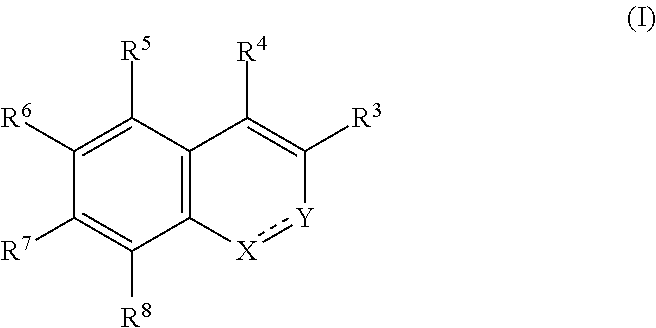
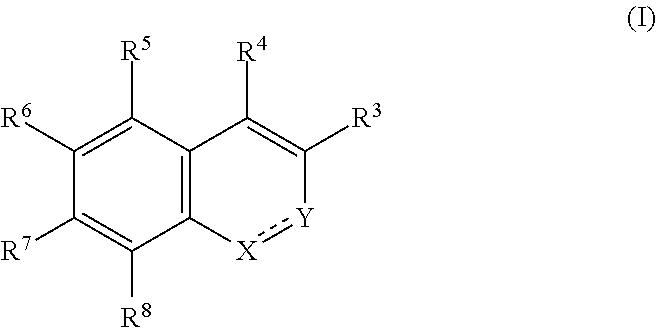
The invention provides a compound of formula I:or a salt thereof, wherein R3-R8 and X and Y have any of the values described in the specification, as well as compositions comprising a compound of formula I. The compounds are useful as antibacterial agents.
Description
PRIORITY OF INVENTION[0001]This application claims priority to U.S. Provisional Application Nos. 61 / 358,759, filed 25 Jun. 2010; 61 / 376,993, filed 25 Aug. 2010; 61,428,791, filed 30 Dec. 2010; and 61 / 430,058, filed 5 Jan. 2011.BACKGROUND OF THE INVENTION[0002]The emergence of Multidrug Resistant (MDR) bacterial pathogens (e.g. methicillin-resistant Staphylococcus aureus (MRSA), Acinetobacter baumannii-calcoaceticus complex (ABC), etc.) has increased concerns as to the adequacy of current antimicrobials and pathogen treatment methods. The lethality of such pathogens, particularly MRSA, has often led to treatment methods that are experimental or would otherwise normally be avoided in standard clinical practice. For example, the antibiotic colistin was traditionally considered too nephrotoxic and neurotoxic for clinical use, but is nevertheless used to treat many MDR bacterial infections due to a paucity of available active drugs. The growing threat from MDR pathogens highlights a crit...
Claims
the structure of the environmentally friendly knitted fabric provided by the present invention; figure 2 Flow chart of the yarn wrapping machine for environmentally friendly knitted fabrics and storage devices; image 3 Is the parameter map of the yarn covering machine
Login to View More
Application Information
Patent Timeline
Application Date:The date an application was filed.
Publication Date:The date a patent or application was officially published.
First Publication Date:The earliest publication date of a patent with the same application number.
Issue Date:Publication date of the patent grant document.
PCT Entry Date:The Entry date of PCT National Phase.
Estimated Expiry Date:The statutory expiry date of a patent right according to the Patent Law, and it is the longest term of protection that the patent right can achieve without the termination of the patent right due to other reasons(Term extension factor has been taken into account ).
Invalid Date:Actual expiry date is based on effective date or publication date of legal transaction data of invalid patent.
Login to View More
Patent Type & AuthorityApplications(United States)



 Login to View More
  Login to View More