Unlock instant, AI-driven research and patent intelligence for your innovation.

Transiently immortalized cells for use in gene therapy

a technology of immortalized cells and gene therapy, applied in the field of tissue transplantation, can solve the problems of use of immortalized cells in cell therapy, and serious risks for patients, and achieve the effect of efficient and rapid reversion of expanding cells

Inactive Publication Date: 2014-06-26
HEART BIOSYST
View PDF0 Cites 0 Cited by
  • Summary
  • Abstract
  • Description
  • Claims
  • Application Information

AI Technical Summary

Benefits of technology

This approach enables the production of cells with extended replicative capacity suitable for cell therapy, eliminating the risks of tumorigenicity and viral infections, while ensuring the cells return to a non-immortalized state after fusion protein removal, making them safe for transplantation.

Problems solved by technology

This is problematic, however, particularly if human cells are desired.
The use of immortalized cells in cell therapy, however, can pose serious risks for patients, because immortalized cells are in many instances tumorigenic.
Virally infected cells also pose serious risks for patients, such as the potential of generating replication-competent virus during vector production; the potential recombination between the therapeutic virus and endogenous retroviral genomes, potentially generating infectious agents with novel cell specificities, host ranges, or increased virulence and cytotoxicity; and the potential independent integration into large number of cells, increasing the risk of tumorigenic insertional events.
However, it is very difficult to prove the absence of residual immortalizing gene.
Any leftover immortalizing gene would pose a serious risk to the recipient of the cell therapy, as it may allow these cells to continue to proliferate in the host after transplantation, and form a tumor.
Accordingly, tissue from cells generated in this fashion is less desirable for cell therapy.

Method used

the structure of the environmentally friendly knitted fabric provided by the present invention; figure 2 Flow chart of the yarn wrapping machine for environmentally friendly knitted fabrics and storage devices; image 3 Is the parameter map of the yarn covering machine
View more

Image

Smart Image Click on the blue labels to locate them in the text.
Viewing Examples
Smart Image
  • Transiently immortalized cells for use in gene therapy
  • Transiently immortalized cells for use in gene therapy
  • Transiently immortalized cells for use in gene therapy

Examples

Experimental program
Comparison scheme
Effect test

example 1

Construction of the VP22-hTERT FUSION

[0090]Materials. Taq polymerase and all restriction, modifying, and enzymes were purchased from Life-Technologies (Basel, Switzerland). The expression vector pCEP4, TA- and Cloning kits were obtained from Invitrogen Corporation (Carlsbad, Calif., U.S.A.). The Quick-Clone CDNA from human testis, lymphoma and HeLa cells, GC-Melt Genomic and cDNA PCR kits were purchased from ClonTech (Basel, Switzerland). The TRAPeze assay kit was obtained from Oncor (Basel, Switzerland).

[0091]Oligonucleotides. The following oligonucleotides were custom synthesized (Life-Technologies or Microsynth) for use as PCR primers in the cloning of the hTERT cDNA: 5′-ATATATGCTAGCGCCACCATGCCGCGCGCTCCCCGCTGCC-3′ (SEQ ID NO: 1). 5′-ATATATGAATTCAGTCCAGGATGGTCTTGAAGTCTGAGGGC-3′ (SEQ ID NO: 2).

[0092]RT-PCR amplification of 293T CDNA using Taq polymerase with these primers produced a 3417 base-pair product. Diagnostic restriction digestion patterns confirmed that this 3417-bp RT-PCR...

example 2

Transient Immortalization Technology

[0097]The goal of this EXAMPLE is to validate the feasibility of chimeric protein translocation systems for the transient immortalization of primary human cells.

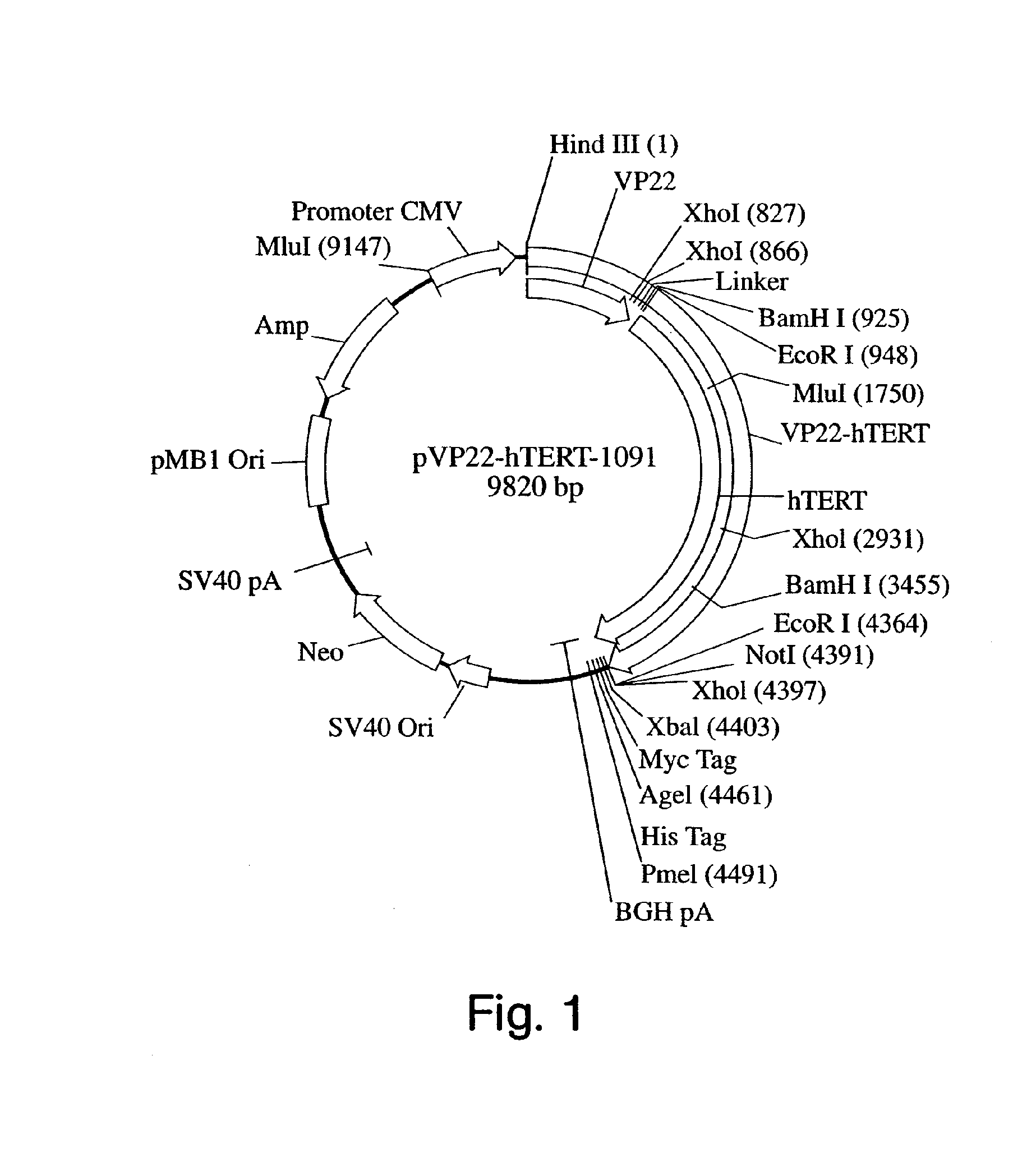
[0098]Construction of VP22-hTERT Fusion Cassettes and Expression Vectors. The basic VP22 expression vector was purchased from Invitrogen and renamed as pVP22-(cMyc-HIS-TAG)-1091. The cMyc and HIS denote the cMyc-tags and HIS-tags that are fused at the C-terminus of the VP22. The first gene to be fused to the VP22 was chosen to be the hTERT that was used successfully to enhance the proliferative potential of the primary human fibroblasts. Due to the concern that the C-terminal tags might interfere the hTERT catalytic activity, it was decided to make two VP22-hTERT fusion cassettes: (1) VP22-hTERT contains an in-frame fusion between VP22 and hTERT with no cMyc and HIS tags at the C-terminus of the fusion protein and (2) VP22-hTERT(cMyc-HIS-TAG) contains an in-frame fusion between VP22 and hT...

the structure of the environmentally friendly knitted fabric provided by the present invention; figure 2 Flow chart of the yarn wrapping machine for environmentally friendly knitted fabrics and storage devices; image 3 Is the parameter map of the yarn covering machine
Login to View More

PUM

PropertyMeasurementUnit
TMaaaaaaaaaa
temperatureaaaaaaaaaa
pHaaaaaaaaaa
Login to View More

Abstract

The invention provides methods and compositions for expanding cells that are not abundant or are difficult to obtain in pure form in culture, are in short supply (e.g., human cells), or have brief lifetimes in culture, using fusion polypeptide. The fusion polypeptide has a first region having the transport function of herpesviral VP22 protein or human immunodeficiency virus (HIV) TAT protein, and a second region with a polypeptide having cell immortalization activity, a polypeptide having telomerase-specific activity, or a polypeptide having telomerase gene activation activity. The resulting cells of the invention are suitable for use in cell therapy.

Description

REFERENCE TO SEQUENCE LISTING[0001]The present application is filed along with a Sequence Listing in electronic format. The Sequence Listing is provided as a file entitled 17161301—1, created Jan. 31, 2014, which is approximately 1.63 Kb in size. The information in the electronic format of the Sequence Listing is incorporated herein by reference in its entirety.FIELD OF THE INVENTION[0002]The invention relates generally to tissue transplantation. More specifically, the invention relates to methods of increasing the replicative capacity of normally quiescent cells, such as normal somatic cells, by transient immortalization or transient telomerization, to produce cells suitable for cell therapy.BACKGROUND OF THE INVENTION[0003]Cell therapy is an emerging field for the treatment of medical disorders. Cells from various tissue sources have been contemplated for transplantation into mammals, including human, recipients for treatment of disease or tissue or organ replacement. Use of prima...

Claims

the structure of the environmentally friendly knitted fabric provided by the present invention; figure 2 Flow chart of the yarn wrapping machine for environmentally friendly knitted fabrics and storage devices; image 3 Is the parameter map of the yarn covering machine
Login to View More

Application Information

Patent Timeline
no application Login to View More
Patent Type & Authority Applications(United States)
IPC IPC(8): C12N9/12C07K14/005C12N5/08C12N9/22C12N15/867
CPCC07K14/005C12N9/1276C07K14/82C07K2319/00C12N2710/16622C12N2740/16322C07K2319/10C12N2740/16045
Inventor BAETGE, E. EDWARDWONG, SHOUDUPRAZ, PHILIPPETHORENS, BERNARD
Owner HEART BIOSYST