Check patentability & draft patents in minutes with Patsnap Eureka AI!

Capacitive wetness sensor and method for manufacturing the same

a wetness sensor and capacitive technology, applied in the field of sensing wetness, can solve the problems of draining resources available, incontinence or uncontrollable urination, and significant portion of patients in care institutions such as hospitals, aged care facilities, geriatric institutions and the lik

Active Publication Date: 2014-10-02
FRED BERGMAN HEALTHCARE PTY LTD
View PDF4 Cites 89 Cited by
  • Summary
  • Abstract
  • Description
  • Claims
  • Application Information

AI Technical Summary

Benefits of technology

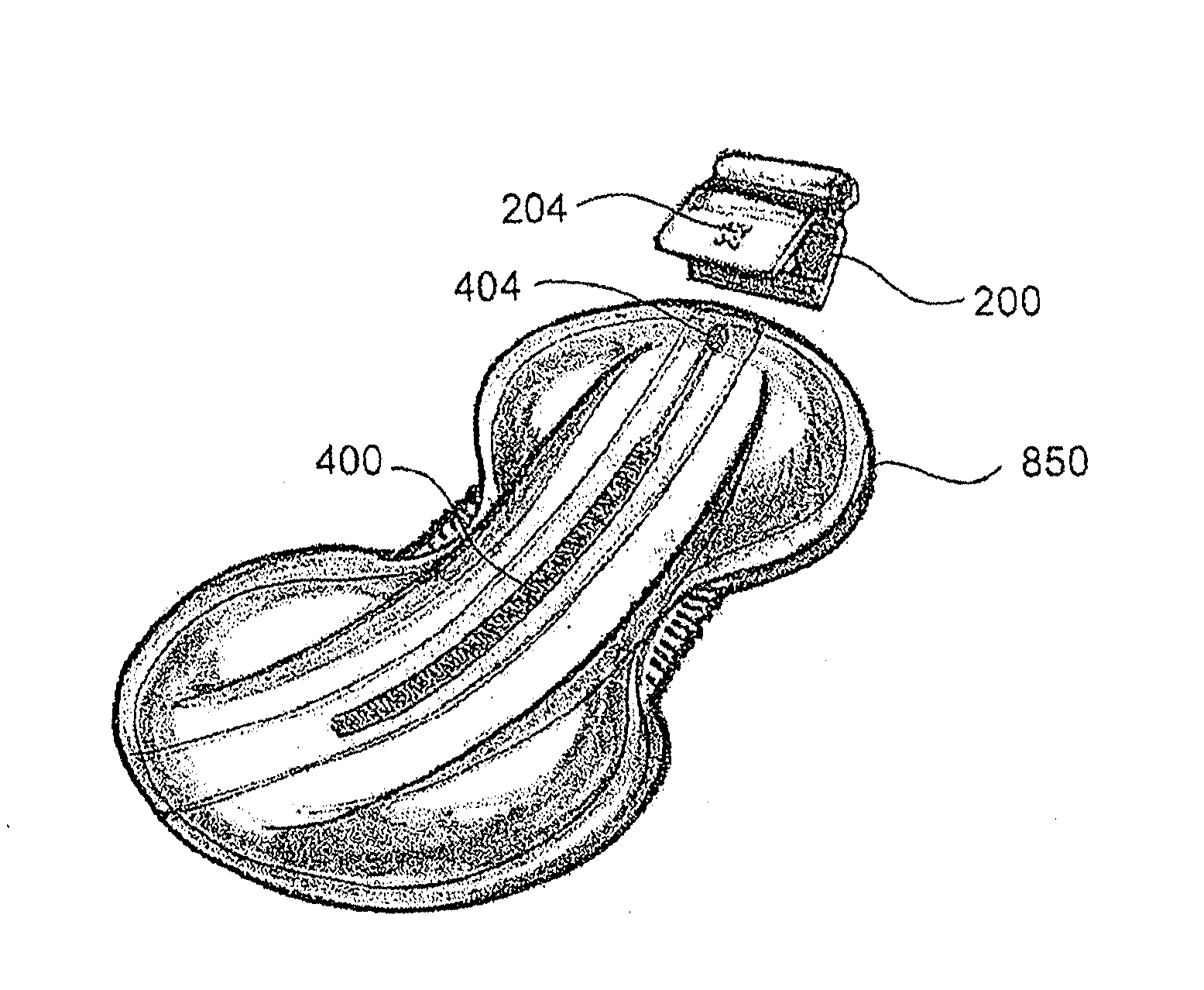
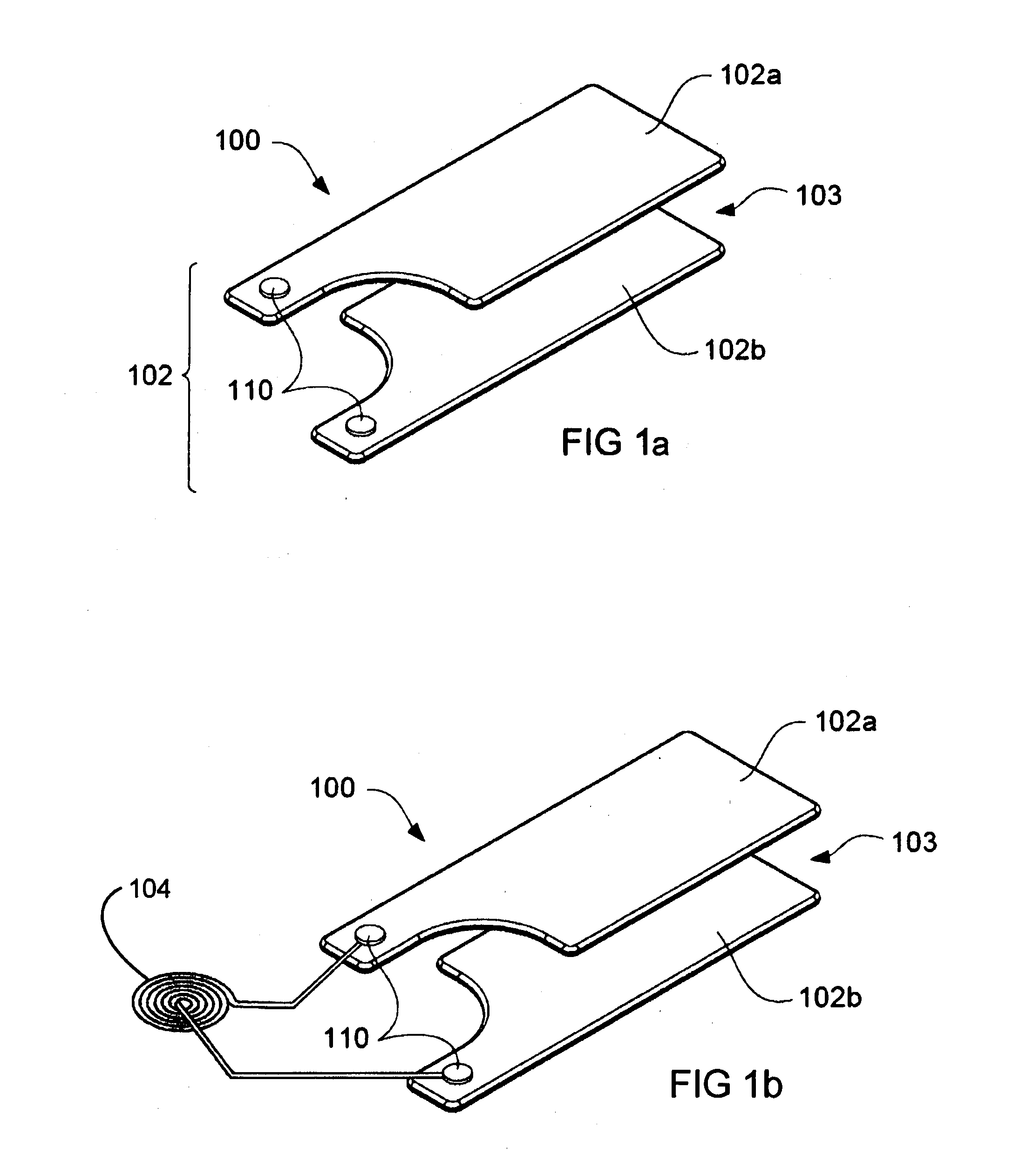
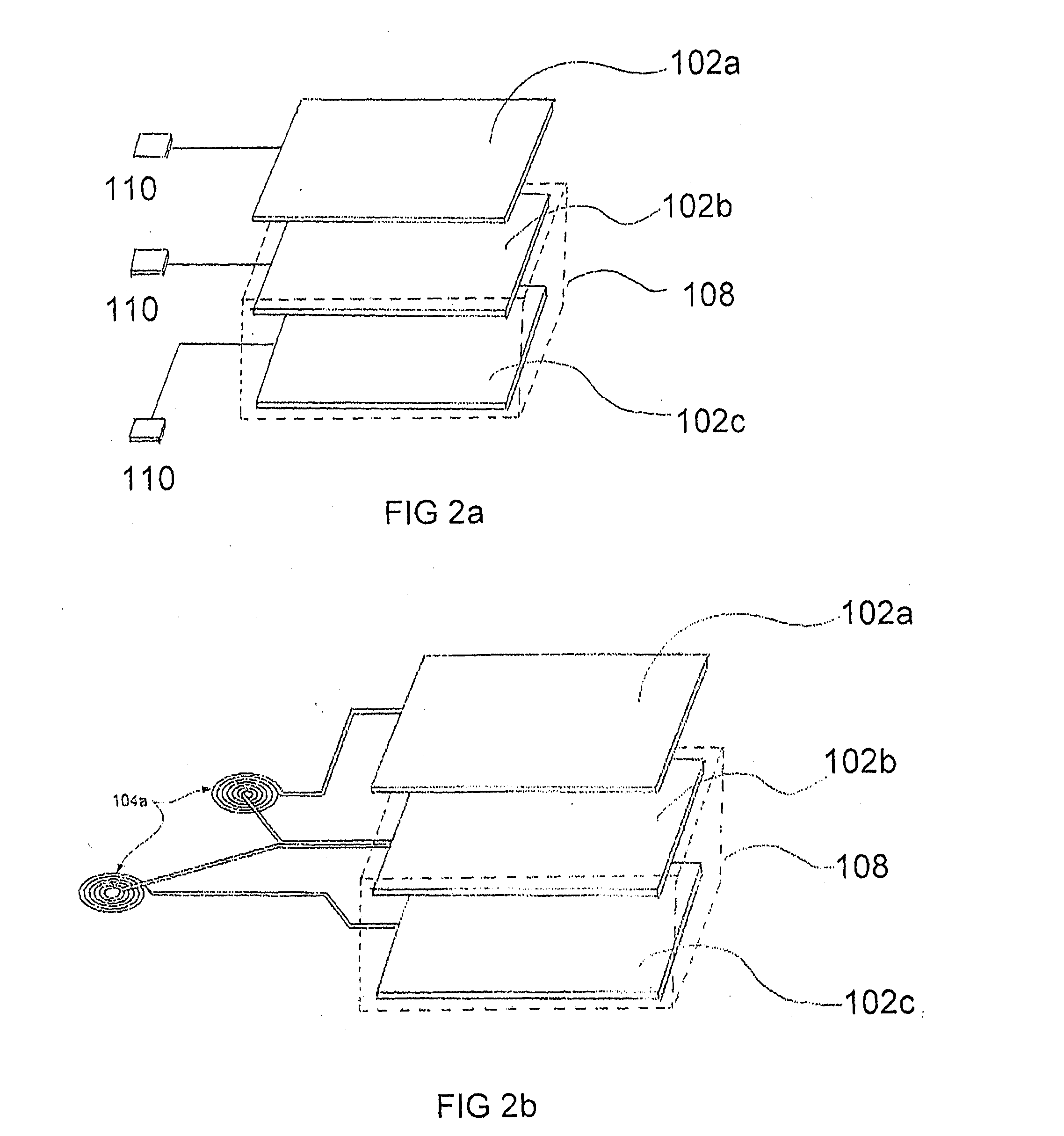
The patent describes a device that can sense changes in an absorbent article by measuring the capacitance between two conductive members. The change in capacitance is caused by a change in the permittivity of a dielectric region between the conductive members, which can be caused by the absorbent article becoming wet with liquid. The device can be integrated into the absorbent article, with a permeable conductive intermediate layer minimizing impact on its absorbent performance. The inductive coil in the device can be fabricated using a conductive thread or ribbon woven or stitched into the material of the substrate or by using printed inks or ribbons. The device can be used as a reusable garment and the inductive coil should be strong enough to withstand laundering and flexing / folding without degrading or breaking.

Problems solved by technology

Urinary incontinence refers to loss of bladder control resulting in involuntary or uncontrolled urination.
However, in circumstances where treatment is not available or is unsuccessful, the only option is to manage the incontinence events themselves.
Therefore, a significant portion of patients in care institutions such as hospitals, nursing homes, aged care facilities, geriatric institutions and the like suffer from various incontinence conditions.
Manual checks are typically carried out irrespective of whether the patient is known to have suffered an incontinence event, as often the patient is unwilling or unable to alert staff of the fact that an incontinence event has occurred.
The need to conduct regular checks of patients for incontinence places a significant drain on the resources available in patient care institutions and also causes inconvenience and disruption to the patient, particularly while resting and during sleep.
Often these are complex sensors which are expensive and require manual insertion to a diaper or other absorbent article worn by the subject.
Such sensors often involve complex arrangements of passive and / or active electronic components and as such, can require significant labour and material costs of production, in addition to the effort required to manually insert the sensor device into the diaper before it can be worn by the incontinent subject.
Automated incorporation of sensor devices into absorbent articles / diapers is complicated by the fact that these products are manufactured at high speed on an assembly line which typically turns out between 300 and 500 units per minute.
Generally there is little lateral or longitudinal precision involved with this process and so it is difficult to reliably insert and position sensing components during the regular diaper manufacturing process.

Method used

the structure of the environmentally friendly knitted fabric provided by the present invention; figure 2 Flow chart of the yarn wrapping machine for environmentally friendly knitted fabrics and storage devices; image 3 Is the parameter map of the yarn covering machine
View more

Image

Smart Image Click on the blue labels to locate them in the text.
Viewing Examples
Smart Image
  • Capacitive wetness sensor and method for manufacturing the same
  • Capacitive wetness sensor and method for manufacturing the same
  • Capacitive wetness sensor and method for manufacturing the same

Examples

Experimental program
Comparison scheme
Effect test

Embodiment Construction

[0048]Throughout this description and claims, the term “absorbent article” is used. It is to be taken as including pads, diapers, liners, nappies, dressings, incontinence appliances and other absorbent devices that absorb moisture such as urine, faces, blood, plasma and the like. The absorbent articles may be worn by adult subjects or babies, children or adolescents as the need may arise. Alternatively / additionally they may be worn by animal subjects.

[0049]Referring firstly to FIG. 1a, there is shown a first embodiment of a sensor device 100 for sensing wetness in absorbent article worn by a subject. In the example provided in FIG. 1a, the sensing element is a capacitor 102 formed by a first conductive member 102a and a second conductive member 102b with an interposing dielectric region 103 there between. Although only one sensing element is shown in FIG. 1, it is to be understood that the sensor device 100 may include a plurality of sensing elements 102. Coupling points 110 are pro...

the structure of the environmentally friendly knitted fabric provided by the present invention; figure 2 Flow chart of the yarn wrapping machine for environmentally friendly knitted fabrics and storage devices; image 3 Is the parameter map of the yarn covering machine
Login to View More

PUM

PropertyMeasurementUnit
Lengthaaaaaaaaaa
Flow rateaaaaaaaaaa
Sizeaaaaaaaaaa
Login to View More

Abstract

A sensor device for sensing wetness in an absorbent article worn by a subject includes one or more sensing elements; and a coupling for communicating sensor signals between the one or more sensing elements and a receiver. A change in environmental parameter causes a change in electrical behaviour of at least one of the sensing elements, which behaviour can be analysed to determine occurrence of a wetness event in the absorbent article. The changes in electrical behaviour are communicated in the sensor signals to the receiver. The analysis may be by the receiver or a processor in communication with the receiver. Ideally, the sensing elements include capacitive elements and preferably, resonance circuits.

Description

FIELD OF THE INVENTION[0001]The present invention relates to sensing wetness. It relates particularly but not exclusively to a sensor and sensor arrangement and related components of a system for sensing wetness events such as urinary and faecal events as occur from time to time in a pad or diaper or similar absorbent article worn by a subject who may experience the condition of incontinence. The invention also relates to a system for coupling such sensors to a receiver and to methods for manufacturing sensors and / or absorbent articles incorporating sensors.BACKGROUND TO THE INVENTION[0002]Incontinence is a condition in which there is an uncontrolled release of discharges or evacuations. Urinary incontinence refers to loss of bladder control resulting in involuntary or uncontrolled urination. Other forms of incontinence include faecal or bowel incontinence.[0003]Incontinence is a normal condition of infants and becomes less normal as the child ages. For infants an understanding of t...

Claims

the structure of the environmentally friendly knitted fabric provided by the present invention; figure 2 Flow chart of the yarn wrapping machine for environmentally friendly knitted fabrics and storage devices; image 3 Is the parameter map of the yarn covering machine
Login to View More

Application Information

Patent Timeline
no application Login to View More
IPC IPC(8): A61F13/42A61F13/15
CPCA61F13/15699A61F13/42A61F13/2051G01N27/225
Inventor CURRAN, PETERBARDA, DAVID ALBERTBLACK, DONPHILLIPS, BRADLEY JOHNKOTLARSKI, PETEROIKKONEN, JUUSO TUOMASMATTILA, TOMI JUHA PETTERI
Owner FRED BERGMAN HEALTHCARE PTY LTD
Features
  • R&D
  • Intellectual Property
  • Life Sciences
  • Materials
  • Tech Scout
Why Patsnap Eureka
  • Unparalleled Data Quality
  • Higher Quality Content
  • 60% Fewer Hallucinations
Social media
Patsnap Eureka Blog
Learn More