
Process for preparing a base oil having a reduced cloud point
a technology of base oil and cloud point, which is applied in the field of process for preparing a residual base oil, can solve the problems affecting the lubrication effect, so as to achieve the effect of reducing the cloud poin
- Summary
- Abstract
- Description
- Claims
- Application Information
AI Technical Summary
Benefits of technology
Problems solved by technology
Method used
Image

Examples
example 1
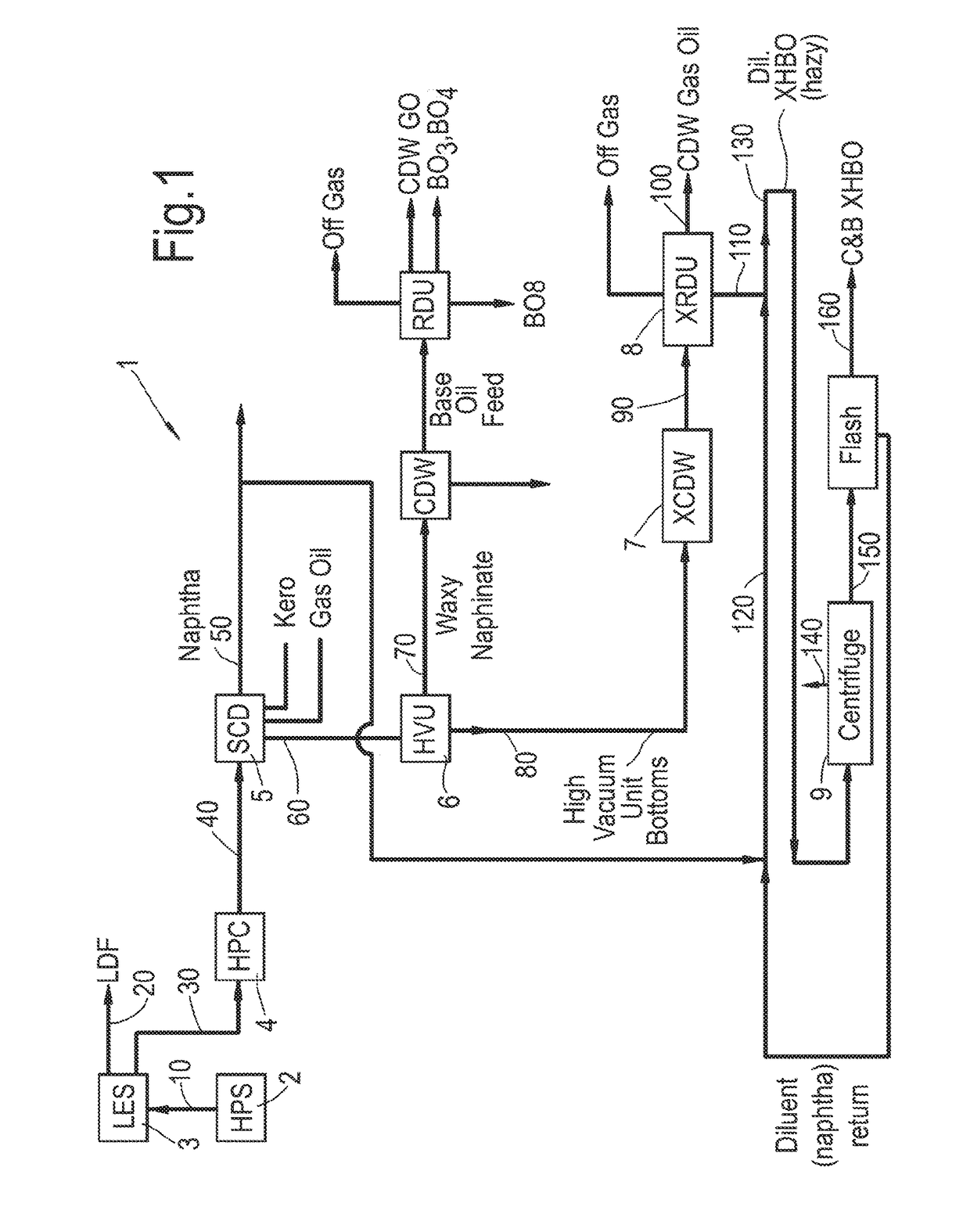
[0051]From a Fischer Tropsch wax product, through a hydrocracking step (60 bar, 330-360° C.) and subsequent atmospheric and vacuum distillation a vacuum hydrowax residue was obtained (congealing point=103° C.). This vacuum hydrowax residue was subjected to a catalytic dewaxing step at 40 bara, WHSV=0.5 kg / l / hr, hydrogen to oil ratio 750N1 / kg, WABT=320° C. and subsequent batch atmospheric distillation followed by vacuum distillation. The isomerized residual fraction, with a density of D70 / 4=0.805, a kinematic viscosity according to ASTM D445 at 100° C. of 21.2 mm2 / s, a pour point of PP=−24° C. and a cloud point of cp=42° C., was mixed with Petroleum Ether 40 / 60) in a ratio of 2 parts by weight of diluent to 1 part by weight of isomerized residual fraction. The diluted isomerized residual fraction was cooled to a temperature of −30° C. The cooled diluted isomerized residual fraction was exposed to a high rotation speed of 14000 RPM (equivalent to a Relative Centrifugal Force (RCF)=210...
example 2
[0052]In a second experiment according to the invention, the vacuum hydrowax residue used in experiment 1 was subjected to a dewaxing step operated at the same conditions that were applied in Example 1. Subsequently, the catalytic dewaxing unit effluent was distilled with a laboratory continuous atmospheric column in series with a short path distillation unit. The isomerized residual fraction, with a density of D70 / 4=0.805, a kinematic viscosity according to ASTM D445 at 100° C. of 21.3 mm2 / s, a pour point of PP=−39° C. and a cloud point of cp=39° C., was mixed with Petroleum Ether 40 / 60) in a ratio of 2 parts by weight of diluent to 1 part by weight of isomerized residual fraction. The diluted isomerized residual fraction was cooled to a temperature of −60° C. The cooled diluted isomerized residual fraction was exposed to a lower rotation speed than in experiment 1 of 9157 RPM (equivalent to a Relative Centrifugal Force (RCF=9000 g force) in a laboratory centrifuge cooled to −20° C...
PUM
| Property | Measurement | Unit |
|---|---|---|
| Temperature | aaaaa | aaaaa |
| Temperature | aaaaa | aaaaa |
| Temperature | aaaaa | aaaaa |
Abstract
Description
Claims
Application Information
 Login to View More