
Semantic extraction method and apparatus for natural language, and computer storage medium
a natural language and semantic extraction technology, applied in the field of information technology, can solve the problems of high error rate of semantic extraction, large difficulty in identification of natural language, unstable or low identification accuracy, etc., and achieve the effect of ensuring the correctness rate and accuracy of semantic extraction
- Summary
- Abstract
- Description
- Claims
- Application Information
AI Technical Summary
Benefits of technology
Problems solved by technology
Method used
Image

Examples
example 1
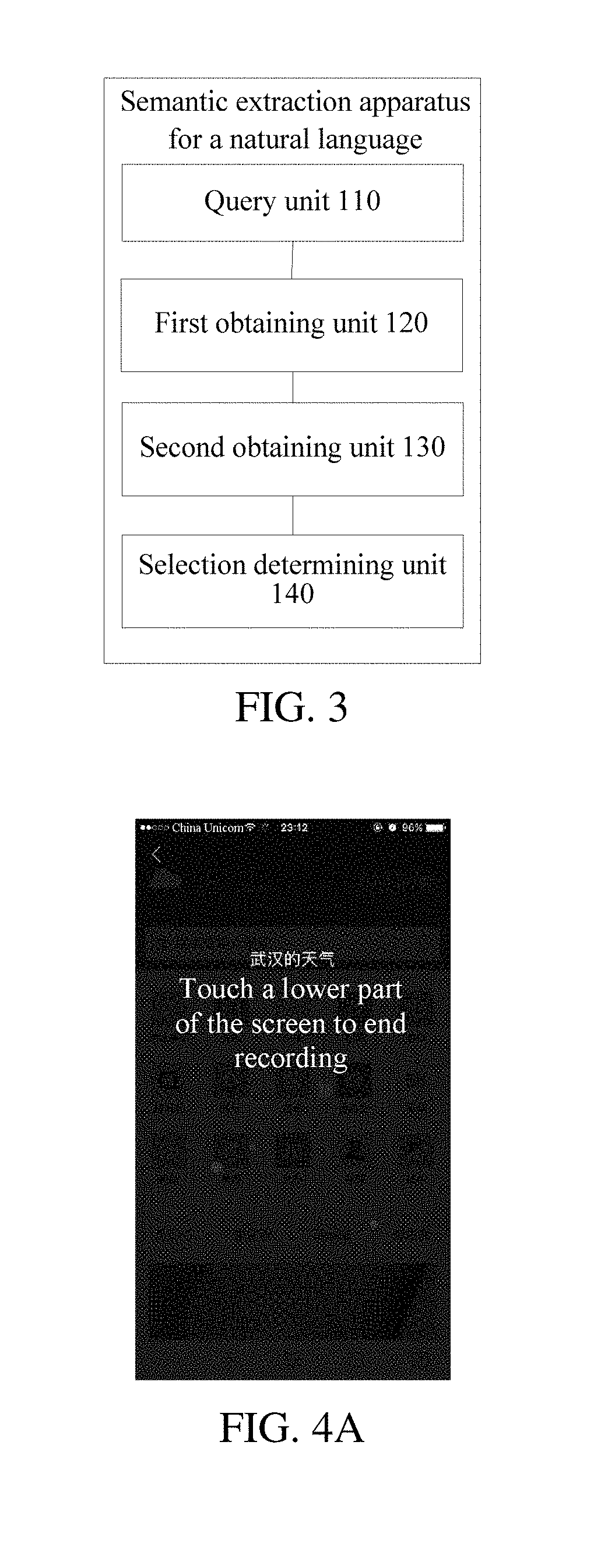
[0126]As shown in FIG. 4A and FIG. 4B, this example provides an application scenario of a semantic extraction method for a natural language. A user terminal receives, by using an audio collection unit (such as a microphone) a natural language input by a user. For example, the user presses and / or holds a speaker button of a recording interface shown in FIG. 4A. The user terminal starts to record, and after recording is completed, a corresponding record is converted into text including one or more characters. The text is based on a natural language corresponding to audio collected by recording. After the natural language is converted into text, extraction of semantic intentions and key information is performed on the language by using the semantic extraction method for a natural language provided in an example embodiment, and then information search is performed according to the obtained semantic intentions and key information, to obtain the search result shown in FIG. 4B. The search ...
example 2
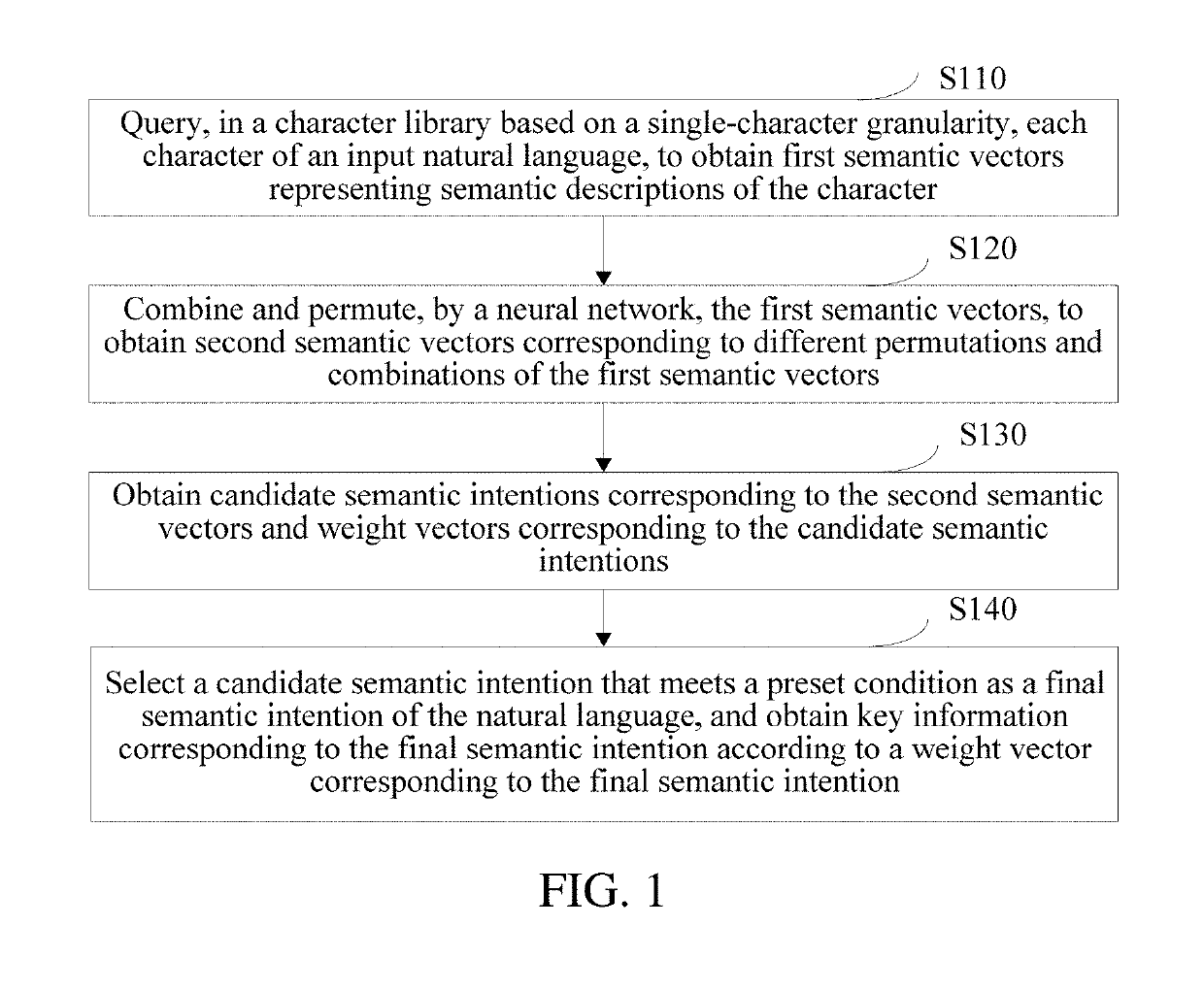
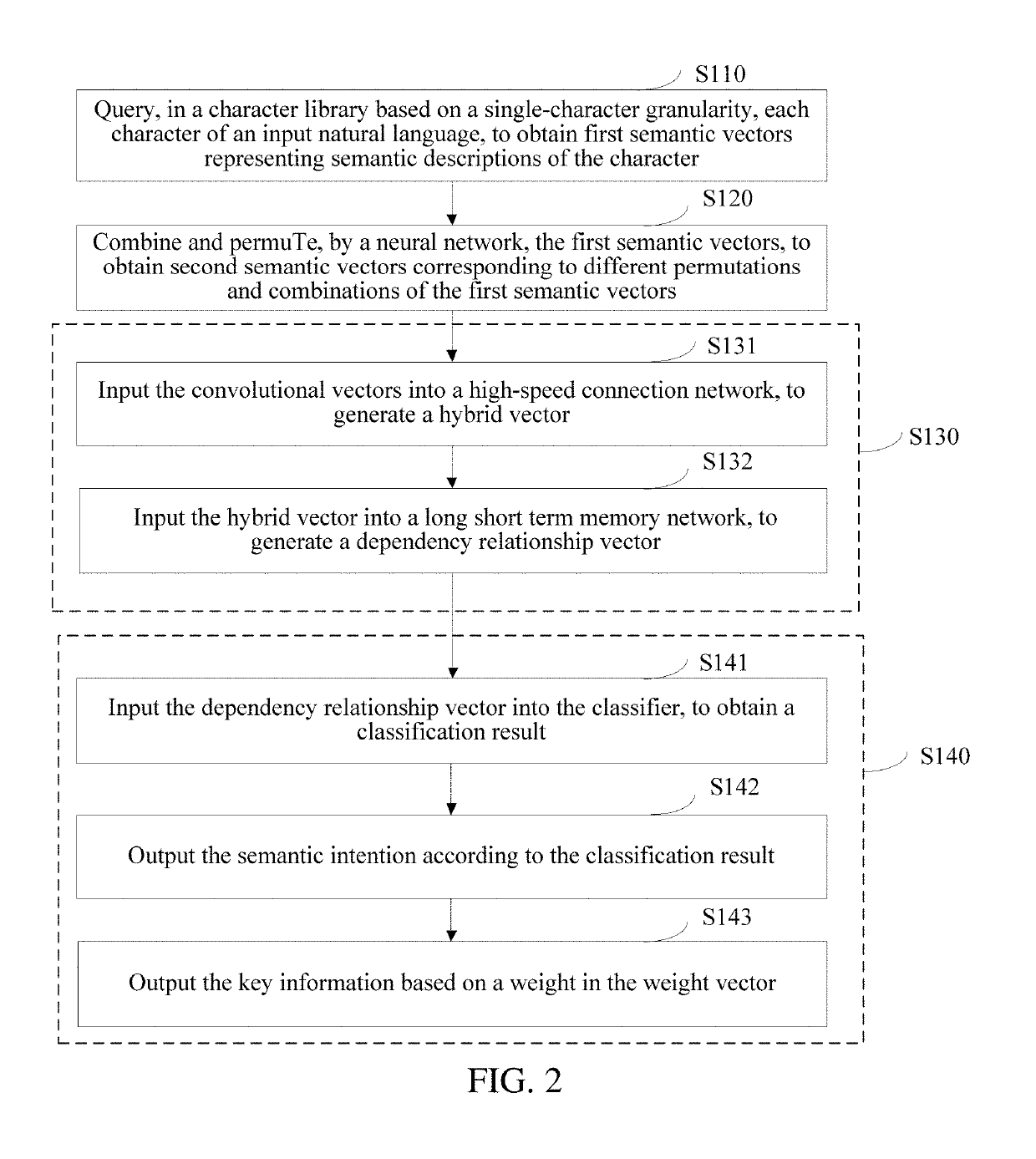
[0129]As shown in FIG. 5, this example provides a semantic extraction method for a natural language. The method mainly includes: offline character semantic training, deep mixing semantic model training, and online application. The online application includes scenario information and key information of the input natural language by using a character library obtained through the character semantic training and a neural network obtained through the deep mixing semantic model training.
[0130]The character semantic training and the deep mixing semantic model training are respectively described below.
[0131]I. Character Semantic Training:
[0132]1.1) Selection and generation of a character set:
[0133]A Chinese standard Chinese character set (approximately 6000 common characters+14 thousand uncommon characters), Chinese and English punctuations, western language characters (e.g., English and figures) are selected as subsequent corpuses and the standard content described and processed by a user....
example 3
[0156]As shown in FIG. 8, this example provides a schematic diagram of an optional hardware structure of a semantic extraction apparatus for a natural language. The semantic extraction apparatus includes a processor 11, an input / output interface 13 (for example, a display screen, a touch screen, or a speaker), a memory 14, and a network interface 12. The assembly may be connected through a system bus 15 for communication. Correspondingly, the memory 14 stores an executable instruction for performing the semantic extraction method for a natural language according to one or more example embodiments. The hardware modules shown in FIG. 8 may be partially implemented or entirely implemented according to needs, or other hardware modules are implemented. There may be one or more hardware modules of each type. The hardware modules may be implemented at a same geographical location, or distributed at different geographical locations for implementation, and may be configured to implement at l...
PUM
 Login to View More
 Abstract
Description
Claims
Application Information
 Login to View More