Unlock instant, AI-driven research and patent intelligence for your innovation.

Solar receivers and methods for capturing solar energy

a solar receiver and solar energy technology, applied in the field of solar thermal systems, can solve the problems of not being economically competitive without government support, solar power systems cannot meet the needs of government support, and the potential to supply a very significant fraction of u.s. and global electricity consumption, and achieves the effects of reducing radiative heat loss, reducing energy consumption, and increasing efficiency operation

Active Publication Date: 2019-10-24
NAT TECH & ENG SOLUTIONS OF SANDIA LLC
View PDF0 Cites 2 Cited by
  • Summary
  • Abstract
  • Description
  • Claims
  • Application Information

AI Technical Summary

Benefits of technology

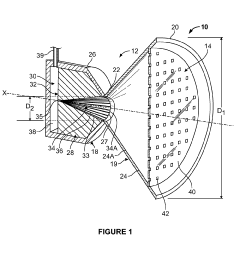
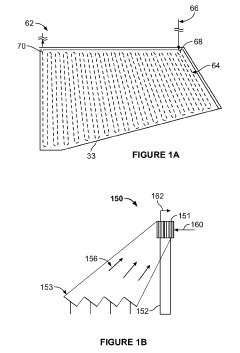
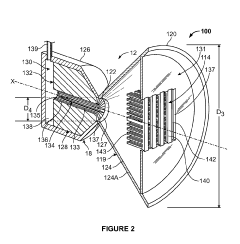
The present invention integrates a volumetric air receiver and a PV system to cool the PV system for higher efficiency operation and preheat the air before it enters the volumetric receiver. The design of the volumetric receiver surfaces allows a greater penetration of solar irradiance, reducing radiative heat loss near the aperture. Additionally, the integration of a PV array at the aperture (and along the spillage boards surrounding the aperture) of a falling particle receiver system simultaneously generates electricity and thermal energy. The PV array helps keep the PV array cooler for improved efficiency and minimizes convective and radiative heat losses from within the cavity receiver.

Problems solved by technology

Solar energy offers a clean, inexhaustible, sustainable solution to energy demands and has the potential to supply a very significant fraction of U.S. and global electricity consumption.
While the U.S. and global solar power potential is known to be immense, solar power systems have not been economically competitive without government support, to date.
These solar cells are expensive, and their efficiencies are limited because they can exploit only a portion of the solar spectrum.
These systems are also characterized by a large energy-payback period, i.e., the time they must be exposed to sunlight and produce electricity, to return the energy required to produce and install them.
These systems suffer from low efficiencies because of high optical losses, such as cosine and other optical losses, solar-receiver losses, as well as temperature and power losses from long fluid-flow loops to and from the tower.
Current designs of the channels do not allow for deep penetration of the irradiance, and the receiver surfaces get hot near the aperture, maximizing radiative heat loss.
None of the previous volumetric receiver designs integrates PV.
None of these previous concepts has included the use of a light-transmitting PV array at the aperture to generate electricity while mitigating convective and radiative heat losses.

Method used

the structure of the environmentally friendly knitted fabric provided by the present invention; figure 2 Flow chart of the yarn wrapping machine for environmentally friendly knitted fabrics and storage devices; image 3 Is the parameter map of the yarn covering machine
View more

Image

Smart Image Click on the blue labels to locate them in the text.
Viewing Examples
Smart Image
  • Solar receivers and methods for capturing solar energy
  • Solar receivers and methods for capturing solar energy
  • Solar receivers and methods for capturing solar energy

Examples

Experimental program
Comparison scheme
Effect test

Embodiment Construction

[0037]The present invention now will be described more fully hereinafter with reference to the accompanying drawings, in which preferred embodiments of the invention are shown. This invention may, however, be embodied in many different forms and should not be construed as limited to the embodiments set forth herein; rather, these embodiments are provided so that this disclosure will be thorough and complete and will fully convey the scope of the invention to those skilled in the art.

[0038]The present disclosure is directed to a thermal receiver that includes a plurality of thermal panels for capturing solar energy from concentrated sunlight and transferring the captured energy to air. A light focusing device focusses and concentrates light on the thermal receiver to capture heat. Air is pulled through the thermal receiver and heat is transferred from the thermal receiver to the air to generate heated air. The heated air can be used for other applications, such as, but not limited to...

the structure of the environmentally friendly knitted fabric provided by the present invention; figure 2 Flow chart of the yarn wrapping machine for environmentally friendly knitted fabrics and storage devices; image 3 Is the parameter map of the yarn covering machine
Login to View More

PUM

No PUM Login to View More

Abstract

Thermal receivers, systems, and methods are disclosed that efficiently capture concentrated solar energy into a plurality of heat absorption bodies for conversion into thermal energy. In an embodiment, the thermal receivers, systems, and methods enable simultaneous electricity conversion and thermal energy capture. The receiver design enables a high penetration of concentrated sunlight deep into the thermal receiver to increase light trapping and reduce thermal losses. The thermal receiver is integrated with a photovoltaic (PV) receiver platform that converts some of the incident light to electricity while passing the remaining light to the thermal receiver. In another embodiment, other thermal receivers, systems, and methods are disclosed that efficiently capture concentrated solar energy into a sheet of falling particles. In an embodiment, the thermal receivers, systems, and methods enable simultaneous electricity conversion and thermal energy capture.

Description

CROSS-REFERENCE TO RELATED APPLICATIONS[0001]This application is a divisional of U.S. Ser. No. 15 / 071,781, entitled “SOLAR RECEIVERS AND METHODS FOR CAPTURING SOLAR ENERGY,” by Clifford K. Ho, filed Mar. 16, 2016, which claims priority to provisional patent applications U.S. Ser. No. 62 / 135,547, entitled “SOLAR RECEIVERS AND METHODS FOR CAPTURING SOLAR ENERGY,” by Clifford K. Ho, filed Mar. 19, 2015, the disclosures of which are incorporated herein by reference in their entireties.STATEMENT OF GOVERNMENT INTEREST[0002]The United States Government has rights in this invention pursuant to Contract No. DE-AC04-94AL85000 between the United States Department of Energy and Sandia Corporation, for the operation of the Sandia National Laboratories, and to Contract No. DE-NA0003525 awarded by the United States Department of Energy / National Nuclear Security Administration.TECHNICAL FIELD[0003]The present disclosure is generally directed to solar energy. The present disclosure is more particul...

Claims

the structure of the environmentally friendly knitted fabric provided by the present invention; figure 2 Flow chart of the yarn wrapping machine for environmentally friendly knitted fabrics and storage devices; image 3 Is the parameter map of the yarn covering machine
Login to View More

Application Information

Patent Timeline
no application Login to View More
Patent Type & Authority Applications(United States)
IPC IPC(8): H02S40/44F24S25/00F24S70/10
CPCF24S70/10H02S40/44F24S25/00F24S20/20F24S70/60Y02E10/47Y02E10/50Y02E10/60
Inventor HO, CLIFFORD K.
Owner NAT TECH & ENG SOLUTIONS OF SANDIA LLC