
Solid state forms of lenvatinib mesylate
a technology of lenvatinib and mesylate, which is applied in the field of solid state forms of lenvatinib mesylate, can solve the problems of no “standard", and the inability to predict the number of polymorphic forms of a given compound,
- Summary
- Abstract
- Description
- Claims
- Application Information
AI Technical Summary
Benefits of technology
Problems solved by technology
Method used
Image

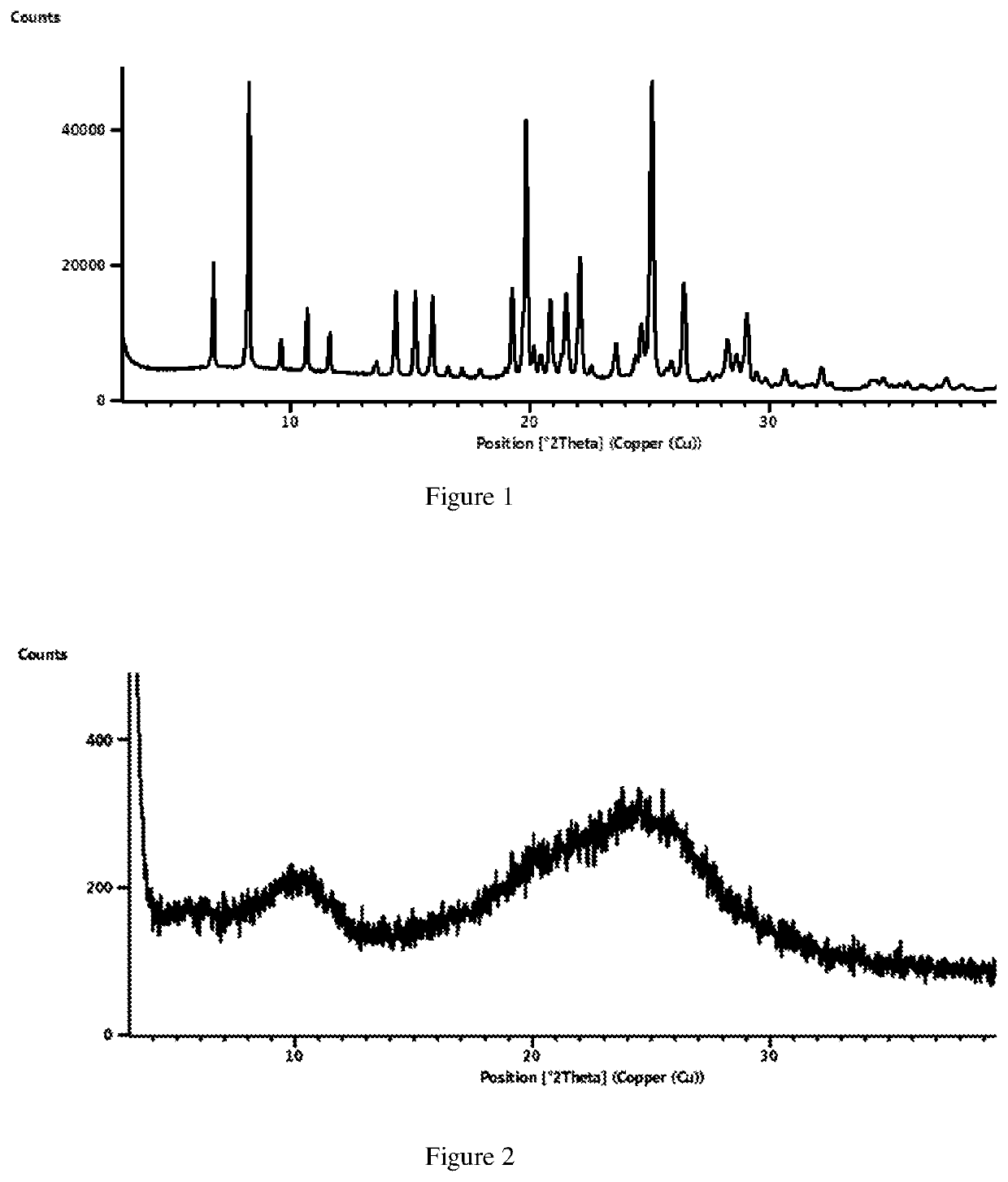
Examples
example 1
[0080]Lenvatinib (0.5 g) and Methyl isobutyl ketone (10 mL) were taken in a vial at 25-30° C. and stirred. Methane sulfonic acid (0.24 g) was added to the above vial and stirred for 24 hours. The contents of the above vial were filtered to obtain title compound.
[0081]Result: Form VN1
example 2
[0082]Lenvatinib Mesylate (2 g) and acetic acid (20 mL) were taken in a flask and heated to 50° C. The contents were filtered for any un-dissolved particle and the clear solution was transferred to an easy max reactor. To this, Methyl Isobutyl Ketone (60 mL) was added at 25° C. and stirred for 2-3 hours. The contents were filtered and dried in vacuum tray dryer at 35° C. for 12-14 hours to yield the title compound.
[0083]Result: Form VN1
example 3
[0084]Lenvatinib Mesylate (1 g) and Methanol (100 mL) were taken in a flask and heated to 50° C. The contents were filtered for any un-dissolved particle and the clear solution was transferred to an easy max reactor. To this, Methyl Isobutyl Ketone (300 mL) was added at 25° C. and stirred for 14-15 hours. The contents were filtered and dried in vacuum tray dryer at 45° C. for 3-4 hours to yield the title compound.
[0085]Result: Form VN1
PUM
| Property | Measurement | Unit |
|---|---|---|
| temperature | aaaaa | aaaaa |
| temperature | aaaaa | aaaaa |
| temperature | aaaaa | aaaaa |
Abstract
Description
Claims
Application Information
 Login to View More