A composite, scaffold and applications thereof

Inactive Publication Date: 2020-05-21
JAWAHARLAL NEHRU CENT FOR ADVANCED SCI RES
View PDF0 Cites 0 Cited by
  • Summary
  • Abstract
  • Description
  • Claims
  • Application Information

AI Technical Summary

Benefits of technology

This patent is about a method of creating a composite of silk protein and melanin, which can be used to repair or regenerate biological tissue. The method involves treating silk protein sponges with melanin in the presence of a solvent to create the composite. The composite can be used to create a biomaterial scaffold that can be implanted into a patient to treat medical conditions. The scaffold is made by modifying silk fibroin with a peptide called laminin-derived peptide YIGSR or a combination of YIGSR and GYIGSR. This modification improves the scaffold's ability to attract and grow cells, which can help to repair or regenerate tissue. Overall, this patent provides a novel method for creating a biomaterial composite that can be used for tissue repair and regeneration.

Problems solved by technology

The synthetic polymers used for tissue engineering and regenerative medicine applications have limitations associated with their biocompatibility, immunogenic response from tissues due to the development of oxidative stress at biomaterial interface.
The soft biomaterial scaffolds, which are made from synthetic polymers, suffer the limitations such as the toxicity associated with their synthesis or degradation, differences in batch-to-batch integrity of polymers and the requirement of additional biofunctionalisation to facilitate cell adhesion and proliferation.
However, the industrial scale availability, stability and ease of processability and moldability into different scaffold formats limit the use of many biopolymers largely.
Moreover, oxidative stress is also associated with several pathological conditions and delayed wound healing.
In spite of the promising applications in modulating cellular functions, CPs have limited use for long-term in vivo tissue engineering (TE) applications because of the problems of biocompatibility, toxicity and non-biodegradability along with difficulty in fabricating different 3D scaffold formats.

Method used

the structure of the environmentally friendly knitted fabric provided by the present invention; figure 2 Flow chart of the yarn wrapping machine for environmentally friendly knitted fabrics and storage devices; image 3 Is the parameter map of the yarn covering machine
View more

Image

Smart Image Click on the blue labels to locate them in the text.
Viewing Examples
Smart Image
  • A composite, scaffold and applications thereof
  • A composite, scaffold and applications thereof
  • A composite, scaffold and applications thereof

Examples

Experimental program
Comparison scheme
Effect test

example 1

n of Silk Fibroin

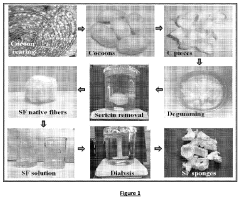
[0203]Regenerated silk fibroin solution is prepared from the mulberry silkworm Bombyx mori cocoons of CB gold variety (Mysuru, India). Briefly, the cocoons are cut into approximately 4 cm×4 cm size pieces and the water-soluble sericin is removed by boiling the cocoon pieces for 30 min in 0.02 M Na2CO3 solution. The resulting native silk fibroin fibers are washed thoroughly with plenty of milli-Q water to remove the water soluble sericin outer layer and dried. The obtained native silk fibroin fibers are dissolved in 9.3M LiBr (Spectrochem India) at 60° C. for 4 hours. The obtained amber-colored solution is dialyzed using an activated 14 KDa MWCO cellulose membrane (Sigma) against milli-Q water with a total of six water changes at regular intervals. The aqueous regenerated silk fibroin solution is centrifuged for 20 min at 6000 rpm, at 4° C. to remove the insoluble debris and stored at 4° C. until further use. Lyophilization of aqueous fibroin solution is carried out ...

example 2

on of Silk Fibroin-Melanin Composite Films

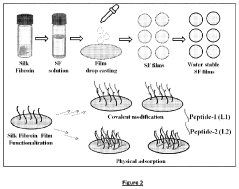
[0204]Pristine silk fibroin and melanin blend (SM; wt / wt 90:10) regenerated silk fibroin solutions made from Hexafluoro-2-propanol (HFIP) are used to fabricate biomaterial scaffold films and electrospun non-woven mats. HFIP is chosen as the solvent owing to its unique properties of dissolving most of the high molecular weight proteins at room temperature. Freestanding, flexible and peelable 2D films are fabricated by drop-casting the respective solutions onto polystyrene (PS) substrates, silk fibroin solution (6 wt %) is reconstituted from HFIP at room temperature from silk sponges. Pristine silk fibroin films (SFFs) are prepared by drop-casting the fibroin solution on to the polystyrene substrates. Drop-casted films are air-dried overnight in a fume hood and treated with 90% methanol-water mixtures for 10 min to promote β-sheet formation.

[0205]Similarly, silk-melanin composite films are prepared from the silk: melanin (wt / wt 90:10) HFIP sol...

example 3

and Characterization of Peptides

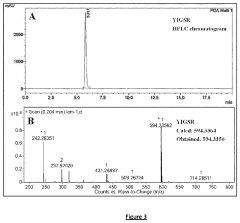
[0206]All the Fmoc amino acids with appropriate side chain protection group are obtained from Novabiochem and used as received without any further purification. Solvents and other reagents are procured either from Sigma or Spectrochem are used for the peptide synthesis. Peptides are synthesised using solid phase Fmoc-chemistry on Multisyntech Syro II automated peptide synthesiser using standard procedures. Fmoc-Rink amide resin from Novabiochem is used as solid support for the synthesis. O-(benzotriazol-1-yl)-N, N, N′, N′-tetramethyluronium hexafluorophosphate (HBTU, Novabiochem) along with N, N-diisopropylethylamine (DIPEA, Spectrochem, India) is used as activation mixture and 4 equivalents of Fmoc protected amino acids (0.5 mmol) in N, N-dimethylformamide (DMF, Spectrochem, India) is used for peptide couplings at room temperature. Peptide cleavage from the resin and side chain protection group removal is achieved by reacting the resin with cleavage ...

the structure of the environmentally friendly knitted fabric provided by the present invention; figure 2 Flow chart of the yarn wrapping machine for environmentally friendly knitted fabrics and storage devices; image 3 Is the parameter map of the yarn covering machine
Login to View More

PUM

PropertyMeasurementUnit
Temperatureaaaaaaaaaa
Timeaaaaaaaaaa
Login to View More

Abstract

The present disclosure relates to the field of biomaterials, tissue engineering and regenerative medicine. Particularly, the present disclosure relates to biomaterial composite and preparation of various scaffold formats using the composite. The disclosure provides for preparation of biomaterial composite comprising silk fibroin and melanin, preparation of scaffolds with the biomaterial composite and its applications in tissue engineering, electrotherapy applications and regenerative medicine. In some embodiments, the silk fibroin is a peptide modified silk fibroin. The biomaterial composite of the present disclosure exhibits various advantages including but not limiting to enhanced antioxidant property, superior electroactive properties, improved myogenic cell differentiation, better cell growth and regeneration, and enhanced cell adhesion property.

Description

TECHNICAL FIELD[0001]The present disclosure relates to the field of biomaterials, tissue engineering and regenerative medicine. Particularly, the present disclosure relates to biomaterial composite and preparation of various scaffold formats using the composite. The disclosure provides for preparation of biomaterial composite comprising silk fibroin and melanin, preparation of scaffolds with the biomaterial composite and its applications in tissue engineering, electrotherapy applications and regenerative medicine. In some embodiments, the silk fibroin is a modified silk fibroin with peptide.BACKGROUND AND PRIOR ART OF THE DISCLOSURE[0002]Any discussion of the prior art throughout the specification should in no way be considered as an admission that such prior art is widely known or forms part of common general knowledge in the field.[0003]The synthetic polymers used for tissue engineering and regenerative medicine applications have limitations associated with their biocompatibility,...

Claims

the structure of the environmentally friendly knitted fabric provided by the present invention; figure 2 Flow chart of the yarn wrapping machine for environmentally friendly knitted fabrics and storage devices; image 3 Is the parameter map of the yarn covering machine
Login to View More

Application Information

Patent Timeline
no application Login to View More
IPC IPC(8): A61L27/48A61L27/56C07K14/78C07K1/14
CPCA61L27/56C07K1/14C07K14/78A61L27/48A61L27/227A61L2430/30
InventorTHIMMAIAH, GOVINDARAJUMANCHINEELLA, SHIVAPRASAD
OwnerJAWAHARLAL NEHRU CENT FOR ADVANCED SCI RES