In contrast, MANETs are subject to rapid topology changes and may not be managed efficiently using a static configuration of network controllers.
In contrast, traditional MANETs typically have trouble scaling beyond 30-40 nodes even when operating over channels with MHz of bandwidth.
Some of the specific problem encountered by traditional MANETs include:Determining and maintaining routes can overcome entire network capacity for network sizes only a few 10 s of nodes under moderate
network topology variation (due to node motion, interference, etc.).
This factor is significantly increased for
high data rate directional networking.Distribution of conventional data voice and location are not well suited to
high data rate networking.
Although this approach is attractive for being waveform agnostic, it generally imposes excessive overhead due to node id tagging.
However, such an approach often means that the rate of discovery is dictated by the specific waveform MAC, making it less configurable and potentially relatively slow with respect to the worst-case episodic channel volatility.
Furthermore, such in-band discovery does not necessarily provide bi-directional link states between the local node and all its neighbors, because it is dependent on the medium access for transmit schedule.
However, the single SDNC present various weaknesses in multi-hop MANET, mainly related to the
fragility of data network wireless communications.
Nonetheless, fundamental weaknesses of centralized SDNC placement render traditional SDN approaches unfit for military MANET deployment.
Another limitation of traditional SDN approaches is the overhead associated with finding communication paths between SDNCs.
High data rate networking, especially directional networking, is well suited to moving large amounts of data via spatially separated routes, but (i) not well suited to moving small amounts of Location / C2 messaging (C2 includes formatted
command and control as well as
text messaging and remote
collaboration) multi-hop to all nodes in network (broadcast / multi-cast nature of location / C2 messaging), and (ii) not well suited to maintaining those routes for networks with dynamic topology due to motion or interference.
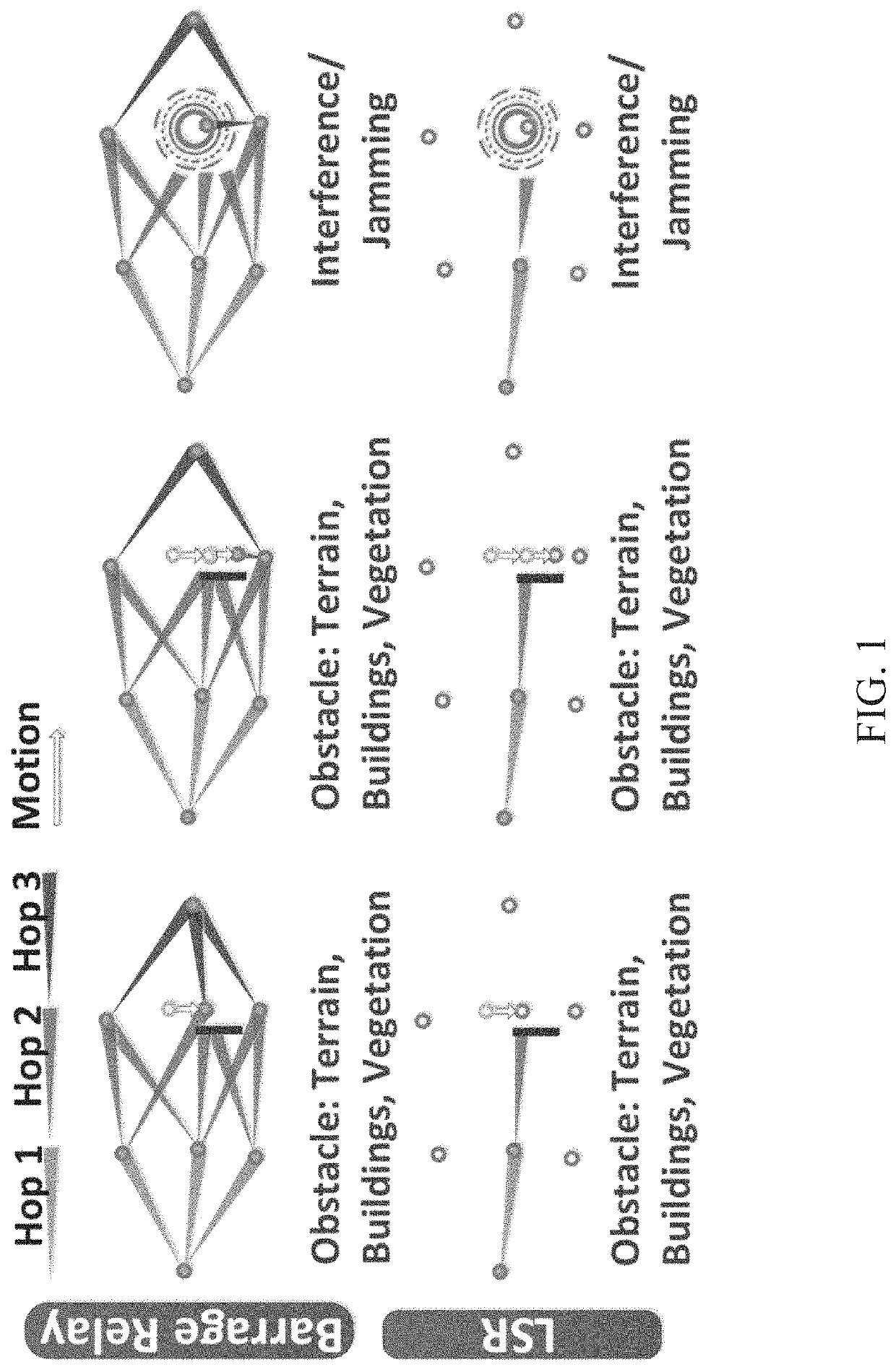
LSR algorithms need time to adapt and optimize new routes and until new routes are found
network connectivity is severely impacted.
At this level of compression, the bi-directional link reporting will be limited to reporting good or other (average, fair, poor, no) with respect to data channel required SNR.
However, a complete separation of the control channel RF bands from those of the data channel bands (e.g. VHF vs L-band) typically means that
network connectivity measurements obtained on the control channel are not predictive of data network
connectivity.
Absolute
noise measurement accuracy will also be within a few dB and
noise measurement accuracy relative to the
signal measurement will be within less than 1 dB, resulting in a total SNR error estimate of approximately 4 dB.



 Login to View More
  Login to View More