Unlock instant, AI-driven research and patent intelligence for your innovation.

Stacking System and Method for Continuously Piling Cutouts from at Least One Foil -or Membrane- Like Material Web onto a Stack

a technology of foilor membrane and stacking system, which is applied in the direction of cell components, sustainable manufacturing/processing, cell components, etc., can solve the problems of affecting the quality of the finished produ

Active Publication Date: 2021-09-30
SIEMENS AG
View PDF2 Cites 0 Cited by
  • Summary
  • Abstract
  • Description
  • Claims
  • Application Information

AI Technical Summary

Benefits of technology

The patent describes a transfer apparatus used in the manufacturing of battery cells. The apparatus has multiple magazines that can hold blanks, or unencapsulated battery cells, which can be stacked to form a battery. The use of separate magazines allows for high production rates and high-quality battery cells without damage. The apparatus can also have multiple material webs, such as separators, anodes, cathodes, and so on, which can be conveyed separately to form the battery cell layers. This increases the manufacturing efficiency and prevents damage to the material. The apparatus can also have a continuous transfer belt or conveyor to directly transfer blanks into the magazines, without the need for a separate pick-and-place process. The invention also involves a method for preventing damage to the material being transferred.

Problems solved by technology

As a result, the dynamics are limited on account of the mass inertia of actuators involved, such as robot arms, which perform the gripping and transfer movement.
Therefore, stacking, which is a high-quality method for forming cell stacks at the same time, constitutes a bottleneck during the manufacture of batteries.
However, only a limited energy density in the battery cells or battery modules can be achieved with this cylindrical or prismatic winding, and therefore conventional winding is generally ruled out as a production method.
In addition, damage to the sensitive foils, which are used for battery cells, is disadvantageously easily possible in the case of prismatic winding processes.
Damage can be caused primarily by narrow radii during winding, and therefore a prismatically wound cell can potentially become very hot or could catch fire during the aging process.
The same challenges are faced in the production of fuel cells.
Pick-and-place methods for stacking bipolar plates and membranes situated between them also slow down the production rate in the production of fuel cells.

Method used

the structure of the environmentally friendly knitted fabric provided by the present invention; figure 2 Flow chart of the yarn wrapping machine for environmentally friendly knitted fabrics and storage devices; image 3 Is the parameter map of the yarn covering machine
View more

Image

Smart Image Click on the blue labels to locate them in the text.
Viewing Examples
Smart Image
  • Stacking System and Method for Continuously Piling Cutouts from at Least One Foil -or Membrane- Like Material Web onto a Stack
  • Stacking System and Method for Continuously Piling Cutouts from at Least One Foil -or Membrane- Like Material Web onto a Stack
  • Stacking System and Method for Continuously Piling Cutouts from at Least One Foil -or Membrane- Like Material Web onto a Stack

Examples

Experimental program
Comparison scheme
Effect test

Embodiment Construction

[0048]In the figures, elements that have the same function have been provided with the same reference signs, unless stated otherwise.

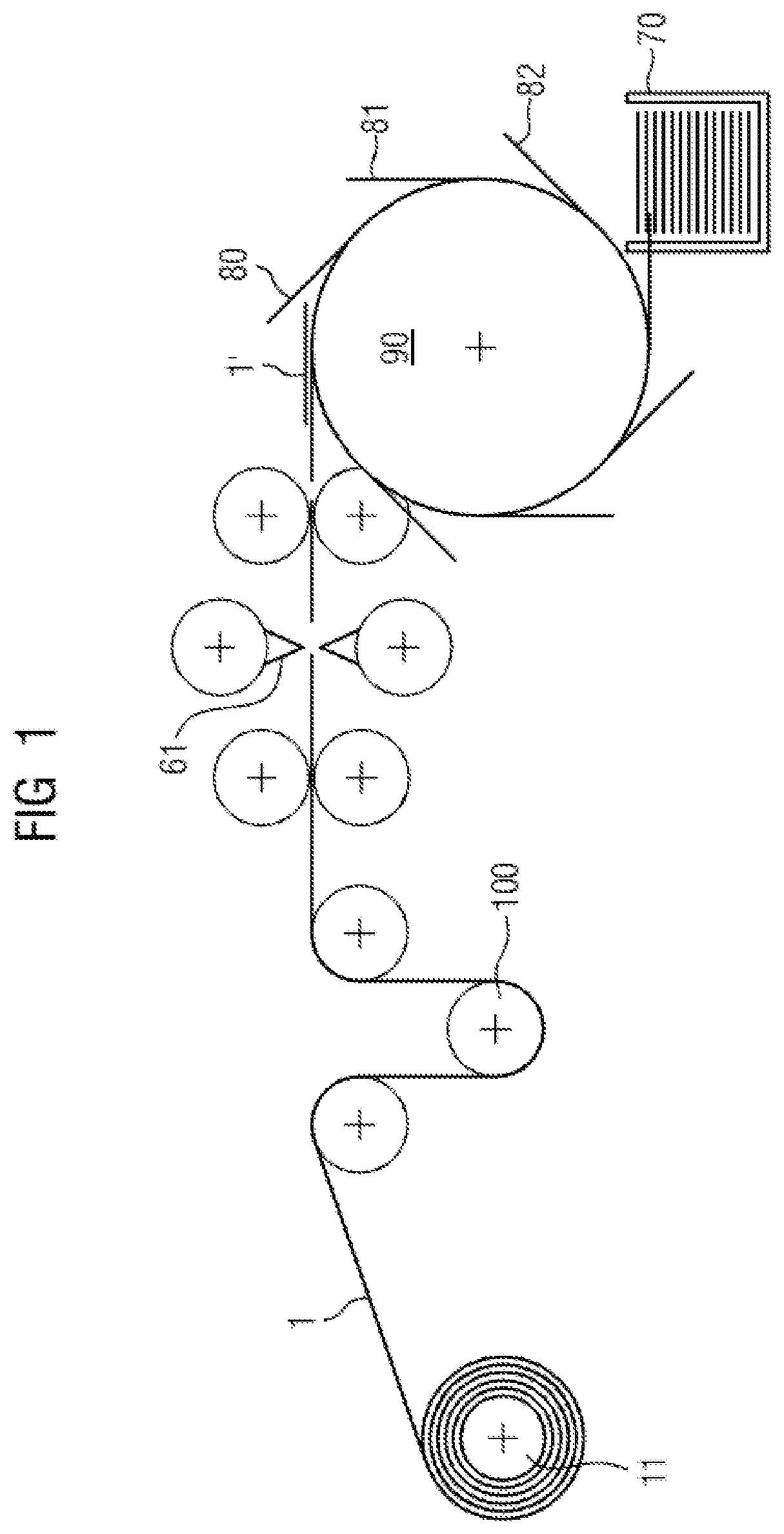
[0049]FIG. 1 shows a stacking system as is used in a first exemplary embodiment of the invention. A foil 1 that can be wound and is unwound from an unwinding roller 11 is provided here. A plurality of feed and deflection rollers are used here, in particular in order to ensure uniform unwinding, for example, with a uniform tension profile in the material web. The material web 1 is fed to a cutting apparatus 61. For example, a dancer unit 100 is provided between the unwinding roller 11 and the cutting apparatus 61 in order to be able to adjust the web tension to a desired value. Blanks 1′ are produced in succession by the cutting apparatus 61.

[0050]The stacking apparatus serves to allow stacking of layers of a battery cell. Foil blanks, which form the starting base for the battery cell, are applied to a stack 70 in layers for this purpose. A battery modu...

the structure of the environmentally friendly knitted fabric provided by the present invention; figure 2 Flow chart of the yarn wrapping machine for environmentally friendly knitted fabrics and storage devices; image 3 Is the parameter map of the yarn covering machine
Login to View More

PUM

No PUM Login to View More

Abstract

Stacking system and method for continuously piling cutouts from at least one foil- or membrane-like material web onto a stack, wherein the at least one foil- or membrane-like material web is continuously fed, the at least one foil- or membrane-like material web is cut to a size dependent on the dimensions of the stack to form a blank, the blank is received by a magazine of a continuously moving, in particular rotating, transfer apparatus having a plurality of magazines, and where the received blank is transferred from the magazine onto the stack, before the magazine receives a subsequent blank.

Description

BACKGROUND OF THE INVENTION1. Field of the Invention[0001]The invention relates to a method and to a stacking system for continuously stacking blanks of at least one foil- or membrane-like material web onto a stack.2. Description of the Related Art[0002]In the search for alternatives to conventional internal combustion engines in the automotive industry, batteries are the focus of research and development. An efficient way of producing batteries is essential for the widespread use of electric motors as a drive source in the transportation and logistics sector. Different methods are employed for producing a battery cell depending on the type of battery. Amongst other things, the format of the battery cells in question is important here. For example, stacking methods are used for pouch cells, for example, where a separator, an anode, a separator and a cathode are alternately placed one on the other. Stacking is generally performed sequentially and via “pick-and-place” methods. As a re...

Claims

the structure of the environmentally friendly knitted fabric provided by the present invention; figure 2 Flow chart of the yarn wrapping machine for environmentally friendly knitted fabrics and storage devices; image 3 Is the parameter map of the yarn covering machine
Login to View More

Application Information

Patent Timeline
no application Login to View More
IPC IPC(8): H01M10/0585H01M4/04B65H35/00
CPCH01M10/0585B65H35/008H01M4/0402B65H35/06B65H23/26B65H29/40B65H39/02H01M8/1004B65H2801/72H01M8/2404H01M8/241H01M2008/1095B32B37/22B32B2457/10Y02P70/50Y02E60/50Y02E60/10
Inventor MAY, TORSTENPILS, SR., JONASWOLKE DA SILVA, LUCIANO
Owner SIEMENS AG