
Bexarotene derivatives and their use in treating cancer
a derivative and cancer technology, applied in the field of cancer compositions and methods, can solve the problems of limited cancer treatment options, uncontrolled growth, afflicted individuals, etc., and achieve the effect of improving immune system function and increasing peripheral blood counts
- Summary
- Abstract
- Description
- Claims
- Application Information
AI Technical Summary
Benefits of technology
Problems solved by technology
Method used
Image

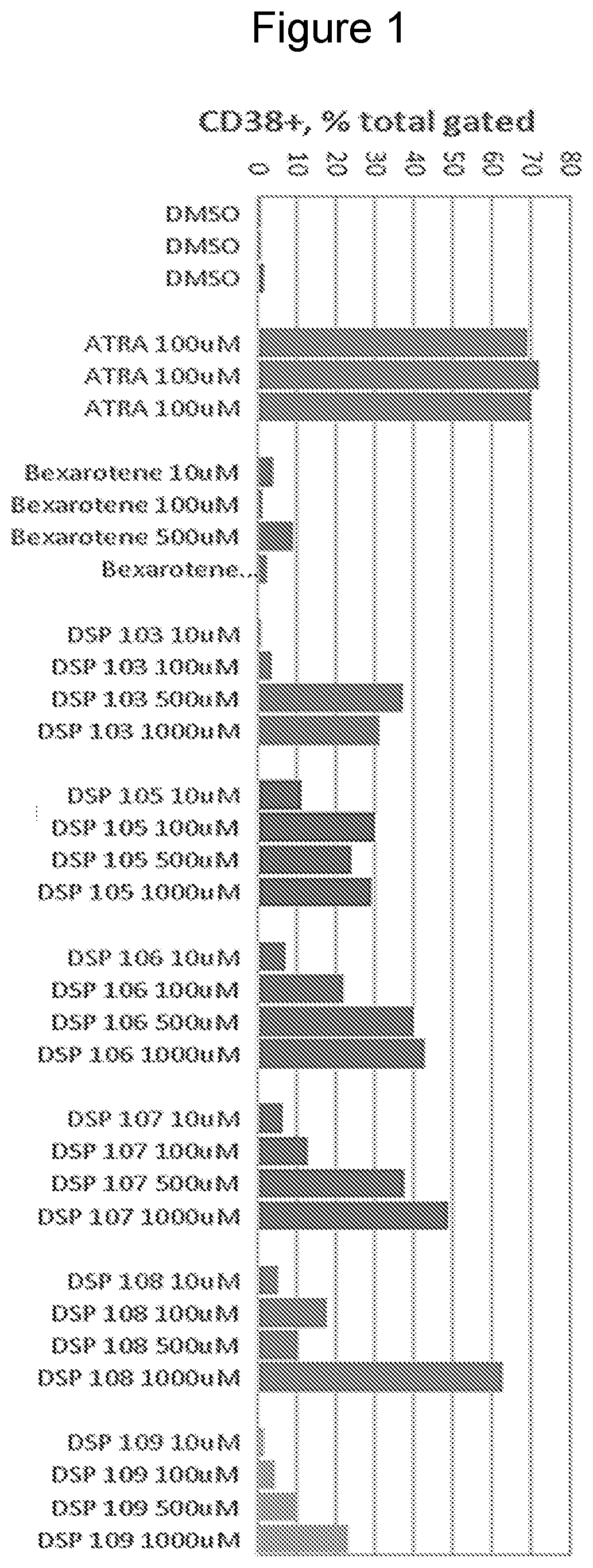
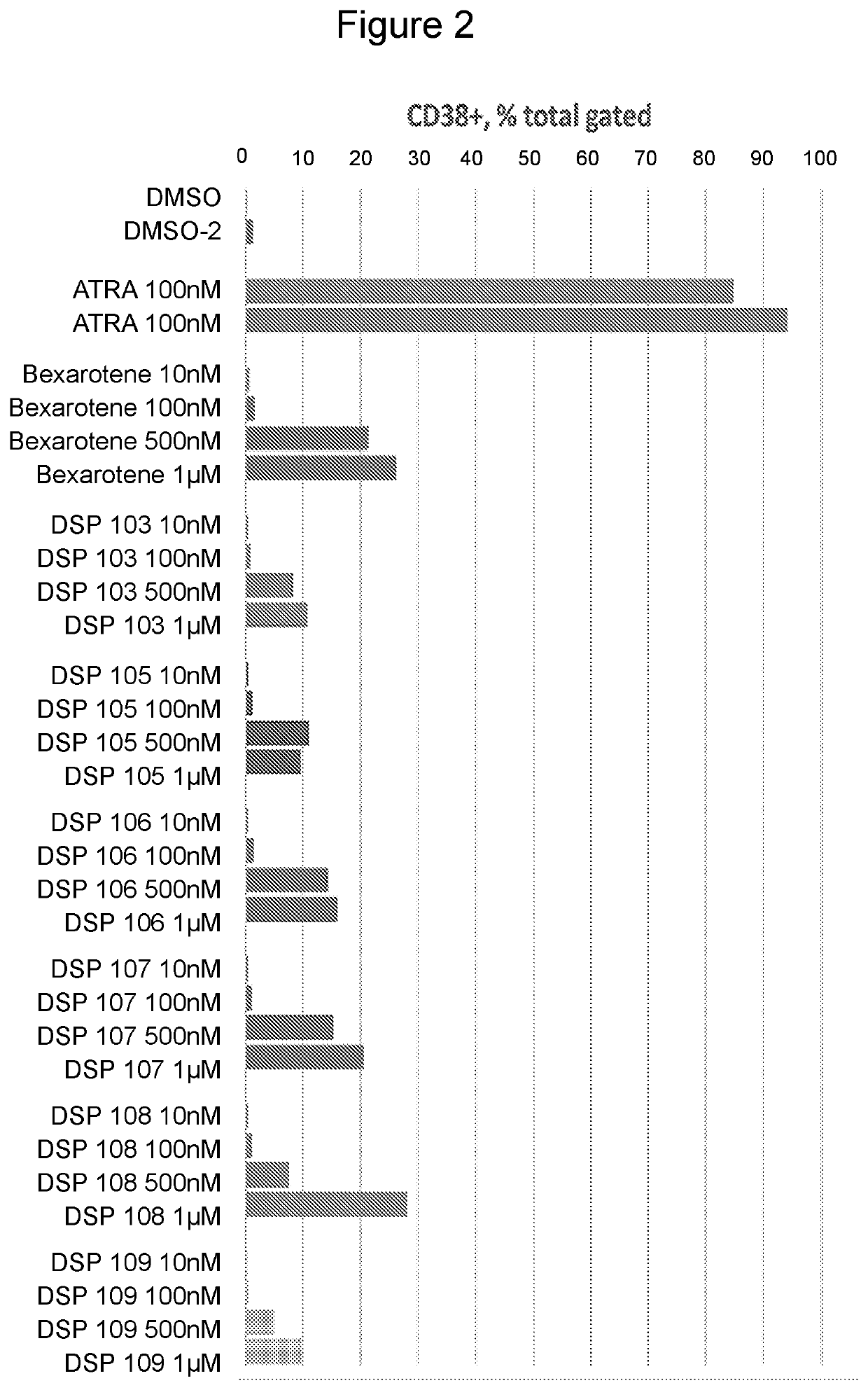
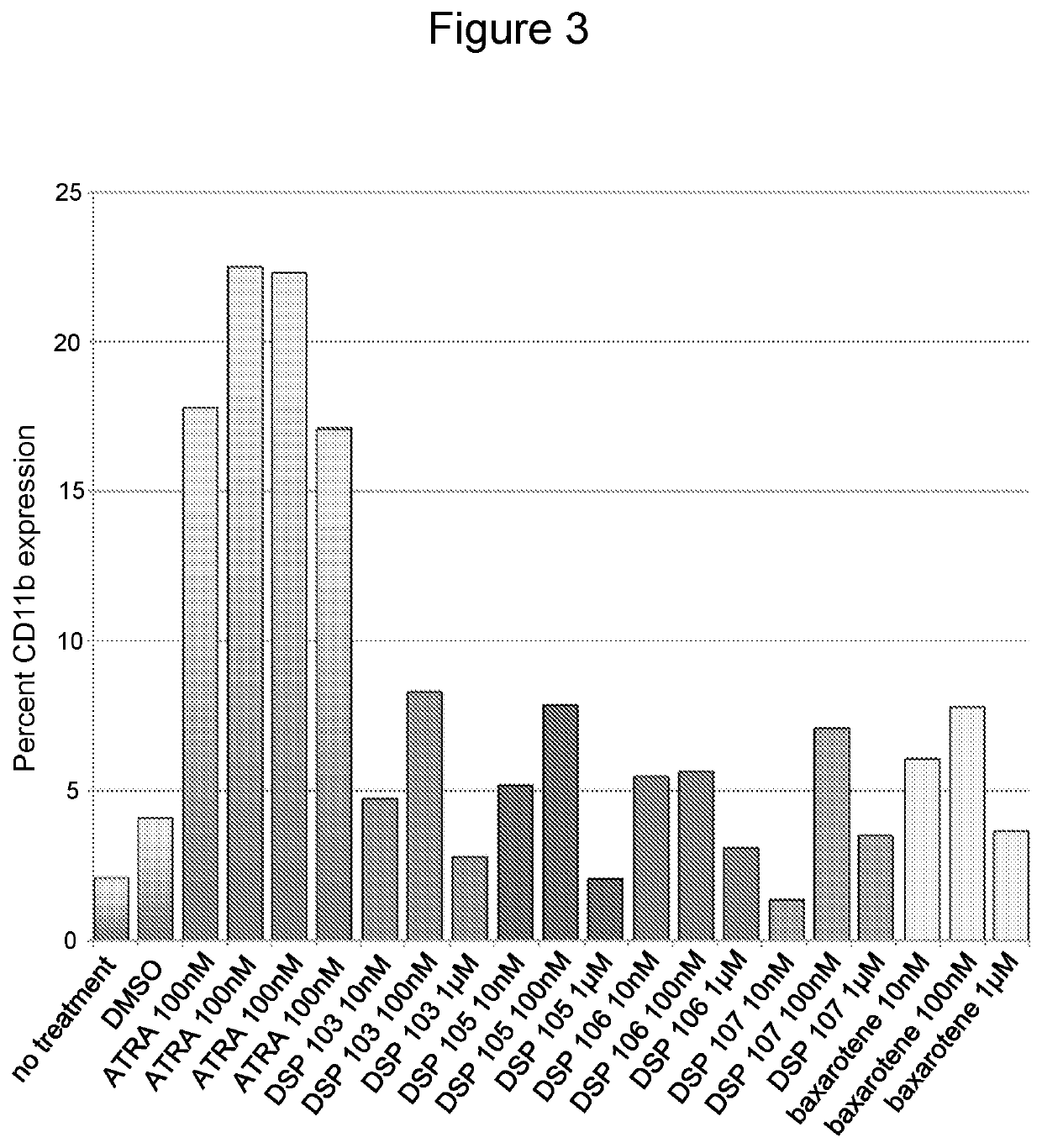
Examples
example 1
on of 4-(1-(6′-(difluoromethyl)-4′,4′-dimethyl-3′,4′-dihydro-2′H-spiro[cyclopropane-1,1′-naphthalen]-7′-yl)vinyl)benzoic Acid (DSP-109; or 109)
[0145]
[0146]To a −10° C. solution of bromo(methyl)triphenyl-[5]-phosphane (89.3 g, 250 mmol, 2.6 eq.) in THF (1 L) under a nitrogen atmosphere was added LDA (2 M in THF, 145 mL, 3.0 eq.) over 30 minutes. To the resulting solution was added 6-chloro-4,4-dimethyl-1,2,3,4-tetrahydronaphthalen-1-one (20 g, 95.8 mmol, 1.0 eq.) over 30 minutes. The resulting solution was stirred at 0° C. for 3 h, then quenched by the addition of 1000 g of ice / H2O. The resulting mixture was extracted with CH2Cl2 (3×500 mL). The combined organic layers were dried (Na2SO4) and concentrated. The residue was purified by silica gel chromatography eluting with petroleum ether to give 18 g (91%) of 7-chloro-1,1-dimethyl-4-methylidene-1,2,3,4-tetrahydronaphthalene as colorless oil.
[0147]To a solution of diethylzinc (106.6 g, 863 mmol, 10 eq.) in dichloromethane (650 mL) at ...
example 2
on of 4-(1-(4′,4′,6′-trimethyl-3′,4′-dihydro-2′H-spiro[cyclopropane-1,1′-naphthalen]-7′-yl)vinyl)benzoic Acid (DPS-107; 107)
[0155]
[0156]A mixture of 4-(4-methylphenyl)butanoic acid (50 g, 260 mmol, 1.0 eq.), MeOH (300 mL), and sulfuric acid (5 mL) was stirred at room temperature for 16 h, then concentrated under reduced pressure. The residue was quenched by the addition of sat. NaHCO3 (200 mL) and the aqueous mixture was extracted with EtOAc (2×200 mL). The combined organic layers were washed with brine, dried (Na2SO4), and concentrated to give 59.1 g of methyl 4-(4-methylphenyl)butanoate as yellow oil.
[0157]To a solution of methyl 4-(4-methylphenyl)butanoate (59.1 g, 307 mmol, 1.0 eq.) in ether (500 mL) and toluene (1 L) was added a solution of methylmagnesium bromide in ether (3 m, 246 mL, 738 mmol, 2.4 eq.). The resulting solution was stirred at room temperature for 2 h then quenched by the addition of saturated aqueous NH4Cl (100 mL). The pH of the solution was adjusted to 7 wit...
example 3
on of 4-(1-(1-fluoro-3,5,5,8,8-pentamethyl-5,6,7,8-tetrahydronaphthalen-2-yl)vinyl)benzoic Acid (DSP-106; 106)
[0165]
[0166]A solution of methyl 4-acetylbenzoate (17.8 g, 100 mmol, 1.0 eq.), Na2CO3 (17.0 g, 160 mmol, 1.6 eq.), Tf2O (56.4 g, 200 mmol, 2.0 equiv.) in CH2Cl2 (150 mL) was stirred at room temperature for 8 h, then the solids were removed by filtration. The filtrate was treated with saturated aqueous NaHCO3 (150 mL), then the layers were separated, and the organic was washed with brine, dried (Na2SO4), and concentrated to give 16 g (52%) of methyl 4-[1-[(trifluoromethane)sulfonyloxy]ethenyl]benzoate as a white solid.
[0167]To a mixture of 2,5-dichloro-2,5-dimethylhexane (16.0 g, 87.4 mmol, 1.2 eq.), AlCl3 (1.98 g, 17.5 mmol, 0.20 eq.) in CH2Cl2 (90 mL) at −10° C. was added a solution of 2-bromo-1-fluoro-3-methylbenzene (14.0 g, 74.1 mmol, 1.0 eq.) in CH2Cl2 (10 mL). Stirred the reaction mixture at −10° C. for 2 h then quenched by the addition of H2O (20 mL) and saturated aqu...
PUM
| Property | Measurement | Unit |
|---|---|---|
| temperature | aaaaa | aaaaa |
| pH | aaaaa | aaaaa |
| temperature | aaaaa | aaaaa |
Abstract
Description
Claims
Application Information
 Login to View More