Sensor module
a sensor module and sensor technology, applied in the field of sensors, can solve the problems of low mechanical strength and thermal fatigue resistance, insufficient reliability as a solder for electronic devices, and solder deterioration
- Summary
- Abstract
- Description
- Claims
- Application Information
AI Technical Summary
Benefits of technology
Problems solved by technology
Method used
Image



Examples
first embodiment
1. First Embodiment
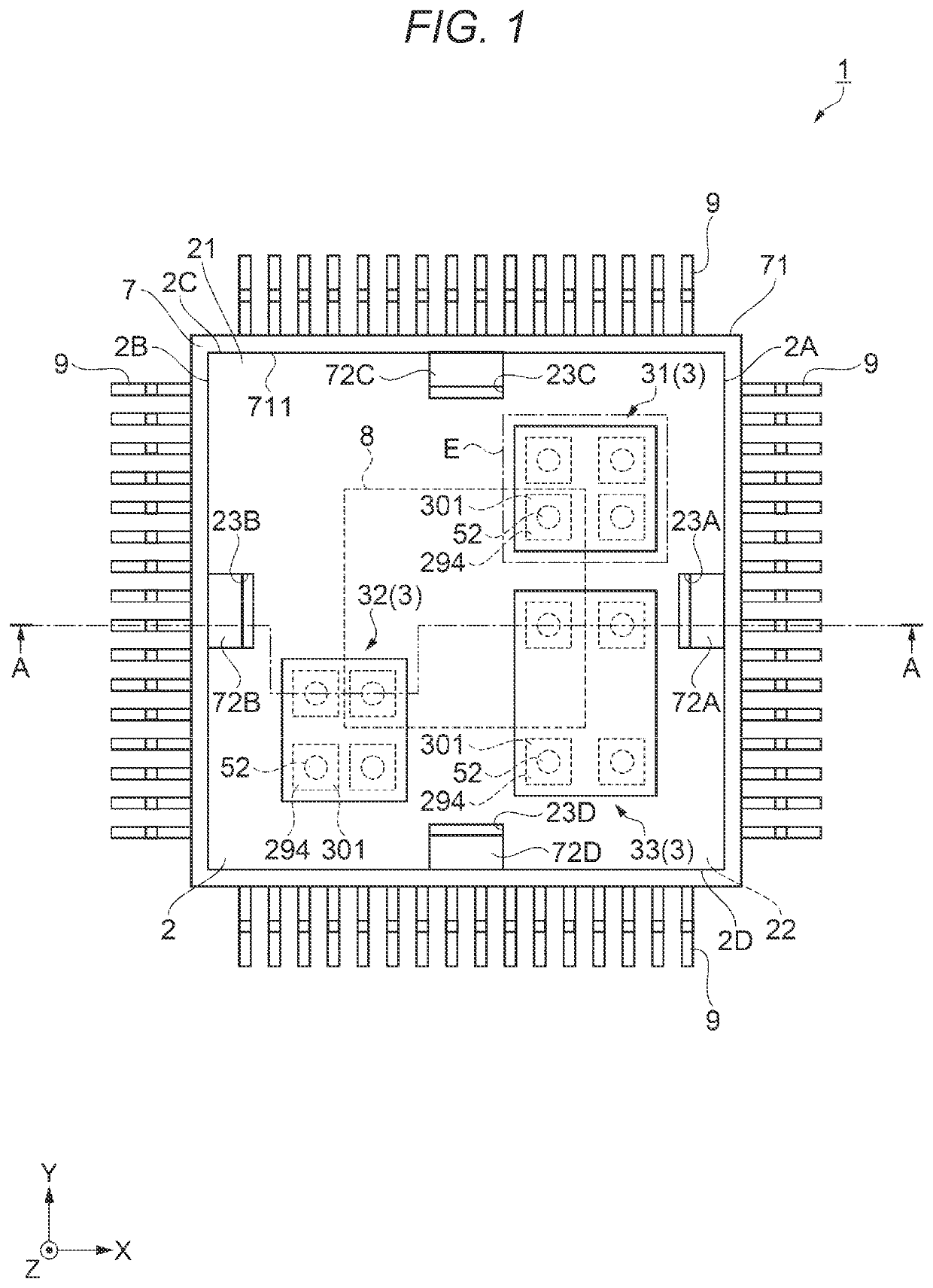
[0019]A sensor module 1 according to the first embodiment will be described with reference to FIGS. 1 to 4. FIG. 1 illustrates a state in which a top plate 70 of a cap 7 is removed for convenience of describing an internal configuration of the sensor module 1. In FIG. 4, for convenience of describing an internal configuration of a first inertial sensor 31, components other than an acceleration sensor element 310, an angular velocity sensor element 3r, and internal electrodes 313 are omitted. Dimensional ratios of each component in each drawing are different from actual dimension ratios.
[0020]As to coordinates illustrated in the drawings, three axes orthogonal to each other are referred to as an X axis, a Y axis, and a Z axis. A direction along the X axis is defined as an “X direction”, a direction along the Y axis is defined as a “Y direction”, and a direction along the Z axis is defined as a “Z direction”, in each of which a direction indicated by an arrow is a p...
second embodiment
2. Second Embodiment
[0095]Next, a sensor module 1a according to the second embodiment will be described with reference to FIGS. 10 and 11. In the following description, differences from the first embodiment described above will be mainly described, the same reference numerals are given to the same configuration as the first embodiment, and redundant description will be omitted.
[0096]The sensor module 1a according to the present embodiment is different from the first embodiment in that the first surface 21 of the substrate 2 is provided with first terminals 292a.
[0097]As shown in FIG. 10, the first terminals 292a are provided at the first surface 21 as the upper surface of the substrate 2, and each first terminal 292a and each coupling portion 91a of a lead 9a overlap each other when viewed from the top in the Z direction.
[0098]As shown in FIG. 11, the first terminals 292a provided at the first surface 21 of the substrate 2 are bonded to the coupling portions 91a of the lead 9a via ...
third embodiment
3. Third Embodiment
[0102]Next, a sensor module 1b according to the third embodiment will be described with reference to FIGS. 12 and 13. In the following description, differences from the first embodiment described above will be mainly described, the same reference numerals are given to the same configuration as the first embodiment, and redundant description will be omitted.
[0103]The sensor module 1b according to the present embodiment is different from the first embodiment in that the inertial sensor 3 is bonded to the substrate 2 via an insulating bonding member 60. The present embodiment is also different from the first embodiment in that the circuit element 8 is bonded to the substrate 2 via an insulating bonding member 61.
[0104]As shown in FIG. 12, when viewed from the top in the Z direction, the insulating bonding member 60 is disposed at a central portion of the lower surface of the inertial sensor 3. As shown in FIG. 13, the lower surface of the inertial sensor 3 is bonded ...
PUM
 Login to View More
 Abstract
Description
Claims
Application Information
 Login to View More