
Communication cable
a technology of communication cable and interposer, which is applied in the direction of power cables, cables, insulated conductors, etc., can solve the problems of increasing difficult to insert into the modular, and the interposer cannot be easily flattened, so as to reduce the amount of attenuation, reduce the difference in delay time, and reduce the cross talk
- Summary
- Abstract
- Description
- Claims
- Application Information
AI Technical Summary
Benefits of technology
Problems solved by technology
Method used
Image

Examples
embodiment 1
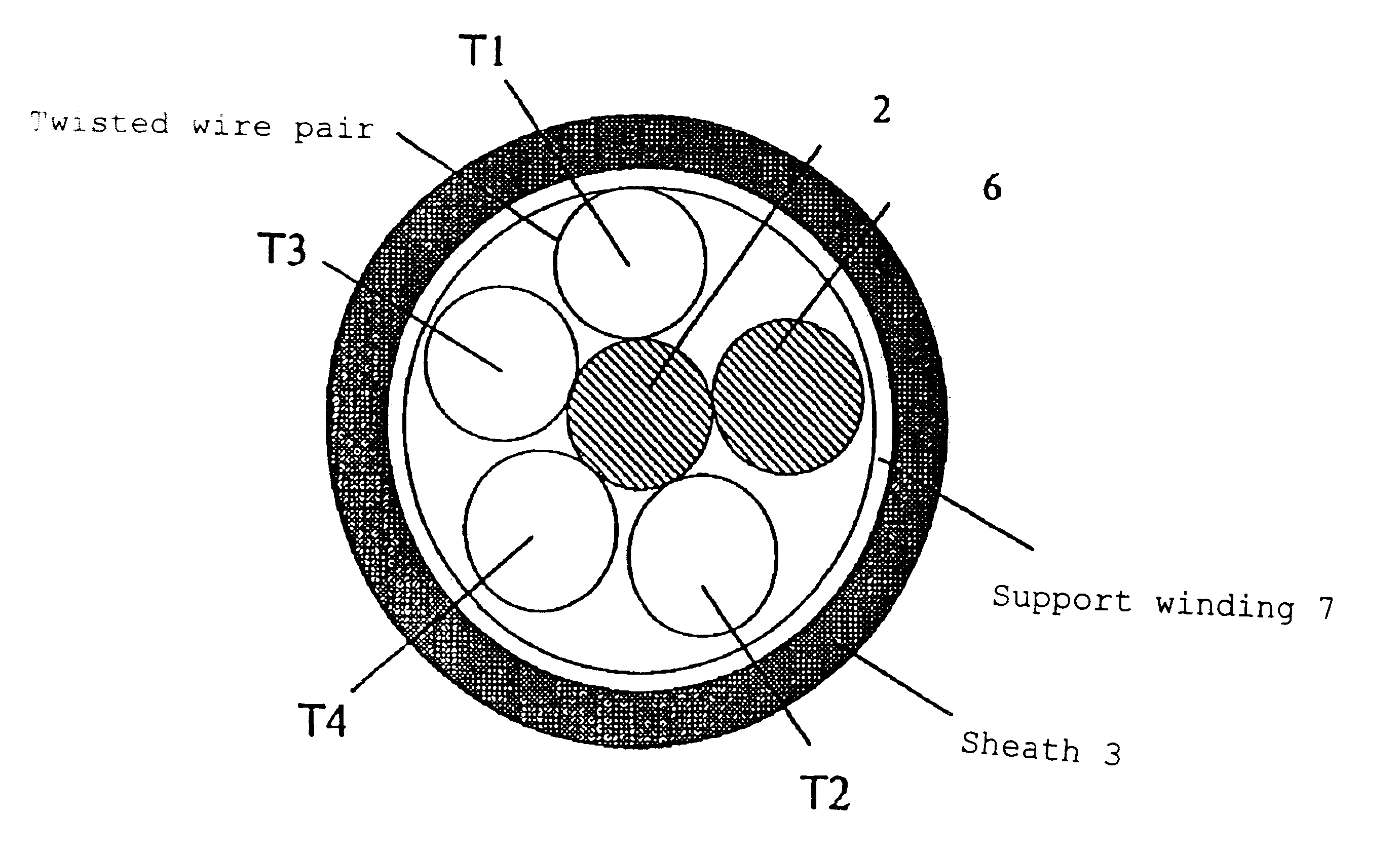
The first embodiment is a case where four twisted wire pairs T1, T2, T3, T4 and the inter-pair interposer 6 made of PE in a 1.4 mm thread are entwined around the central interposer 2 made of polyolefin in a round rod of a diameter of 1.4 mm, as shown in FIG. 10. Twist pitches of the four twisted wire pairs T1, T2, T3, T4 are set to 9.9 mm (T1), 10.9 mm (T2), 14.4 mm (T3) and 23.8 mm (T4), (refer to Table 1)
At this time, the inter-pair interposer 6 made of PE thread was inserted between the twisted wire pair T1 having the least pitch and the twisted wire pair T2, and was entwined to adjoin T1.
A cable was made as a comparative example by using a central interposer 2 having diameter of 0.8 mm and entwining the twisted wire pairs having similar pitches as shown in FIG. 11. FIG. 12 and FIG. 13 show the measured values of near-end cross talk of the first embodiment and the comparative example, respectively. Each graph is a plot of the near-end cross talk measured on all (six) selected com...
embodiment 2
The second embodiment is a case where four twisted wire pairs T1, T2, T3, T4 and the inter-pair interposer 6 made of a rod-shaped body made of polyolefin in and 1.4 mm in diameter are entwined around the central interposer 2 made in a rod-shaped body made of polyolefin in having a diameter of 1.6 mm, as shown in FIG. 14.
embodiment 3
The third embodiment is a case where the four twisted wire pairs T1, T2, T3, T4 and the inter-pair interposer 6 made of a rod-shaped body made of polyolefin and 1.2 mm in diameter are entwined around the central interposer 2 made in a rod-shaped body made of polyolefin in having a diameter of 1.8 mm, as shown in FIG. 15. It was confirmed that these two embodiments have effects similar to those of the first embodiment.
Embodiment 4
The fourth embodiment is a case where one central interposer 2 made of PP yarn 11000d (cross sectional area 1.02 mm.sup.2 or larger) is provided to fill the central interstice instead of a rod-like interposer, and one inter-pair interposer 6 made of PP yarn 11000d and four twisted wire pairs are entwined around thereof as shown in FIG. 16. A similar effect were confirmed also in this embodiment.
In any of the first through fourth embodiments, a support winding layer 7 was formed by taping around the four twisted wire pairs and the rod made of a thermoplastic ...
PUM
 Login to View More
 Abstract
Description
Claims
Application Information
 Login to View More