The method according to the present invention for controlling a drive of a first subsystem of a printing press which is, at least at some times, mechanically decoupled from a second subsystem of the printing press has the feature that a motion sequence is determined for the second subsystem in advance, the motion sequence being composed of a basic motion sequence and an additional motion sequence and used as a reference curve for controlling the drive of the first subsystem. This has the
advantage that the motion sequences of the first and second subsystems can be very accurately synchronized or else be correlated in a different way. A synchronization of the two motion sequences takes place at least over time intervals or during periods in time. In
spite of the mechanical decoupling of the two subsystems and the generally different vibration behaviors, this control of the drive of the first subsystem allows very accurate synchronization with the motion sequence of the second subsystem at all times.
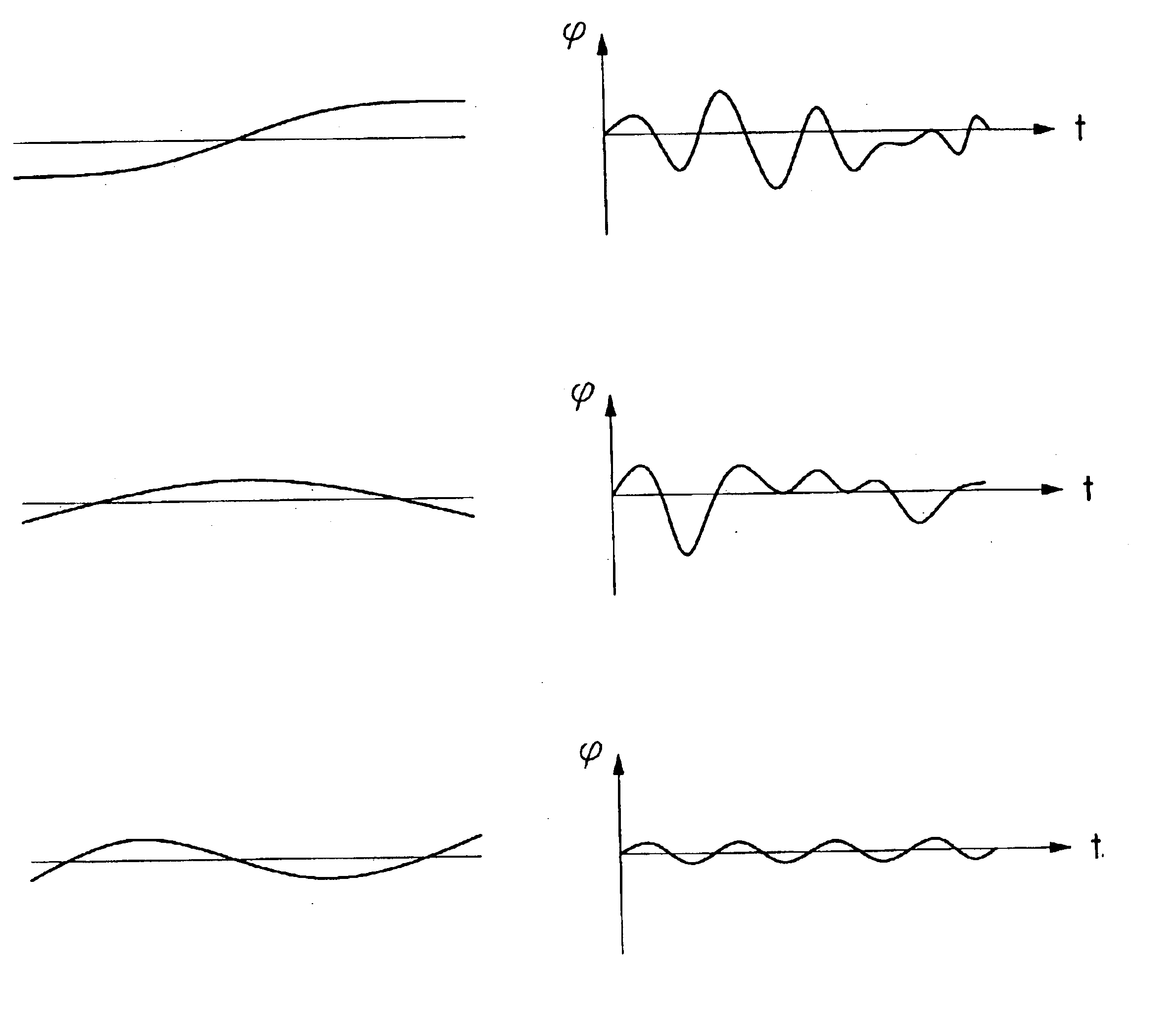
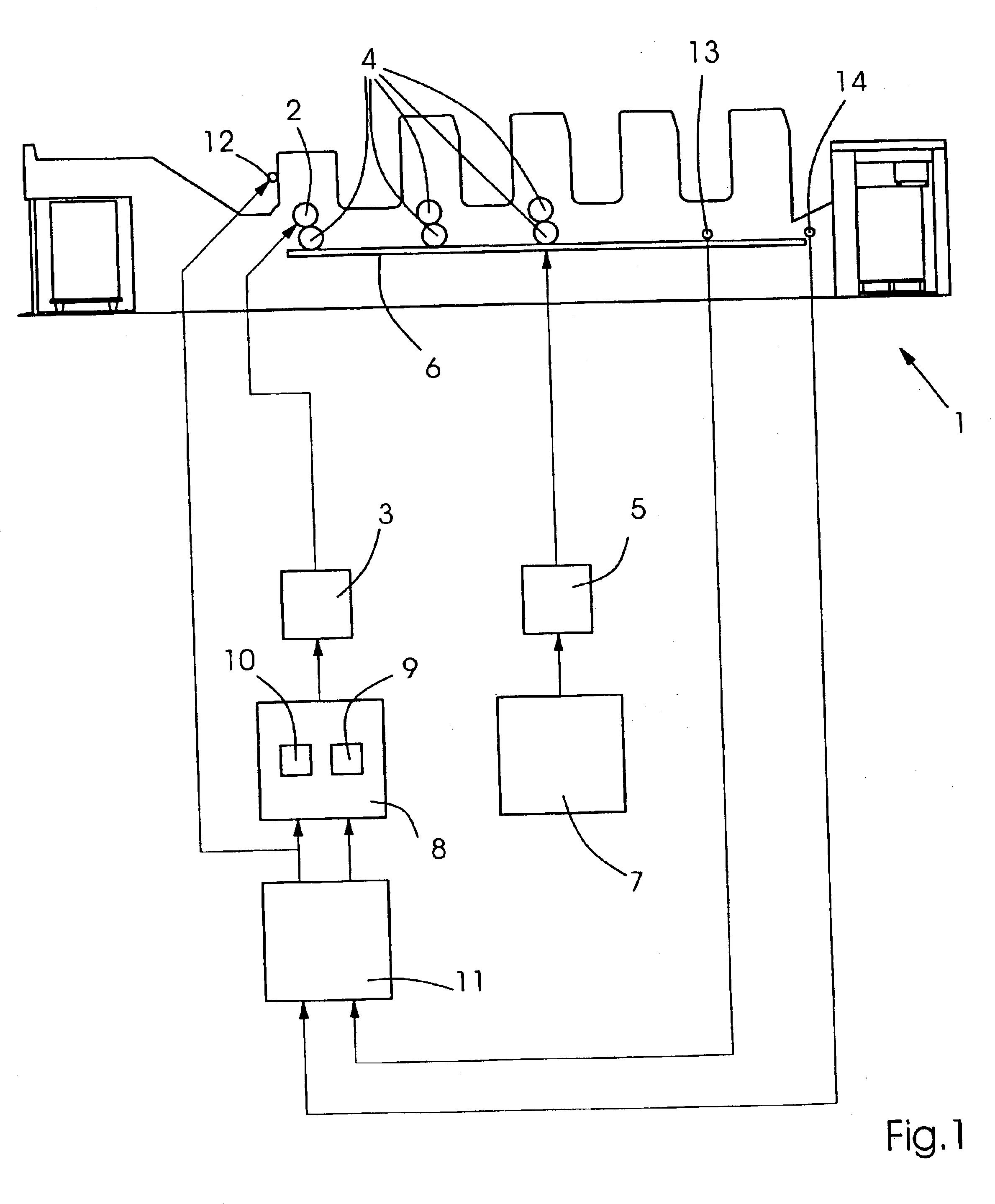
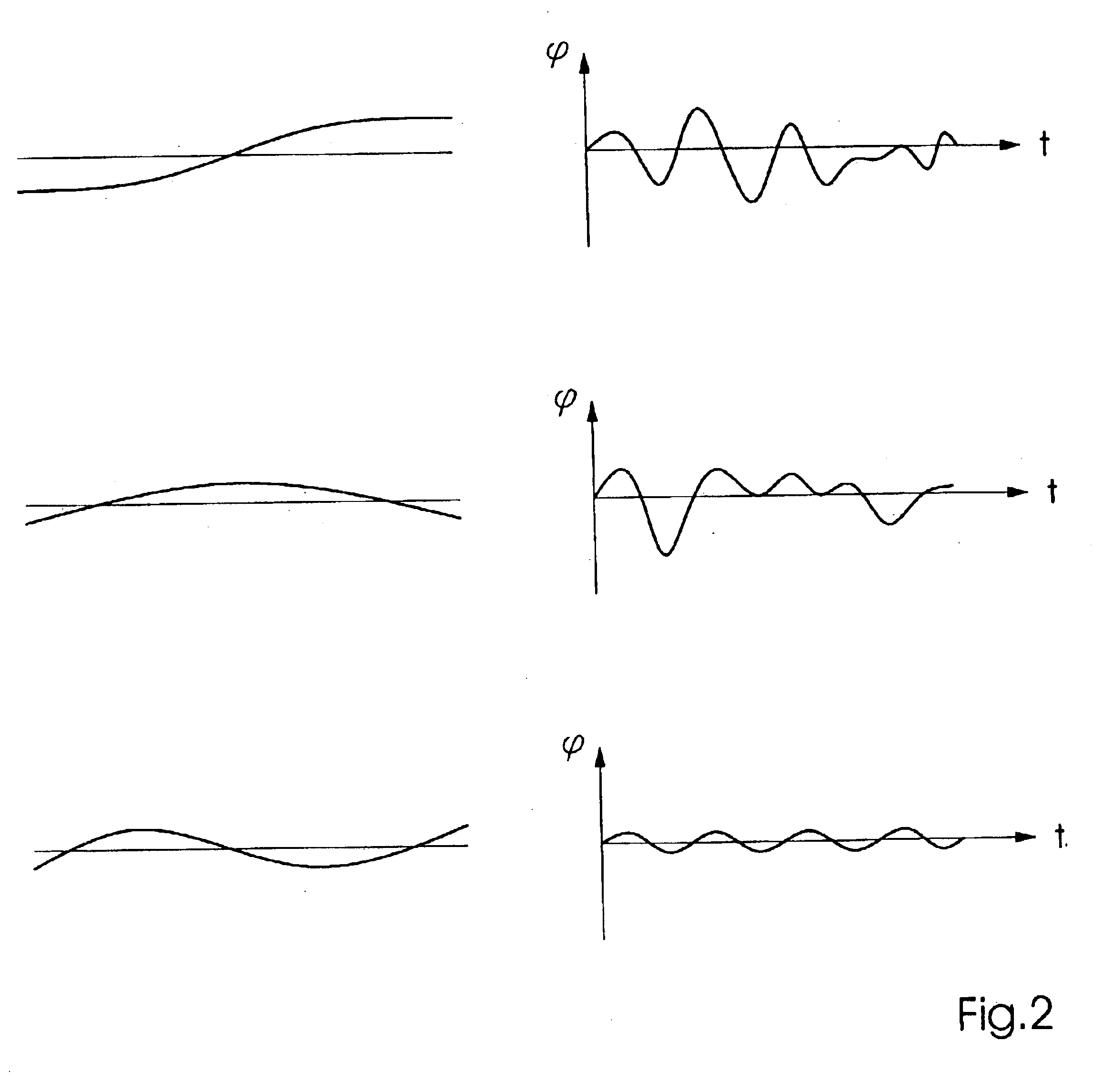
Since the complexity of the motion sequence of the second subsystem is essentially caused by the vibration behavior thereof, a systematic and expedient way of characterizing the motion sequence is to determine natural
modes of vibrations (the spectrum or the basis of the natural
modes) to a selectable order for the second subsystem in advance, and to determine characteristics of vibrational amplitudes which are associated with the respective natural
modes and form the basis on which the motion sequence can be reconstructed. In other words, the additional motion sequence superimposed on the basic motion sequence can be represented by a breakdown into natural modes of vibrations to an order required to achieve a selectable precision. Moreover, this has the
advantage that the particular desired accuracy can be easily adjusted through the selection of the order that is still to be considered. It is clear that the natural modes of vibrations can be the natural modes of vibrations of the overall
system, of the first or second subsystems, or even of a part of the subsystems. In other words, the spectrum or the basis on which a breakdown is carried out is selectable. A preferred selection of the natural modes will be determined, inter alia, by the convergence behavior of the representation of the additional motion sequence in natural modes.
In the preferred embodiment, the reference curve is modified as a function of the current operating condition of the printing press. In this context, the reference curve can be modified as a function of a current value of a characteristic operating condition, such as the temperature, of the printing press. It is also possible for the reference curve to be alternatively or additionally modified as a function of the current motion sequence of the second subsystem. A further variant is to modify the reference curve as a function of an average value for the current motion sequence of the second subsystem. Taking into account the current operating condition advantageously allows the drive to be controlled in a very reliable and precise manner. The method automatically adapts to the respective prevailing operating situation and is also able to automatically
process changes in the printing press to a certain degree.
The drive of the first subsystem is preferably controlled in such a manner that the first subsystem simulates the reference curve, i.e., that the first subsystem moves in
sync with the second subsystem. To this end, the reference curve can be fed as a
setpoint signal to a regulating device which controls the drive of the first subsystem. In this context, a very beneficial effect is obtained when the
setpoint signal precedes the current motion sequence of the second subsystem by a selectable
phase difference. The precedence in time gained through the
phase difference can be used to carry out the input from the reference curve almost without
delay and with high precision and, in fact, even if the reference curve exhibits high dynamics. With regard to this, it is also an
advantage if the regulating device contains a precontrol and a controller which are each fed with the
setpoint signal, a coarse control of the drive of the first subsystem being carried out by the precontrol and a fine control of the drive of the first subsystem being carried out by the controller. In other words, the precontrol allows high dynamics and the controller permits high precision. In order to form a closed-
loop control circuit, the controller can be fed with an actual-value signal characterizing the current motion sequence of the first subsystem.


 Login to View More
  Login to View More